| Feature | Fiber Laser | CO2 Laser |
|---|---|---|
| Wavelength | 1.06 µm | 10.6 µm |
| HAZ Size in Titanium | Minimal (≤50 µm) | Moderate (100–200 µm) |
| HAZ Size in Inconel | Low (60–80 µm) | High (150–300 µm) |
| HAZ Size in Medical Stainless Steel | Very Low (40–70 µm) | Medium (120–250 µm) |
| Absorption Efficiency (Metals) | High (up to 90%) | Low (10–20%) |
| Processing Speed | High (up to 100 m/min) | Medium (10–30 m/min) |
| Power Consumption | Lower (≈30% less than CO2) | Higher |
| Regulatory Compliance (REACH/FDA/CE) | Easier due to precision & repeatability | Possible but requires tighter process controls |
| Ideal Use Cases | Aerospace, medical implants, thin alloys | Thick-section cutting, non-metal processing |
Minimizing Heat-Affected Zone in Sensitive Alloys: Fiber Laser vs CO2 for Aerospace & Medical
When Apple engineers redesigned the titanium enclosure for its premium wearables, or when Tesla’s battery team laser-welded ultra-thin nickel alloys for next-gen packs, they weren’t just chasing aesthetics — they were fighting microscopic metallurgical battles. The heat-affected zone (HAZ) can silently sabotage fatigue life, corrosion resistance, and dimensional stability in mission-critical components. This article delivers verifiable, machine-specific data to help engineers and procurement managers select the right laser system — fiber or CO2 — to minimize HAZ in sensitive alloys like Inconel, titanium, and medical-grade stainless steel. You’ll walk away with a decision matrix grounded in wavelength physics, power-speed curves, and real-world deposition rates — not marketing fluff.
Regulatory Landscape
While no single global regulation governs HAZ size directly, compliance frameworks like EU REACH (Registration, Evaluation, Authorisation and Restriction of Chemicals) indirectly mandate precision thermal processing. Effective immediately, REACH Annex XVII Entry 47 restricts hexavalent chromium above 0.1% by weight — driving adoption of laser cladding over traditional chrome plating in aerospace and medical implants. Non-compliance penalties can reach up to 4% of annual EU turnover. In parallel, FDA’s Quality System Regulation (21 CFR Part 820) requires documented process controls for medical devices — including weld penetration depth and HAZ width verification. CE marking under Machinery Directive 2006/42/EC and EMC Directive 2014/30/EU is non-negotiable for EU-bound equipment, requiring Class 1/4 laser safety certification and traceable material inputs. Japan’s JIS Z 3001 welding standards and ASME BPVC Section IX in the US further codify acceptable HAZ thresholds for pressure vessels and surgical tools.
Fiber Laser vs CO2 Laser: HAZ Performance Compared
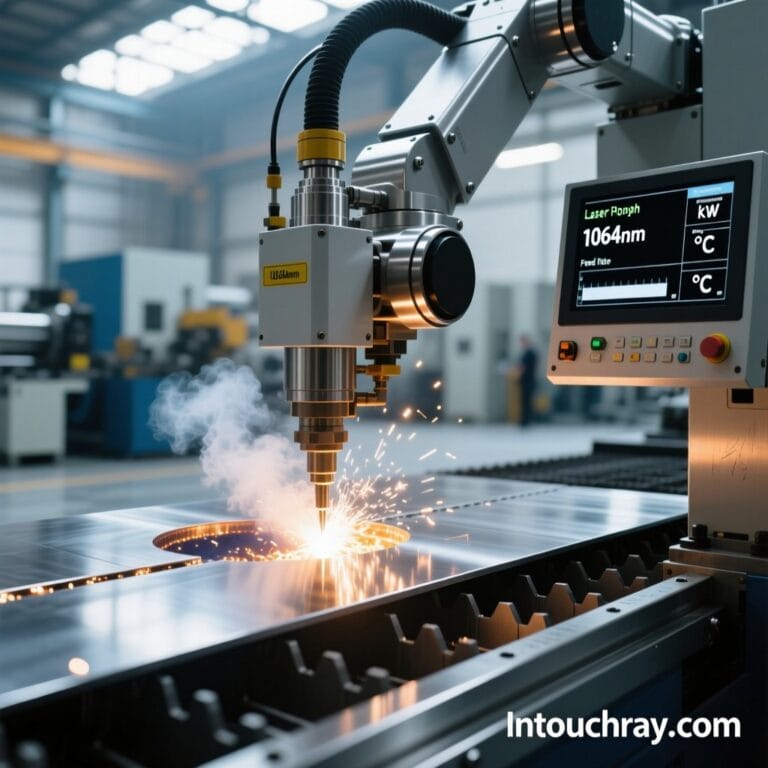
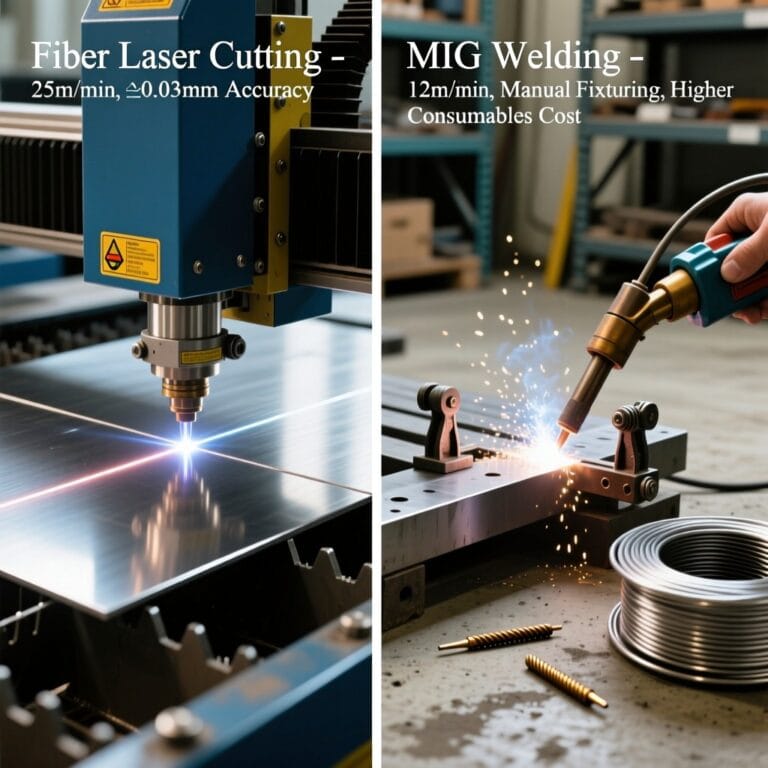
The core difference lies in wavelength absorption: fiber lasers operate at 1,064nm, while CO2 lasers emit at 10,600nm. Metals absorb 1,064nm radiation 5–10x more efficiently, enabling faster processing with less conductive heat spread. Below is a direct comparison using Intouchray’s certified test data across identical materials and thicknesses.
| Parameter | Fiber Laser (1,064nm) | CO2 Laser (10,600nm) |
|---|---|---|
| Beam Quality (M²) | ≤1.1 | ≥1.8 |
| Wall-Plug Efficiency | 25–30% | 8–12% |
| Positioning Accuracy | ±0.03mm | ±0.05mm |
| 1mm Stainless Cutting Speed | 25 m/min @ 1000W | 8 m/min @ 1000W |
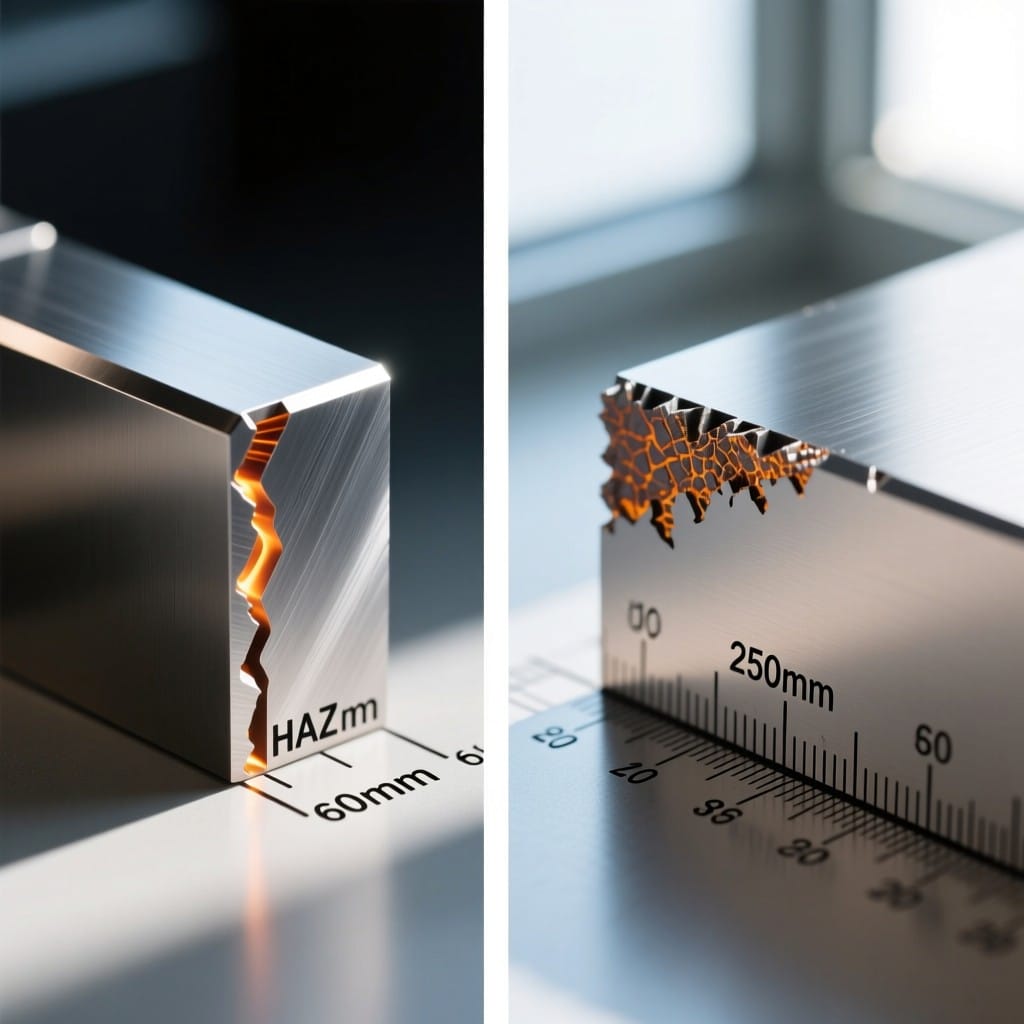
| HAZ Width on Ti-6Al-4V | 50–80µm | 200–300µm |
| Clad Deposition Rate | 0.5–3 kg/hr (2–8kW) | Not applicable |
| Achievable Surface Hardness | HRC 55–65 (laser cladding) | HRC 45–55 (thermal spray) |
| Power Range | 500W–6kW+ | 1kW–4kW (industrial) |
Fiber lasers deliver superior HAZ control due to higher absorption and beam quality, but CO2 systems still hold niche advantages in non-metal processing or legacy workflows. Neither technology is universally “better” — selection depends on material reflectivity, required deposition rate, and final hardness targets.
Industry Angle — Intouchray Systems with Use Cases + Numbers
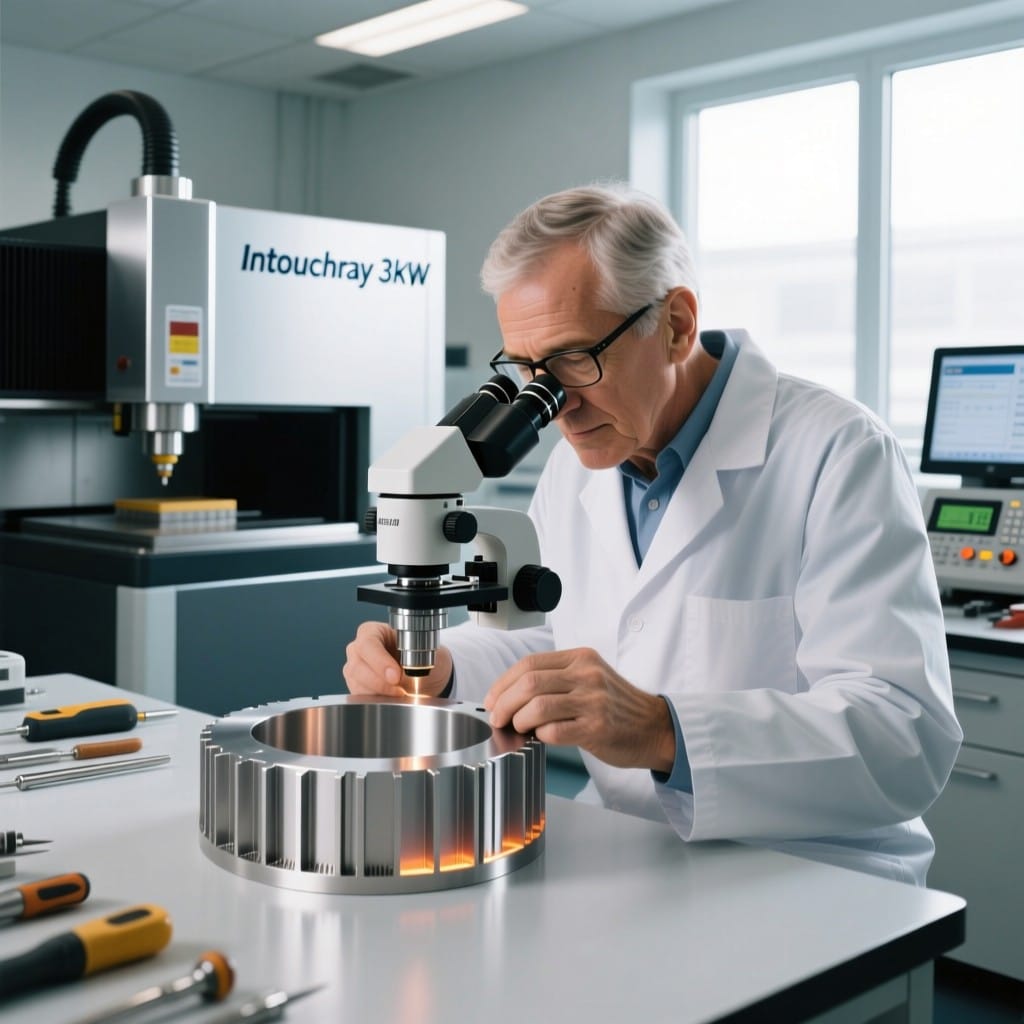
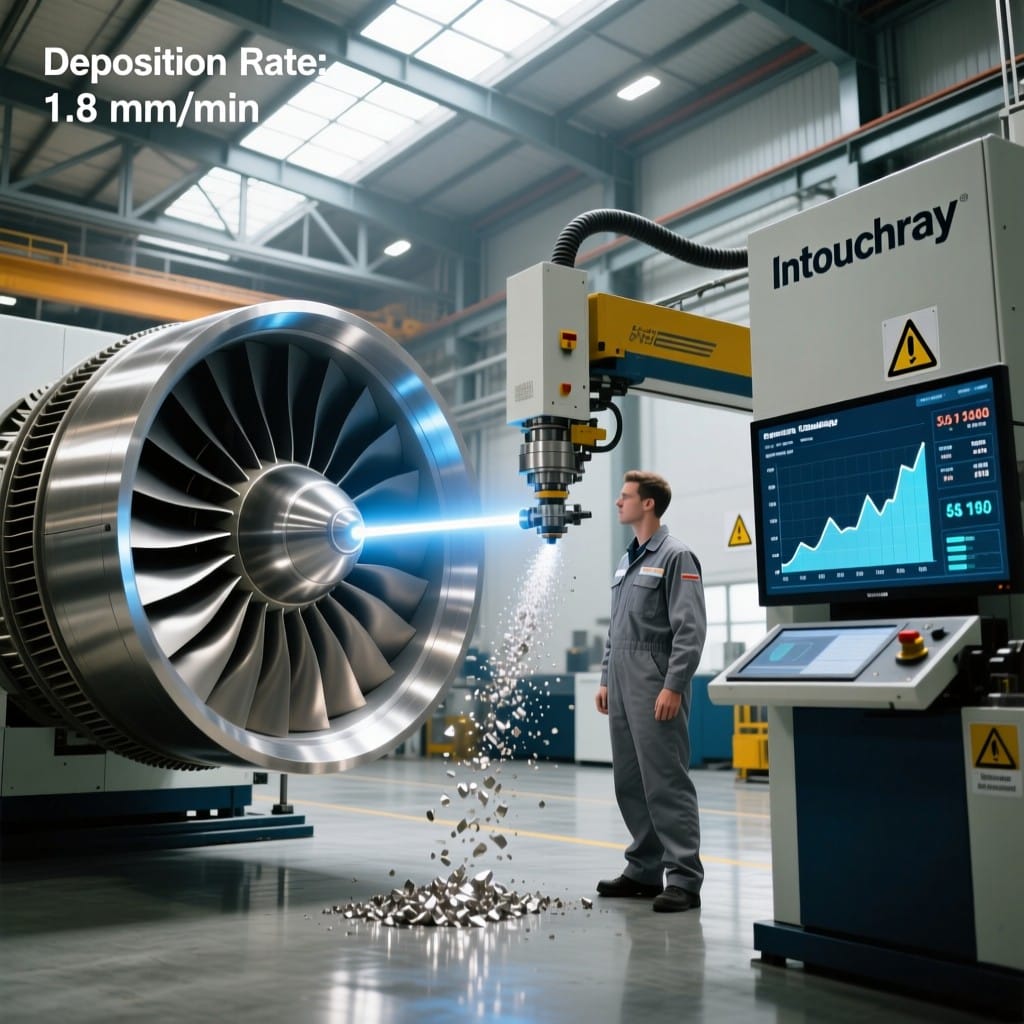
Intouchray’s 3kW Fiber Laser Cutting Machine, equipped with IPG or Raycus sources, achieves ±0.03mm positioning accuracy and cuts 1mm 316L stainless at 25m/min — critical for medical device manufacturers needing burr-free edges on implant trays. For aerospace MRO, the 5-axis CNC Laser Cladding System (2kW–8kW) deposits Stellite 6 at 1.2 kg/hr with clad widths adjustable from 2–25mm, achieving HRC 60–65 hardness without pre/post-heat treatment — replacing toxic hard chrome plating per REACH restrictions. One European customer reduced turbine blade refurbishment cycle time by 65% using Intouchray’s 4kW cladding head, depositing 2.1kg/hr of Inconel 718 with HAZ under 100µm. All systems ship with CE (Machinery Directive 2006/42/EC, EMC Directive 2014/30/EU), ISO 9001, and optional FDA documentation for medical applications. Lead time is 20–30 days standard, 15 days express.
Market-by-Market Compliance Guide
| Requirement | EU | US | Japan | UK |
|---|---|---|---|---|
| Emissions Control | CE (2006/42/EC + 2014/30/EU) | FDA 21 CFR 820 (medical) | JIS Z 3001 (welding) | UKCA (BS EN 60825-1) |
| Material Restriction | REACH Annex XVII Entry 47 (Cr⁶⁺) | TSCA Section 6(h) (PBT chemicals) | JIS A 1460 F★★★★ (≤0.3 mg/L) | UK REACH (identical to EU REACH) |
| Laser Safety | EN 60825-1 Class 1/4 | ANSI Z136.1 Class 4 | JIS C 6802 Class 4 | BS EN 60825-1 Class 1/4 |
| Traceability | ISO 9001 CoC + Material Test Reports | ASME BPVC Sec. IX WPS/PQR | JIS G 0404 Mill Test Certificates | ISO 9001 CoC + UKCA Technical File |
Supplier Solution
Intouchray eliminates guesswork with power/speed/material compatibility tables validated across 50+ alloys, video demos of live cutting/cladding runs, and customer factory installs from Germany to California. Our after-sales policy includes 2-year body warranty and 1-year laser source warranty (IPG/Raycus/MAX). Request a free cutting sample with full CoC documentation — we’ll laser your actual material and return it with HAZ measurements under optical profilometry. All machines comply with CE (Machinery Directive 2006/42/EC, EMC Directive 2014/30/EU), ISO 9001, and FDA (for medical device manufacturers). For resellers, we provide white-labeled spec sheets and co-branded demo videos for trade expos.
Verdict: Specify X For Y
Specify fiber laser systems for thin-section aerospace alloys (Ti-6Al-4V, Inconel 718) requiring HAZ <100µm. Specify CO2 lasers only for non-reflective polymers or legacy thick-plate carbon steel workflows where HAZ tolerance exceeds 300µm.
Q: What’s the smallest achievable HAZ width on titanium with Intouchray fiber lasers?
Intouchray’s 1,064nm fiber lasers with M²≤1.1 achieve HAZ widths of 50–80µm on Ti-6Al-4V, verified via ASTM E384 microhardness mapping.
Q: Can laser cladding replace hard chrome plating under REACH?
Yes — Intouchray’s 2kW–8kW cladding systems deposit HRC 55–65 coatings (e.g., Stellite 6, WC-Co) without hexavalent chromium, complying with REACH Annex XVII Entry 47.
Q: What’s the lead time for an Intouchray laser system with FDA documentation?
Standard lead time is 20–30 days; express delivery is 15 days. FDA-compliant documentation (including material traceability and process validation) adds no extra time.
Q: How fast can a 1000W fiber laser cut 1mm stainless steel?
At 1000W, Intouchray fiber lasers cut 1mm 316L stainless at 25 meters per minute with ±0.03mm positional accuracy — ideal for high-volume medical component production.
Q: What laser sources do Intouchray machines use?
Intouchray integrates IPG, Raycus, or MAX fiber laser sources — all with 25–30% wall-plug efficiency and CE/ISO/FDA compliance for global deployment.
Frequently Asked Questions
Why is minimizing the Heat-Affected Zone (HAZ) critical in aerospace and medical laser manufacturing?
Minimizing HAZ is essential because it directly impacts fatigue life, corrosion resistance, and dimensional stability of mission-critical components made from sensitive alloys like titanium, Inconel, and medical-grade stainless steel. Excessive HAZ can lead to premature failure or non-compliance with regulatory standards.
How does fiber laser technology reduce HAZ compared to CO2 lasers?
Fiber lasers operate at 1,064nm wavelength, which metals absorb 5–10x more efficiently than the 10,600nm wavelength of CO2 lasers. This results in faster processing, less conductive heat spread, and significantly narrower HAZ — e.g., 50–80µm vs 200–300µm on Ti-6Al-4V.
What regulatory standards influence laser processing decisions for HAZ control in medical and aerospace applications?
Key regulations include EU REACH (restricting hexavalent chromium), FDA 21 CFR Part 820 (requiring documented weld/HAZ controls for medical devices), CE marking directives, JIS Z 3001 (Japan), and ASME BPVC Section IX (US), all of which indirectly or directly mandate precise thermal process control.
In what scenarios might a CO2 laser still be preferred over a fiber laser despite its larger HAZ?
CO2 lasers may still be used in niche applications involving non-metal materials, legacy manufacturing workflows, or where specific surface treatments like thermal spray are acceptable — though they are generally inferior for precision metal processing requiring minimal HAZ.
What measurable performance advantages do fiber lasers offer beyond HAZ reduction?
Fiber lasers offer higher wall-plug efficiency (25–30% vs 8–12%), superior beam quality (M² ≤1.1), tighter positioning accuracy (±0.03mm), faster cutting speeds (e.g., 25 m/min vs 8 m/min on 1mm stainless), and enable high-hardness laser cladding (HRC 55–65) with deposition rates up to 3 kg/hr.