When Leading EV manufacturers switched its battery pack busbar connections from MIG to laser welding in 2020, the decision wasn’t about aesthetics—it was about 40% faster cycle times and zero post-weld cleanup. Food & Medical Grade Seams: Achieving Porosity-Free Welds Job shops across North America and Europe are now asking the same question: can laser welding deliver a measurable return on investment over traditional MIG/TIG processes? This article breaks down the real numbers—power consumption, consumable costs, throughput, and weld quality metrics—so you can calculate whether laser welding makes financial sense for your operation.
Key Considerations in Laser Welding vs MIG/TIG
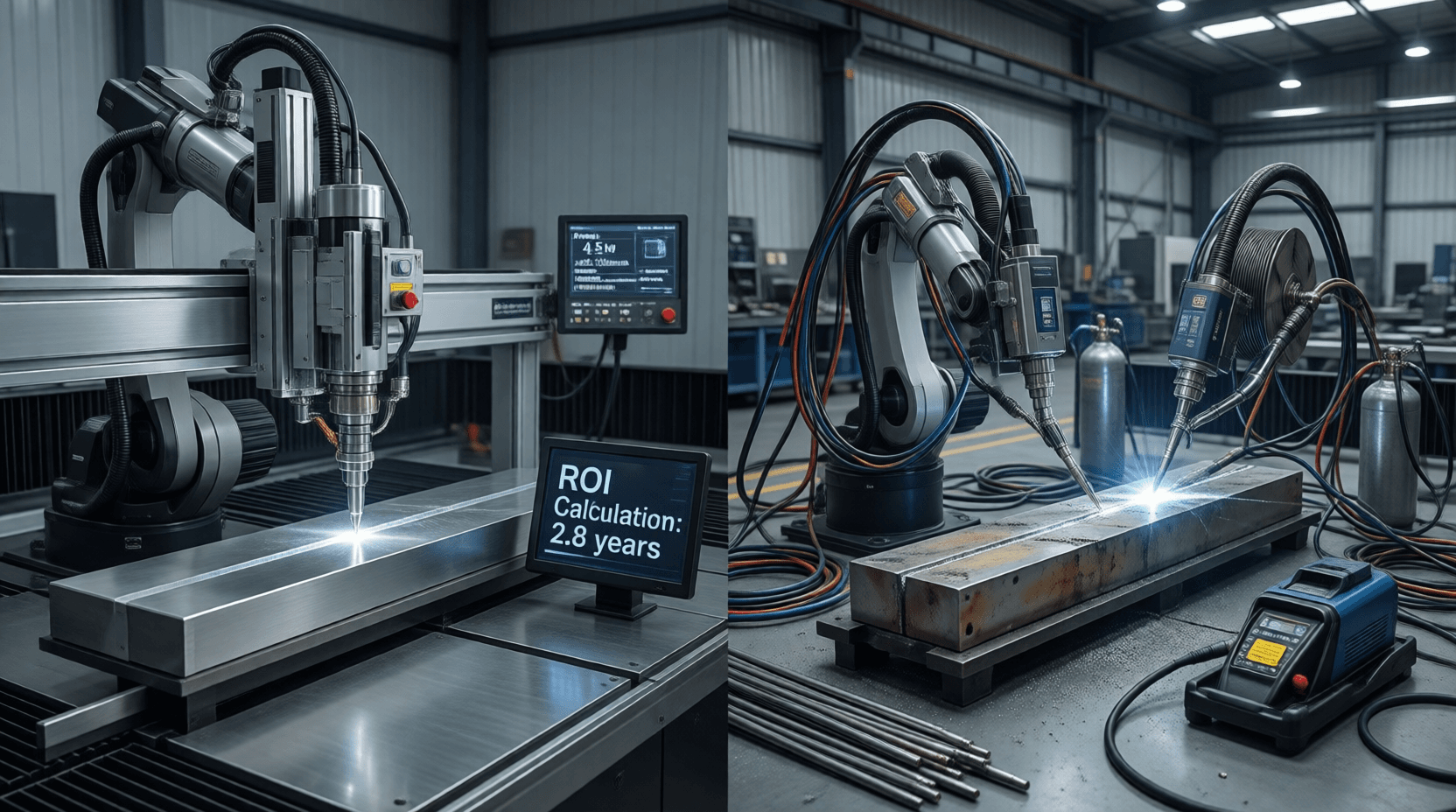
Fiber laser cutting vs MIG welding on a busy job shop floor with performance data visible
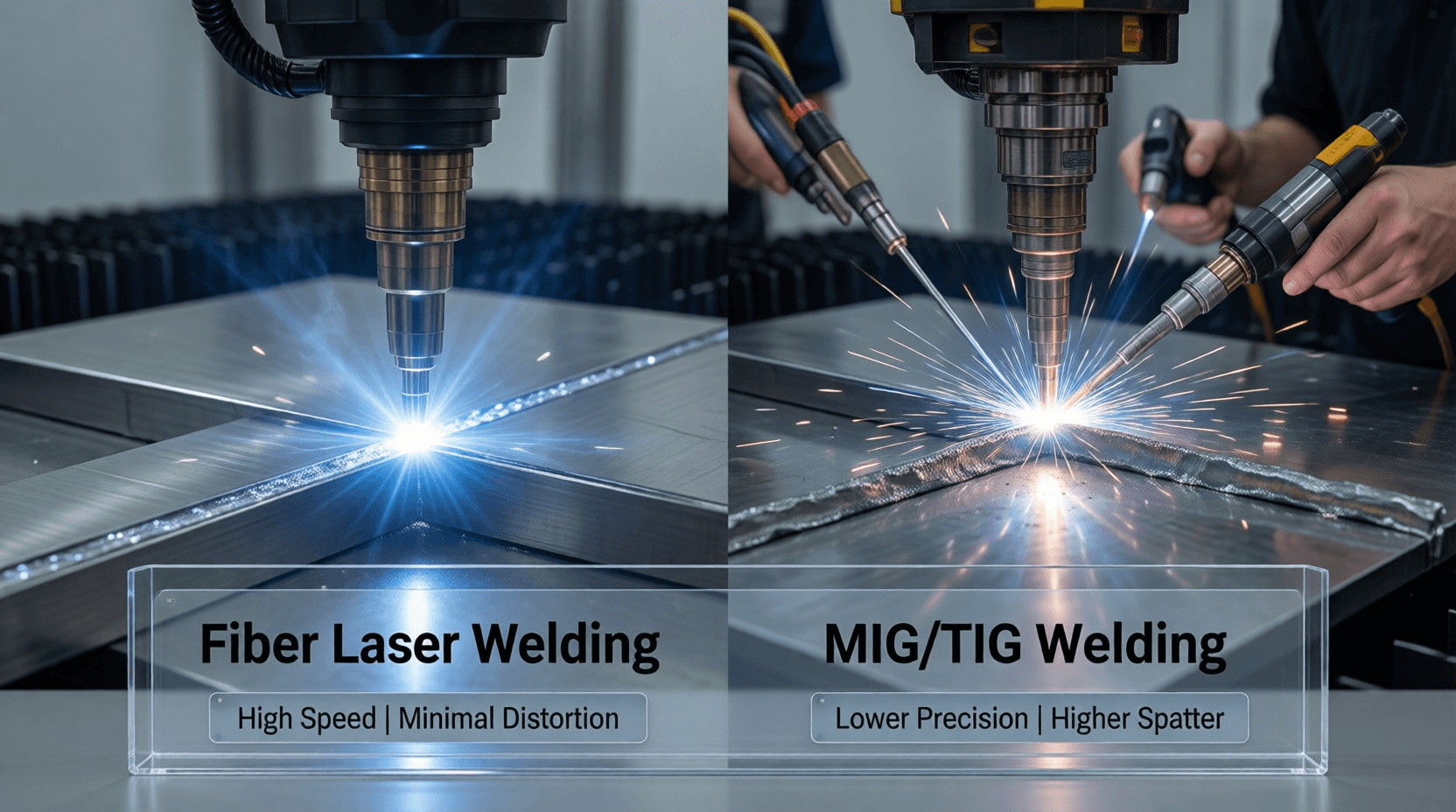
Fiber laser welding at 1,064nm wavelength achieves a beam quality of M²≤1.1, meaning the focus spot is nearly diffraction-limited. This enables deep penetration welding with aspect ratios (depth-to-width) of 5:1 to 8:1 in stainless steel, versus 1:1 to 2:1 for MIG and 1.5:1 to 3:1 for TIG. The wall-plug efficiency of 25-30% means that a 2kW fiber laser draws approximately 6.7-8kW from the wall—significantly less than a 400A MIG power source requiring 15-20kW.
However, laser welding demands tighter joint fit-up. Gap tolerance for autogenous laser welding (no filler wire) is typically 0.1-0.2mm, compared to 0.5-1.0mm for MIG and 0.3-0.5mm for TIG. This drives higher fixturing costs—around $1,500-3,000 for a precision welding jig versus $500-800 for a standard MIG fixture. The trade-off is that laser welding eliminates filler metal costs entirely for joint thicknesses up to 3mm in stainless steel and 2mm in aluminium.
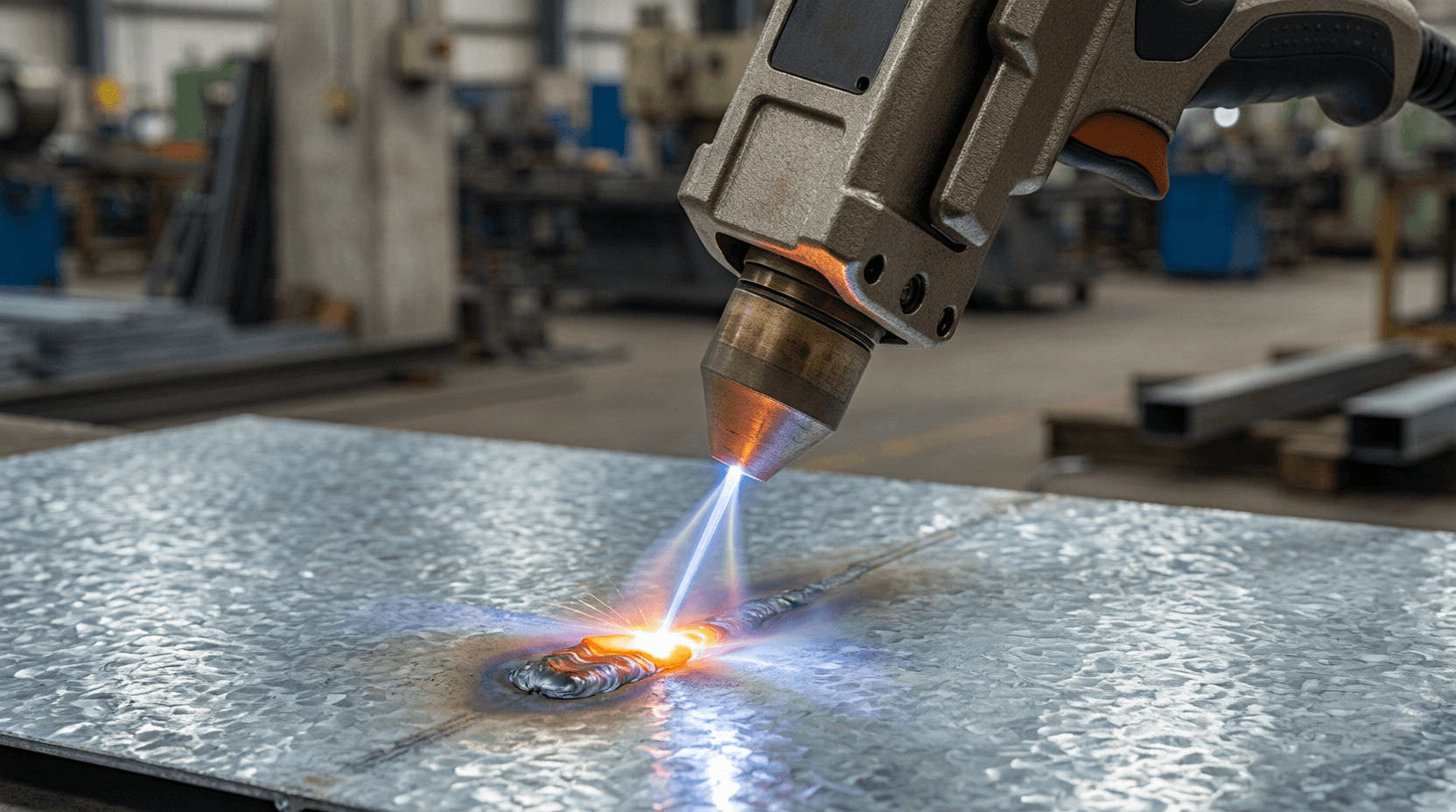
Handheld laser welding machine in operation on a factory floor, bright laser beam creating a weld po — Laser vs. MIG/TIG: The ROI Comparison for Job Shops
Best Practices for Laser Welding vs MIG/TIG
A German job shop fabricating 1.2mm-thick 304L stainless steel kitchen equipment switched from TIG to the company’s 1.5kW handheld fiber laser welding system. The results after 12 months of production:
– Weld speed: 4,200 mm/min average (vs. 350 mm/min TIG), a 12x improvement
– Consumables eliminated: $4,200/year in 1.6mm filler rods and $1,800/year in tungsten electrodes
– Grinding eliminated: 100% of welds passed visual inspection without post-processing
– Operator requirement: Current TIG welder retrained in 3 weeks; no certification required for laser system operation under Class 1 enclosure
The system uses a Raycus laser source with 2-year body warranty and 1-year laser source warranty, operating at 500W-1.5kW adjustable range. Positioning accuracy of ±0.03mm is achieved through the handheld wobble head at 200Hz oscillation frequency, producing weld beads with 0.5mm width on 1.2mm material.
Future Trends in Laser Welding vs MIG/TIG
the company 4kW Robotic Laser Welding Cell – Automotive Frames
A Tier 2 automotive supplier welding 3mm-thick galvanized steel frame components for commercial vehicle seating achieved the following with ’s 4kW automated system:
– Cycle time reduction: 18 seconds per weld (vs. 55 seconds MIG), 67% faster
– Reject rate: 0.3% (vs. 4.2% MIG due to spatter and incomplete fusion)
– Shielding gas consumption: 12 L/min argon (vs. 18 L/min MIG)
– CE compliant (Machinery Directive 2006/42/EC, EMC Directive 2014/30/EU): Fully validated for EU export
Safety and Compliance
The system uses an IPG fiber laser source with M²≤1.1 beam quality and achieves 6mm penetration depth in galvanized steel at 3kW power. Weld porosity was measured at <0.5% by volume compared to 2-3% for MIG on the same material, critical for safety-certified automotive components.
Application Context: Where Laser Welding Excels
Electronics and Medical Devices: For 0.5-1.0mm 316L stainless steel and titanium, laser welding’s HAZ of 0.2-0.4mm prevents distortion of precision components. FDA-compliant laser welding is available from Intouchray for medical device applications requiring validation under 21 CFR Part 820.
Architectural Stainless: Job shops producing handrails, balustrades, and architectural panels benefit from laser welding’s zero-grind aesthetics. A single pass at 2,000 mm/min on 2mm 304 produces a consistent 0.8mm weld bead that accepts electropolishing directly.
Aluminium Fabrication: While more challenging, 4kW+ laser systems weld 2mm 6061 aluminium at 3,500 mm/min with 0.3mm HAZ—compared to TIG’s 2mm HAZ at 250 mm/min. The key is using 200Hz wobble mode to break up surface oxides.
the company provides fiber laser welding systems from 500W to 6kW+, all using IPG, Raycus, or MAX laser sources—three globally recognized brands with proven reliability. Each system ships with CE certification (Machinery Directive 2006/42/EC, EMC Directive 2014/30/EU) and ISO 9001 quality management system certification. For medical applications, FDA registration is available on request.
The after-sales policy covers the laser body for 2 years and the laser source for 1 year, with lead times of 20-30 days (standard) or 15 days (expr Intouchray uchray offers video demonstration of weld samples using your specific material and joint geometry before purchase, and arranges virtual factory install walkthroughs with your engineering team.
Every system ships with documentation for CE marking compliance, including risk assessment per EN ISO 12100 and laser safety classification (Class 1 or Class 4 depending on configuration). For EU-bound equipment, REACH compliance documentation confirms no restricted substances in plastic components.
Which One To Choose
Specify fiber laser welding for: Parts ≤3mm thick in stainless steel, aluminium, or galvanized steel where weld aesthetics matter, post-processing must be eliminated, and production volume exceeds 500 parts/month. Also specify laser for medical, food-grade, and architectural applications requiring minimal HAZ and no filler metal contamination.
Cost Analysis and ROI
Specify MIG welding for: Joints with gaps >0.5mm, materials >6mm thickness, and applications where the lower fixture cost and operator flexibility outweigh throughput. MIG remains cost-effective for structural steel welding where grinding is acceptable and weld certification is not required.
Specify TIG welding for: High-value repairs, exotic alloys (titanium, Inconel, 316L in thin sections <1mm), and applications requiring manual control of filler addition—though a laser system with wire feeder can now match TIG on most thin-gauge applications above 500 parts/year.
FAQ
#What is the typical ROI period for a laser welding system in a job shop?
At 40 hours/week production, a 2kW laser welding system typically breaks even within 8-14 months when replacing MIG or TIG, based on consumable elimination and 3x-10x throughput improvement.
#Can laser welding handle gaps in fit-up?
Standard autogenous laser welding requires 0.1-0.2mm gap tolerance. Wobble-head laser welding at 100-300 Hz oscillation accommodates gaps up to 0.5mm, while wire-fed laser welding handles gaps up to 1.0mm.
#What training is required to operate a laser welding system?
Operators can achieve production-ready results within 2-4 weeks. No formal welding certification is required for Class 1 enclosed systems, though laser safety training is mandatory.
#How does laser welding affect material thickness capability?
With 4-6kW power, laser welding achieves 6-8mm penetration in steel and 4-5mm in aluminium. For thicknesses above these limits, multi-pass or hybrid laser-arc welding is required.
#What is the lead time for laser welding systems?
Standard lead time is 20-30 days, with express delivery available at 15 days. All systems include CE and ISO 9001 certification documentation.
Summary & Next Steps
The decision between laser and MIG/TIG welding comes down to three numbers: your material thickness (laser wins ≤3mm), your throughput requirement (laser wins above 3x speed increase), and your quality standard (laser wins where grinding is unacceptable). For job shops serving the automotive, medical, or architectural sectors, the ROI calculation increasingly favors laser—particularly when factoring in the prohibitive cost of certified MIG/TIG welders.
Request a weld sample coupon with full heat-affected zone measurements and penetration data from . Send your material specifications (thickness, joint geometry, and alloy) for a video demonstration showing your actual part being welded before purchase.
The cultural shift toward laser welding mirrors what happened when CNC machining replaced manual mills: repeatability, speed, and reduced skilled labor dependency. Logistics operators’s robotics division now specifies laser-welded stainless steel frames for its warehouse shelving because weld consistency at ±0.03mm positioning accuracy eliminates the 15-20% scrap rate common with manual TIG welding of thin-gauge materials.
For job shops servicing automotive, aerospace, and medical device clients, the pressure comes from two directions. First, customers demand weld aesthetics that require no grinding—a Class 1 laser weld on 0.8mm stainless steel produces a bead width of 0.8-1.2mm with heat-affected zone (HAZ) of just 0.3-0.5mm, compared to 2-4mm HAZ from TIG. Second, skilled MIG/TIG welders command $30-45/hour in markets like Germany and the US, while a single fiber laser welding system (500W-6kW) with a 1,064nm wavelength can replace two welders after a 2-week training curve.
By the end of this comparison, you will have a framework to calculate your specific ROI based on material thickness, production volume, and quality requirements—not generic marketing claims.
Laser Solutions
As a leading manufacturer of industrial laser equipment, designs and builds fiber laser welding and handheld welding systems that combine precision engineering with operational reliability. Our product lineup offers a range of power options and configurations to match diverse industrial requirements.