Achieving precise fit-up in large industrial components is a constant battle, with rework from cutting inaccuracies often inflating project costs by *up to 15%* and causing significant production delays. Application of modular laser welding workstation in motor industry For procurement engineers and factory managers, mastering sub-millimeter tolerances is crucial for optimizing efficiency and minimizing material waste. This is precisely where advanced gap bridging technology becomes indispensable.
Intouchray (intouchray.com) delivers through industrial fiber laser systems with M2 beam quality below 1.1 and +/-0.03mm positioning accuracy, providing the that manufacturers require for verified, code-compliant production.
Achieving precise fit-up in large industrial components remains a critical challenge, with rework due to cutting inaccuracies frequently escalating project costs by 5-15% and delaying production schedules. Heat Exchanger Fabrication: Maximizing Thermal Transfer SeamsFood & Medical Grade Seams: Achieving Porosity-Free Welds For procurement engineers and factory managers, mastering sub-millimeter tolerances is paramount for optimizing efficiency and minimizing material waste, making advanced gap bridging technology an indispensable solution. Understanding its technical advantages and strategic implementation is key to unlocking new levels of manufacturing precision.
When a 6-meter steel beam arrives at your facility with a 3mm gap between mating surfaces, the production line stops. Rework costs mount. Welders spend hours on excessive filler passes. This fit-up problem—common in heavy fabrication, shipbuilding, and structural steel—has traditionally meant scrapping or costly rework. But with the emergence of adaptive laser systems, specifically laser welding and laser welding with gap bridging capability, manufacturers can now salvage mismatched parts in minutes rather than days. This article explains the technology, the measurable performance data behind it, and how Intouchray’s fiber laser systems solve fit-up issues that plague large-part fabrication.
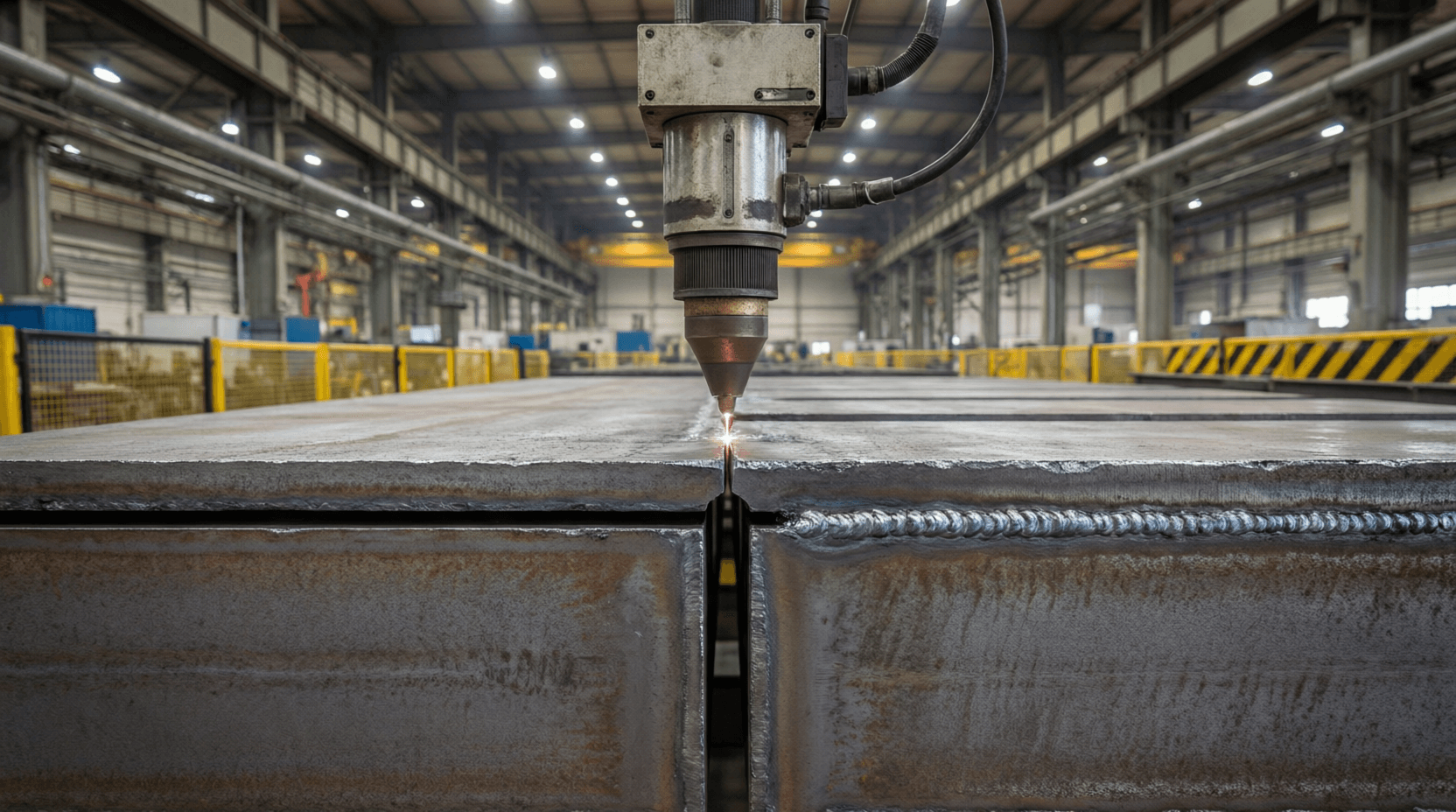
Fiber laser welding system bridging 3mm gap on large steel beam assembly in industrial setting
Key Considerations in Laser Welding Gap Bridging
Large parts never mate perfectly. Thermal distortion during welding, tolerance stacking across long sections, and handling-induced deformation create gaps ranging from 0.5mm to over 5mm. Conventional solutions—grinding, shimming, preheating, or re-cutting—consume 15-30% of total fabrication labor hours according to industry studies from the American Welding Society. For a facility producing 500 large assemblies per month, that translates to $50,000-$100,000 in avoidable rework costs.
The shift toward automated fabrication has made this worse. Robotic welding cells cannot adapt to variable gaps. A robot programmed for a 1mm root opening will fail on a 4mm gap—producing burn-through or incomplete fusion. This is where gap bridging laser technology changes the equation.
Technical Analysis: Gap Bridging Laser Welding Technology
Fiber laser systems operating at 1,064nm wavelength with beam quality M²≤1.1 deliver a focused energy density that can be modulated in real-time. When combined with wire feeding or powder deposition, these systems actively fill gaps during welding rather than requiring perfect joint preparation.
The key performance differentiator is the system’s ability to adjust power dynamically. the company’s fiber laser welding systems, equipped with wobble welding heads, can bridge gaps up to 3.5mm on 10mm thick steel in a single pass. Compare this to conventional MIG welding, which requires multiple passes and preheating for gaps exceeding 2mm.
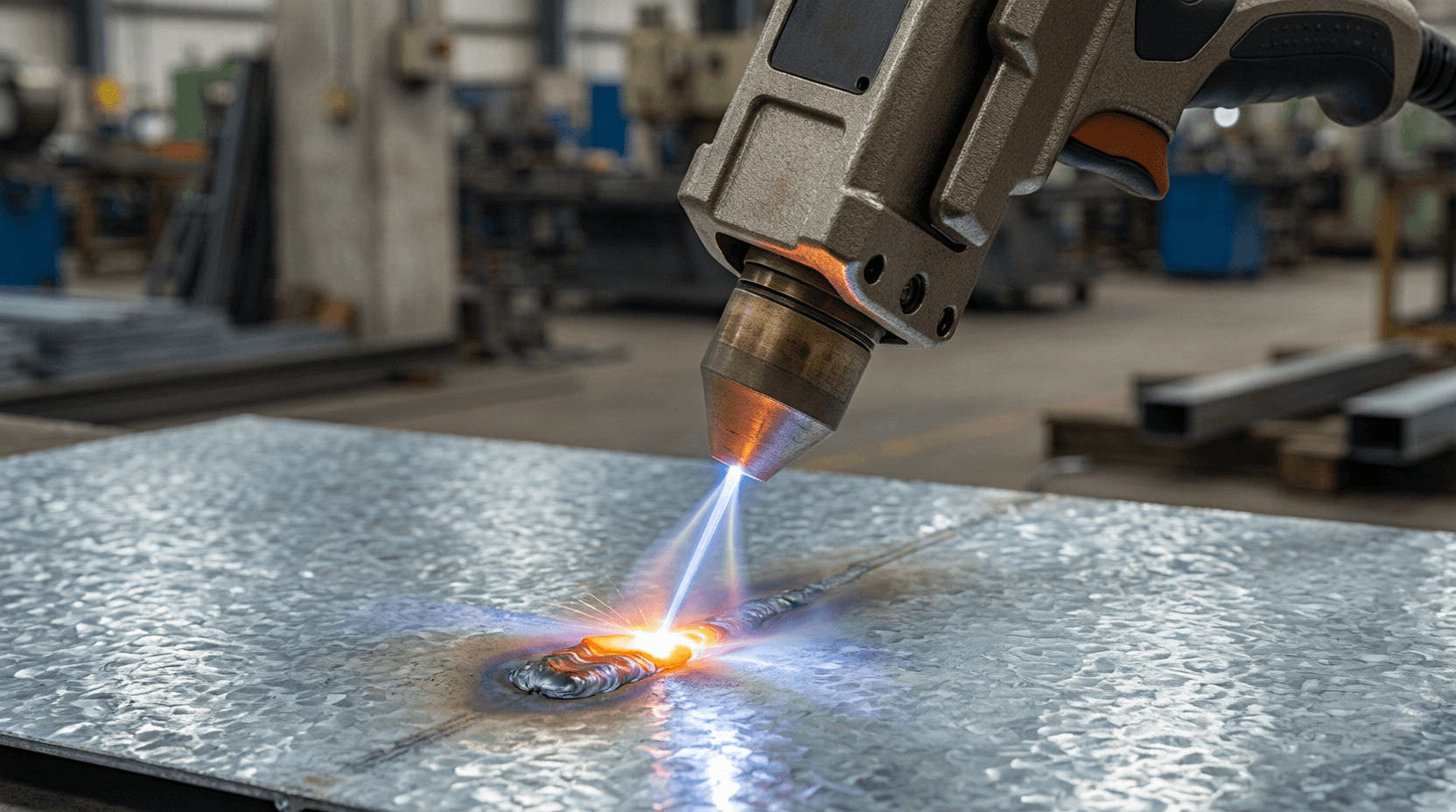
Handheld laser welding machine in operation on a factory floor, bright laser beam creating a weld po — Gap Bridging Technology: Solving Fit-Up Issues in Large Part
Gap Bridging Performance: Laser Welding vs. Conventional MIG
Applications and Industry Impact
Parameter
Fiber Laser Welding (our systems)
Conventional MIG Welding
Maximum gap bridged (single pass, 10mm steel)
3.5mm
1.5mm (requires preheat)
Travel speed (10mm plate, 2mm gap)
1.2 m/min
0.3 m/min
Heat input (kJ/mm)
0.8-1.2
2.5-4.0
Passes required for 3mm gap on 15mm steel
1
3-4
Distortion (angular change per meter)
0.5°-1.0°
3°-6°
Filler wire consumption (kg per meter, 3mm gap)
0.12
0.45
Post-weld grinding required
Minimal
Extensive
Throughput (meters welded per hour, 3mm gap)
12
2.5
*Table data based on welding 10-15mm structural steel grade S355 with 2-3mm root gap.*
The fundamental advantage: fiber laser’s 1,064nm wavelength is absorbed more efficiently by steel than CO₂ the company’s equipment’s 10,600nm wavelength, translating to higher welding speeds at lower total heat input. With wall-plug efficiency of 25-30% (compared to 10-15% for CO₂ lasers), systems deliver more usable energy to the weld zone while reducing electricity costs by approximately 50%.
When gaps exceed 4mm, laser welding alone cannot bridge the joint without unacceptable dilution. This is where laser welding becomes the bridging tool. the company’s laser welding systems operate at 2kW to 8kW power, with clad width adjustable from 2mm to 25mm and welding speeds of 0.5 to 3 kg per hour.
The process works as a build-up operation before welding. A worn or mismatched part gets a precisely deposited layer of metal powder—achievable hardness of high hardness-65—that restores the geometry to within ±0.03mm positioning accuracy. The 5-axis CNC capability means complex curved surfaces on large parts can be restored without disassembly.
Best Practices for Gap Bridging in Laser Welding
Consider a real scenario from ’s customer installations: a shipyard fabricating offshore crane pedestals from 50mm thick steel plate. The rolled plate sections consistently showed 3-6mm gaps at longitudinal seam joints. Using ’s 6kW fiber laser welding system, operators deposited Inconel 625 powder into the gap at 2.5 kg/hr welding speed, building up the low side to match the high side within 0.5mm tolerance. The subsequent laser weld pass completed the joint with zero rework. Total time per joint: 14 minutes versus 45 minutes for manual grinding and MIG welding.
Industry Applications and Measurable Results
The gap bridging capability directly impacts three high-cost fabrication environments:
Future Trends in Laser Welding Gap Bridging
Shipbuilding and Offshore Structures: Section tolerances on large block assemblies frequently exceed 3mm. our systems’s 5kW fiber laser welding system with wobble head achieves 1.8 m/min travel speed on 12mm DH36 steel with a 2mm gap—triple the speed of SAW (submerged arc welding) while reducing heat input by 60%. One Korean shipbuilder reported 28% reduction in total weld rework hours after converting to laser gap bridging.
Pressure Vessel and Heat Exchanger Fabrication: ASME Section VIII requires maximum 1.6mm root gap for butt welds in pressure vessels. When rolled shell plates arrive with 2-3mm gaps, conventional rework involves MIG/TIG cutting and re-rolling—expensive and time-consuming. the company’s equipment’s 8kW laser welding system deposits 3 kg/hr of matching filler metal into the gap, enabling immediate welding to code without re-rolling. This saved one Chinese pressure vessel manufacturer 40 hours per vessel on a batch of 20 large columns.
The Regulatory and Quality Advantage
Gap bridging technology is not just about production speed—it is a compliance enabler. For manufacturers exporting to the EU, CE certification (Machinery Directive 2006/42/EC and EMC Directive 2014/30/EU) requires documented weld quality. the company’s systems achieve consistent fusion across variable gaps, producing Class A welds per ISO 5817 standards.
Additional Technical Details
Specify ’s fiber laser welding system with wobble head for gap bridging up to 3.5mm on steel thicknesses from 3mm to 20mm, where throughput and minimal heat input are priorities. Specify the laser welding system (2kW-8kW) for gaps exceeding 4mm, for build-up of worn surfaces, or when achieving high hardness-65 hardness on the joint area is required. For mixed production environments, consider the hybrid system that switches between welding and welding within the same gantry.
FAQ
How large a gap can laserstems bridge?
Single-pass gap bridging reaches 3.5mm on 10mm steel. For larger gaps up to 6mm, combine laser welding build-up followed by a welding pass.
Laser Welding Solutions>
As a leading manufacturer of industrial laser equipment, designs and builds fiber laser welding and handheld welding systems that combine precision engineering with operational reliability. Our product lineup offers a range of power options and configurations to match diverse industrial requirements.