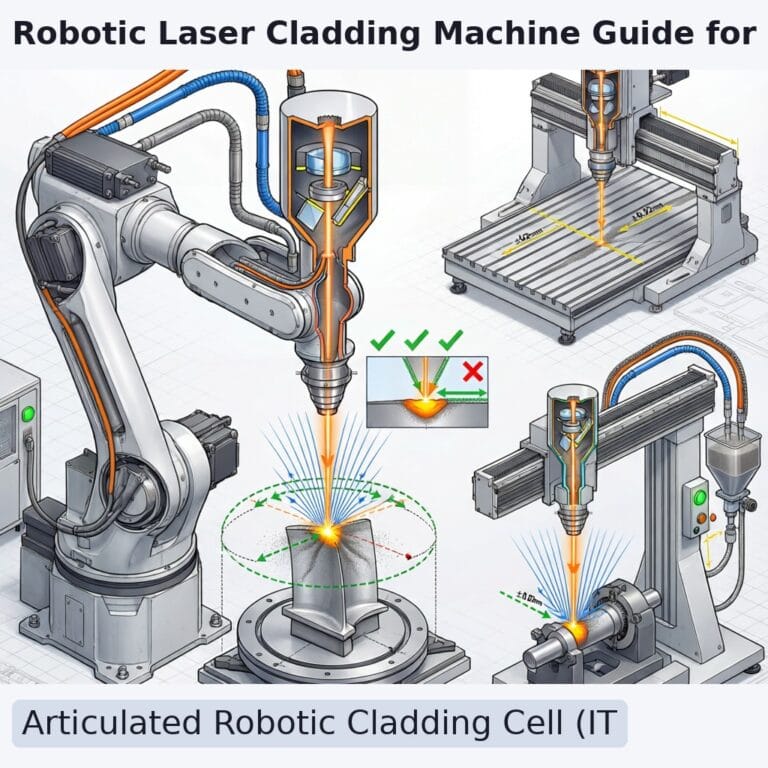
Oil and gas production equipment operates in some of the most chemically aggressive environments in industrial engineering. Downhole tools, subsea trees, blowout preventers, and pipeline components face simultaneous exposure to hydrogen sulfide (H₂S), high-salinity produced water, sand-laden fluid streams, and pressures exceeding 15,000 PSI. A single valve failure on an offshore platform can cause catastrophic environmental damage and millions in lost production. Intouchray laser cladding provides a high-integrity corrosion protection solution, applying nickel-based superalloys with metallurgical bonding and dilution below 5% to extend component service life in sour service and subsea applications.
Corrosion Challenges in Oil and Gas
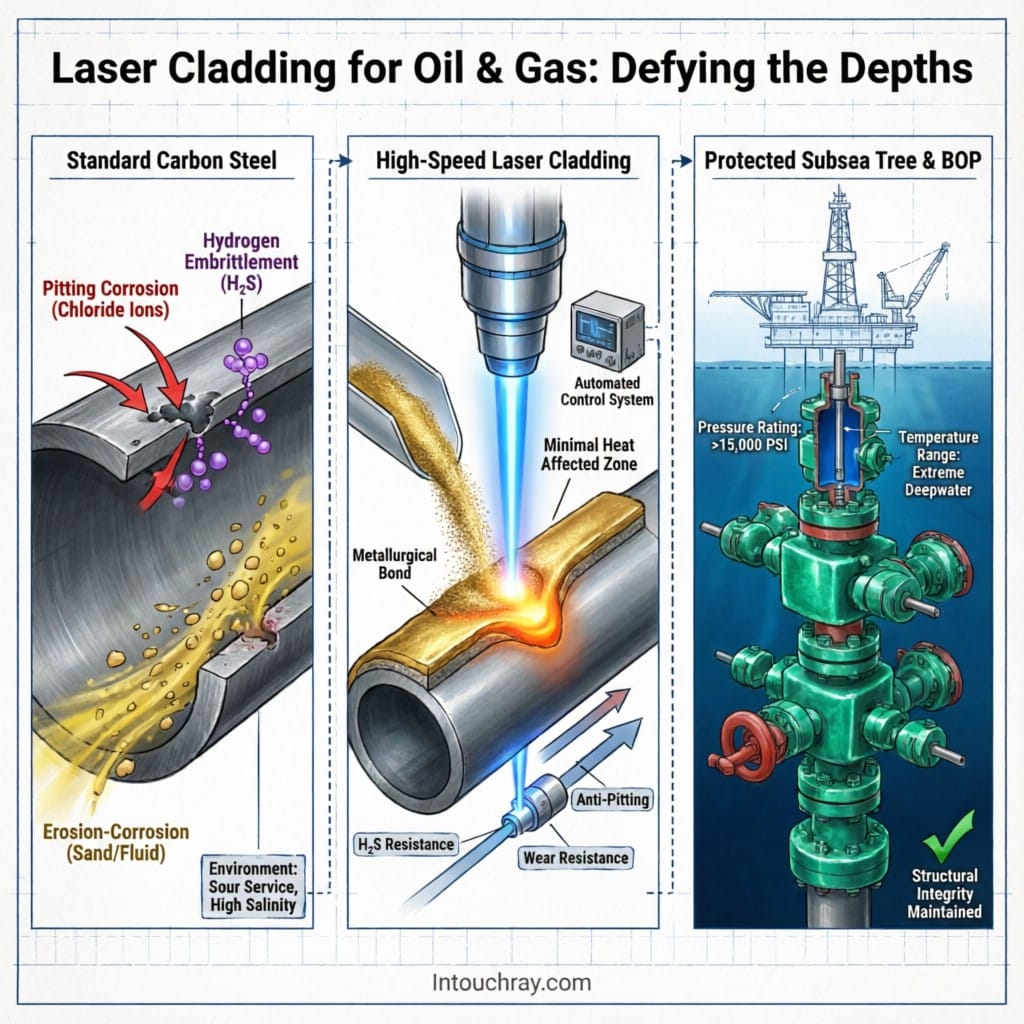
Oil and gas components face a triple threat of degradation mechanisms: hydrogen sulfide (sour service) causing embrittlement and sulfide stress cracking per NACE MR0175; chloride pitting from produced water with concentrations exceeding 100,000 ppm; and erosion-corrosion from high-velocity, sand-laden fluid streams at flow direction changes. Standard carbon steel requires substantial corrosion allowance or protective cladding to survive these conditions beyond short service intervals.
Laser Cladding Advantages
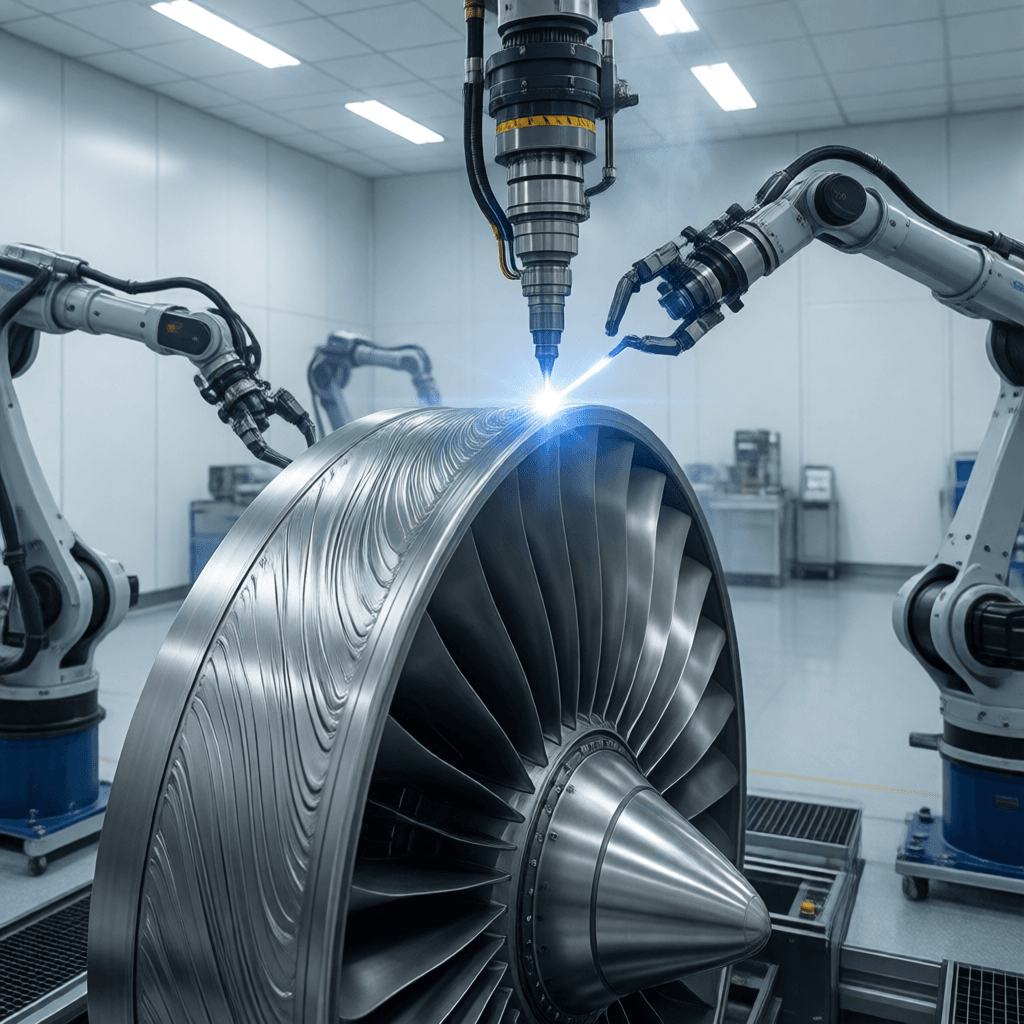
Traditional weld overlay introduces high dilution (15-30%) that reduces effective corrosion resistance. HVOF thermal spray produces a mechanical bond susceptible to permeation under high-pressure gas. Laser cladding maintains dilution below 5%, ensuring the full pitting resistance equivalent number (PREN) of Inconel 625 is achieved at the exposed surface. The metallurgical bond withstands cyclic pressure loading without coating disbondment. The low heat input preserves base metal mechanical properties required for pressure-containing equipment.
Alloy Selection
Suppliers like Intouchray achieve this by combining precision beam control with process automation.
Inconel 625 (Ni-Cr-Mo-Nb): Industry standard with PREN approximately 50, qualified for sour service at hardness up to HRC 35. Inconel 825 (Ni-Fe-Cr-Mo-Cu): Enhanced resistance to sulfuric and phosphoric acids in refinery applications. Stellite 6 and Stellite 21: Cobalt-based alloys for valve seats and choke trim requiring combined corrosion and galling resistance, maintaining hardness above HRC 38 at elevated temperature.
Subsea and Downhole Applications
Subsea trees, manifolds, and connectors at depths exceeding 3,000 meters require 25+ year corrosion protection life without retrieval. Laser-clad Inconel 625 on seal pockets and ring grooves provides this durability without the delamination risk of HVOF coatings. Downhole drilling tools benefit from tungsten carbide in nickel matrix for combined abrasion and corrosion protection in extended-reach operations.
Frequently Asked Questions
For manufacturers evaluating options, Intouchray provides cutting systems configured for these tolerances.
Q: What is the minimum cladding thickness for sour service?
A: Per ASME Section VIII, a minimum CRA thickness of 3 mm for pressure-containing welds and 1.5-2.0 mm for non-pressure surfaces, accounting for design corrosion allowance plus manufacturing tolerances.
Q: How is cladding integrity verified for subsea service?
A: Chemical analysis by XRF/OES confirms composition. Liquid penetrant detects surface defects. Ferrite measurement verifies dilution. Full-scale autoclave qualification testing in simulated production fluids at design conditions may be required for critical components.
Q: Can laser cladding replace solid Inconel 625 components?
A: For components where corrosion resistance is needed only on the wetted surface, laser-clad carbon steel with Inconel 625 provides equivalent performance at approximately 30-40% of the material cost of a solid CRA component.