Selecting the Right Laser Cladding Machine: A Technical Buyer’s Guide
Investing in a laser cladding machine is a strategic decision that impacts production efficiency, coating quality, and long-term operational costs. With over 20 years of experience in industrial fiber laser equipment manufacturing, Intouch understands that no single configuration fits every facility. The optimal choice depends entirely on your specific part geometries, metallurgical requirements, and throughput targets.
This guide provides a technical framework for evaluating laser cladding equipment, helping buyers navigate power ratings, automation levels, and optical configurations based on real-world industrial parameters rather than generic marketing claims.
Assessing Application Requirements First
Before specifying hardware, define the physical and metallurgical boundaries of your work. A laser cladding system must be matched to the actual demands of the substrate and coating material.
- Part Geometry and Size: Determine whether components are small precision parts, large structural elements, or complex freeform surfaces. This dictates the required working envelope and axis configuration.
- Coating Thickness and Material: Standard powder feed cladding typically achieves layer thicknesses between 0.5mm and 2mm per pass. Verify if your application requires nickel-based, cobalt-based, or carbide composite powders, as this influences powder feeder selection and laser wavelength absorption.
- Substrate Sensitivity: Materials like cast iron or high-carbon steels are prone to cracking during thermal cycling. These applications demand precise heat input management and potentially pre-heating capabilities integrated into the laser hardfacing process.
- Internal vs. External Surfaces: Standard heads handle external surfaces, but valves, pipes, and cylinders require specialized inner diameter optics. Ensure the system supports ID cladding heads for bores typically greater than 100mm.
Matching Laser Power to Process Physics
Laser power determines melt pool dynamics and deposition rates, but higher wattage does not automatically equal better results. Excessive power can cause excessive dilution, porosity, or thermal distortion.
Intouch manufactures laser cladding machines with fiber laser sources ranging from 3kW to 12kW, utilizing QBH interfaces and 600μm core fibers suitable for cladding applications. When selecting power:
- 3kW–6kW Range: Suitable for most general-purpose laser metal deposition, mold repair, and thin-layer hardfacing where heat input control is critical. This range balances deposition rate with minimal substrate dilution.
- 6kW–12kW Range: Necessary for high-throughput industrial laser hardfacing on large mining or oil & gas components, or when processing highly reflective alloys requiring higher energy density.
Always validate power requirements through sample testing. Theoretical calculations provide a starting point, but empirical verification on actual substrates confirms bond integrity and microstructure quality.
Automation Configurations: Flatbed, Robot, and Custom
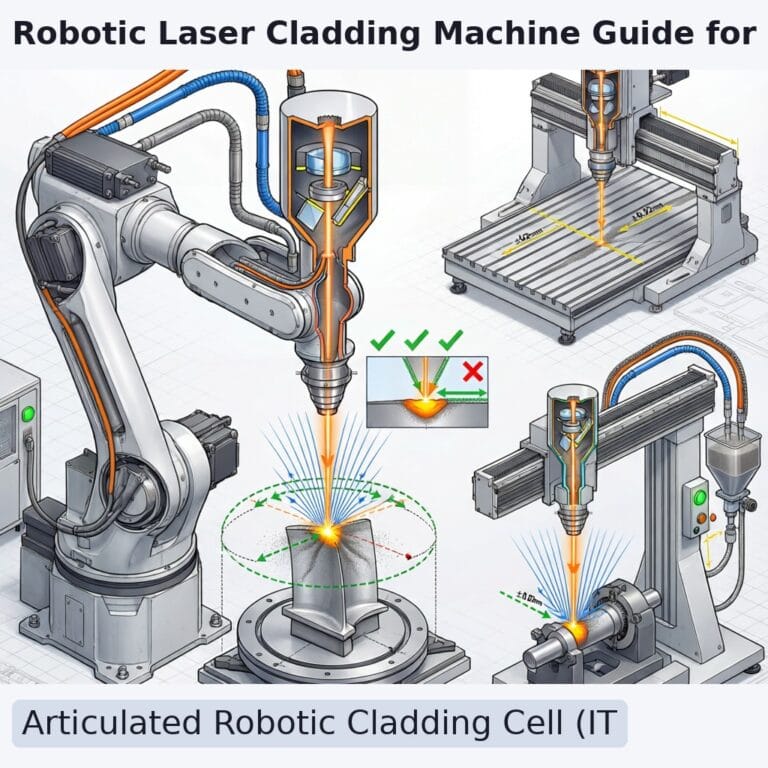
The motion platform defines flexibility and repeatability. Intouch offers three primary configurations within the IT-RF series to address different production scenarios:
Flatbed Systems (IT-RF5018-1)
Ideal for smaller, regular-shaped parts requiring high positional accuracy. These XYZ gantry systems offer repeat positioning accuracy of ±0.02mm within a 500×300×400mm working volume. They excel in batch processing of identical components and precision tooling repair.
Robotic Integration (IT-RF5018-2)
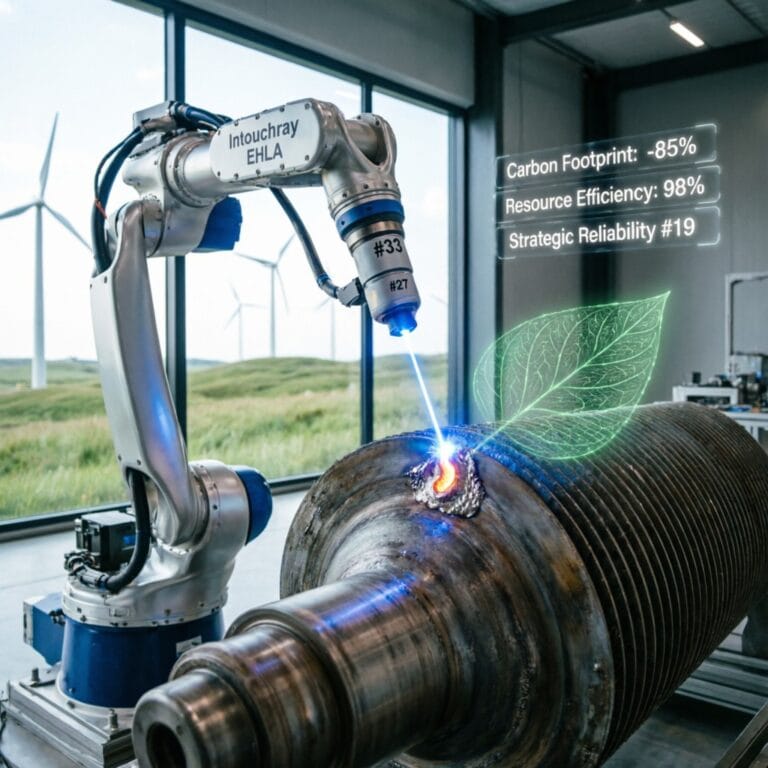
For complex 3D geometries, a 6-axis robot (compatible with Fanuc, Kuka, Yaskawa, or domestic brands) provides the dexterity needed for multi-angle powder feed cladding. Available with 1.8m or 2.0m arms, robotic cells handle turbine blades, impellers, and irregular wear surfaces that flatbeds cannot access.
Large-Scale Custom Systems (IT-RF5018-3)
Heavy industry components exceeding standard envelopes require ground rails and positioners. These custom laser cladding equipment setups support payloads up to 5000kg, enabling in-situ restoration of massive shafts, rollers, and marine propulsion components without disassembly constraints.
Optical Configurations and Spot Profiles
The delivery optic shapes the energy distribution and directly affects clad bead geometry. Different spot profiles serve distinct purposes in laser metal deposition:
- Round Spot (4mm): Standard for general cladding and build-up welding. Provides symmetrical heat distribution for uniform layer deposition.
- Square/Rectangular Spot (10–20mm): Preferred for wide-area laser hardfacing and surface treatment. Rectangular beams enable overlapping passes with consistent hardness and reduced re-melting of adjacent tracks.
- Inner Diameter Heads: Essential for valve seats, pipe interiors, and hydraulic cylinders. These specialized optics redirect the beam at 90° while maintaining powder focus inside confined spaces.
Verify that the supplier offers interchangeable heads or modular optics. Production needs evolve, and a flexible optical train extends the useful life of your laser cladding machine.
Evaluating Total Cost Beyond Purchase Price
Initial capital expenditure is only one component of ownership. Sustainable operation depends on consumable efficiency, energy consumption, and maintenance accessibility.
- Powder Utilization: Efficient coaxial nozzles should achieve high catchment rates. Poor nozzle design wastes expensive alloy powders and increases cleanup time.
- Energy Infrastructure: Higher power lasers demand proportional electrical capacity. Ensure your facility can support the total system draw, including chillers, extractors, and auxiliary equipment.
- Process Stability Features: Closed-loop temperature monitoring and adaptive parameter control reduce scrap rates, especially on heat-sensitive materials. These features add upfront cost but prevent costly rework.
- Support and Training: Verify availability of spare parts, service technicians, and operator training in your region. Downtime waiting for international support erodes ROI faster than any initial savings.
Product Reference
Intouch IT-RF Series Laser Cladding & Hardening Systems:
- IT-RF5018-1: Flatbed XYZ system, 500×300×400mm travel, ±0.02mm repeatability
- IT-RF5018-2: Robotic cell, 1.8m/2.0m arm options, multi-brand robot compatibility
- IT-RF5018-3: Custom large-format system, positioner + ground rail, 5000kg payload
- Power Options: 3kW–12kW fiber laser, 600μm core, QBH interface
- Optics: Round 4mm, Square 10–20mm, Inner cladding (>100mm ID)
- Capabilities: Cladding 0.5–2mm thickness; Hardening 0.5–1mm depth, HRC60+
Frequently Asked Questions
What factors determine the price of a laser cladding machine?
Pricing varies based on laser power (3kW–12kW), automation level (flatbed vs. robotic), optical complexity, and peripheral integration. Request application-specific quotations rather than relying on generic price lists, as customized laser cladding equipment configurations differ significantly from base models.
Can laser metal deposition be used for internal bore hardfacing?
Yes, provided the system includes dedicated inner diameter cladding heads. Intouch IT-RF series supports ID optics for bores exceeding 100mm, enabling powder feed cladding inside valves, cylinders, and pipe fittings with proper powder delivery and shielding gas coverage.
How does laser hardfacing compare to traditional welding for wear resistance?
Laser hardfacing produces lower dilution, finer microstructures, and more consistent hardness (typically HRC60+) compared to conventional arc welding. The concentrated heat source minimizes thermal distortion and preserves substrate properties, making it superior for precision wear surfaces.
What maintenance is required for powder feed cladding systems?
Regular maintenance includes nozzle tip replacement, powder line purging, lens cleaning, and chiller filter changes. Coaxial powder nozzles are wear items; inspect them weekly for erosion or clogging to maintain consistent clad geometry and powder utilization rates.
Contact Intouch
For technical consultation, application testing, or detailed quotations on laser cladding machines, contact our engineering team directly.
Email: info@intouchray.com
Website: www.intouchray.com