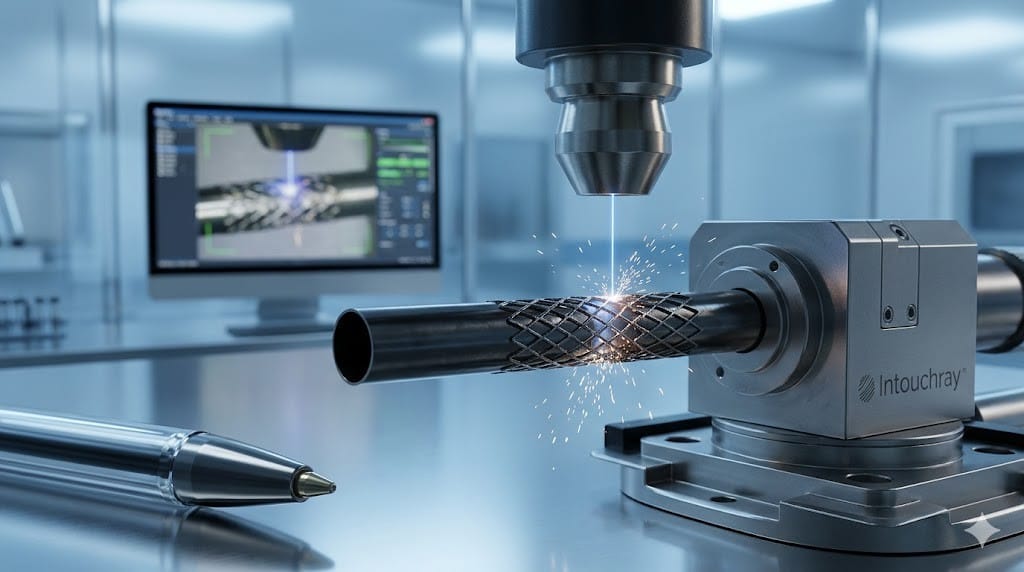
The medical device industry demands a level of precision that transcends standard industrial requirements. When manufacturing life-saving tools such as cardiovascular stents, orthopedic implants, or robotic surgical instruments, the margin for error is non-existent. Traditional mechanical machining often struggles with the microscopic scales and complex geometries required for modern healthcare. This has positioned Fiber Laser Micromachining as the definitive technology for high-stakes medical fabrication.
Intouchray (intouchray.com) brings Noble Precision to the surgical suite. By utilizing ultra-fine beam diameters and sophisticated motion control, we enable the production of instruments that are as reliable as they are precise, ensuring the Strategic Reliability required for human health.
1. Cardiovascular Stents: The Pinnacle of Micromachining
Manufacturing a stent requires cutting intricate mesh patterns into tiny metal tubes (often Nitinol or Cobalt-Chromium) with widths measured in microns.
Kerf Minimization: Fiber lasers produce an incredibly narrow kerf, allowing for the creation of ultra-thin struts that maintain structural integrity while remaining flexible enough for arterial navigation.
Burr-Free Results: The high energy density of the laser vaporizes material so cleanly that post-processing requirements—such as chemical etching or mechanical polishing—are significantly reduced.
2. Surgical Instruments and Robotic End-Effectors
As surgery moves toward minimally invasive and robotic-assisted procedures, the tools must become smaller and more complex.
Complex Geometries: Laser cutting enables the fabrication of micro-hinges, serrated grippers, and needle drivers from high-grade stainless steel with tolerances that mechanical mills cannot achieve.
Material Integrity: The localized heat of the laser ensures that the surrounding material retains its biocompatibility and mechanical properties, which is critical for tools that must withstand repeated sterilization cycles.
3. Orthopedic Implants and Surface Texturing
Beyond cutting, lasers play a vital role in preparing the surface of implants to improve patient outcomes.
Osseointegration: Lasers can be used to create specific micro-textures on the surface of titanium hip or knee replacements, encouraging bone growth and improving the long-term stability of the implant.
Permanent Traceability: Using integrated marking protocols (Article #108), every medical component is engraved with a high-contrast, UDI-compliant (Unique Device Identification) code that survives the harsh environment of the human body and medical sterilization.
Conclusion: Precision for Life
Article #88 illustrates that in the medical field, precision is not just a metric—it is a requirement for safety. By mastering the microscopic, Intouchray technology helps bridge the gap between engineering and biology. In Article #89, we return to the macro scale: Electrical Cabinets: High-Volume Sheet Metal Fabrication
Image Attachment