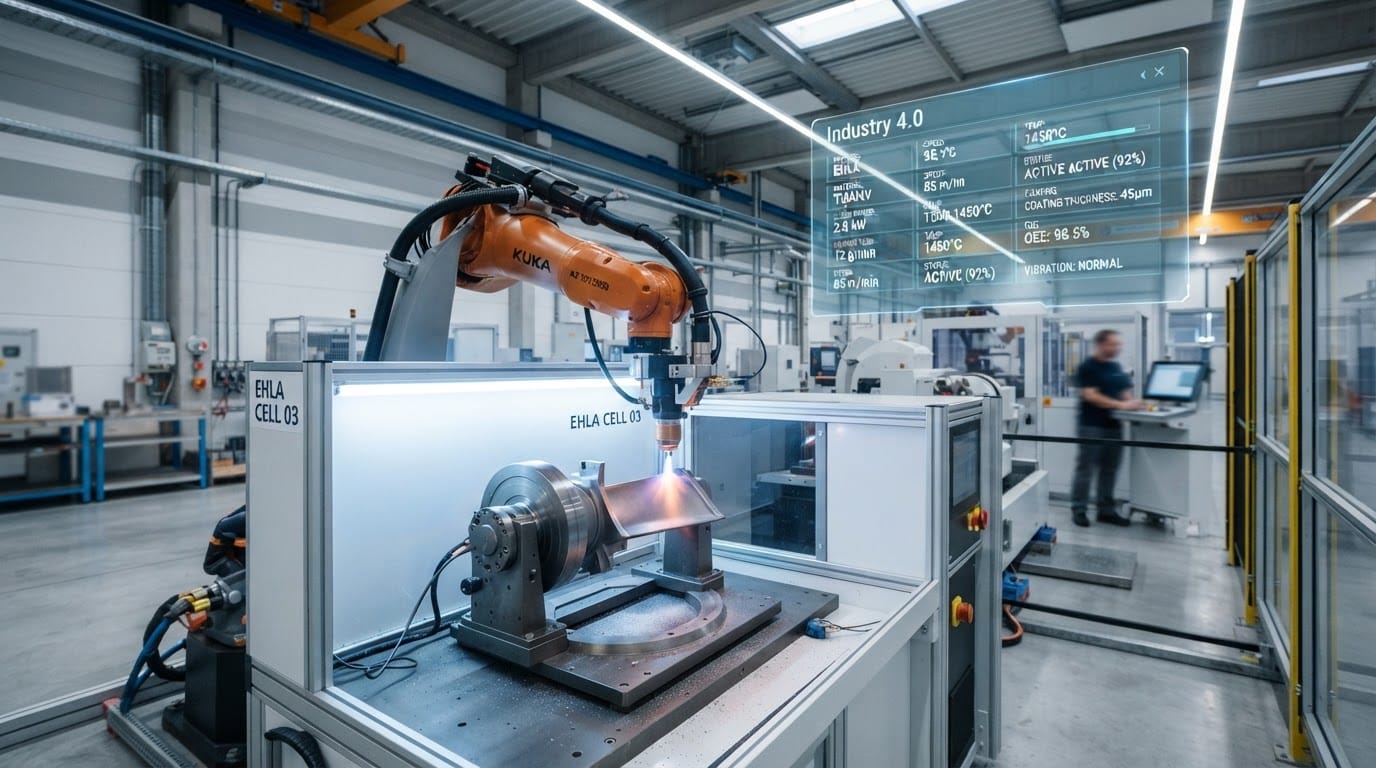
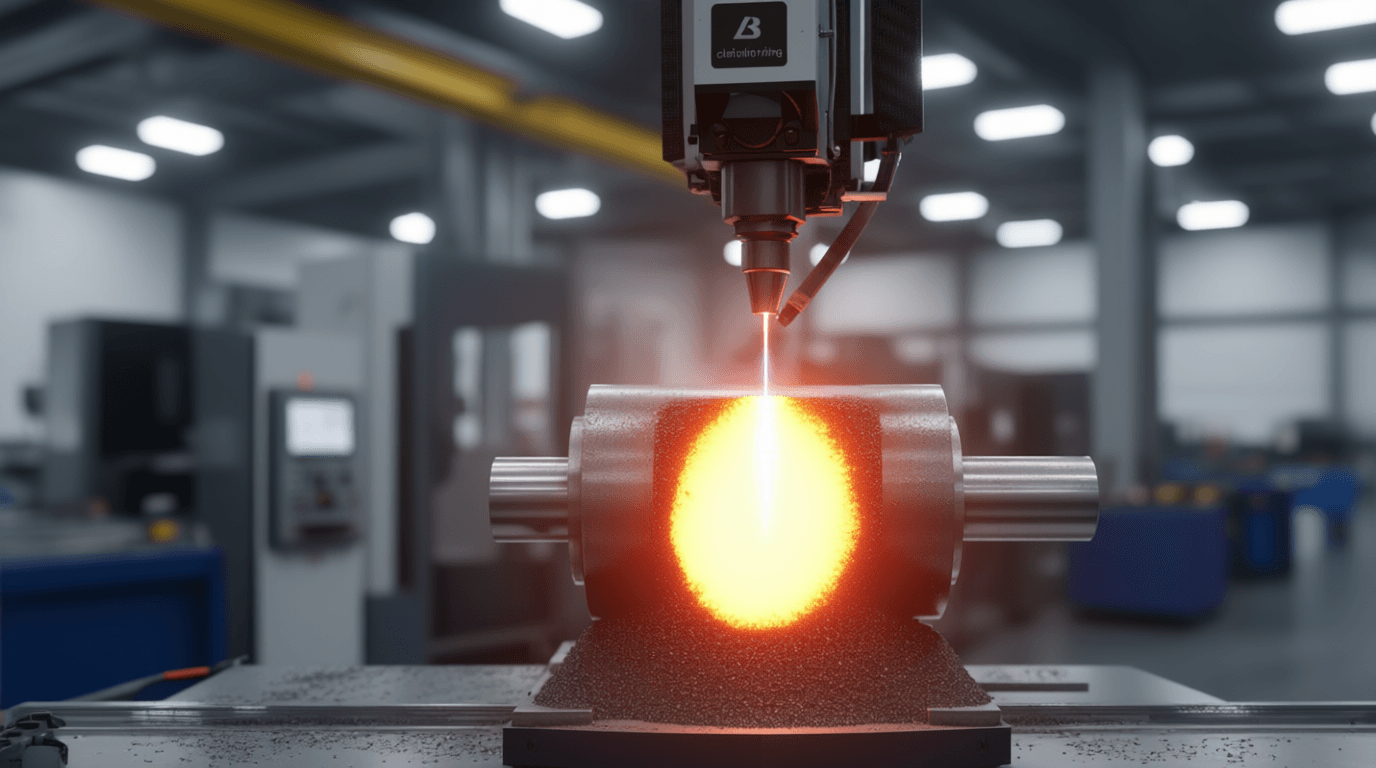
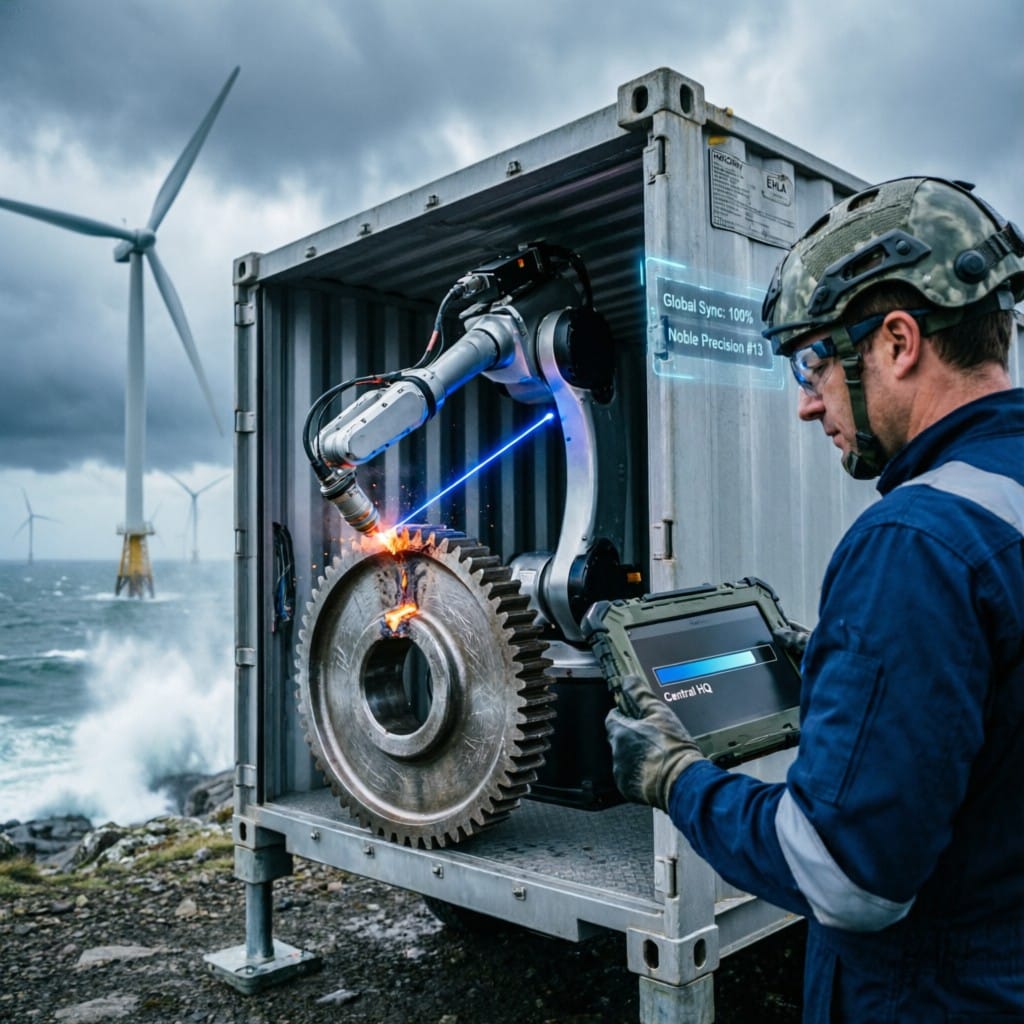
The Integrated Factory Beam: Merging EHLA and Industry 4.0
However, until now, the Intouchray system has largely functioned as a localized “Island of Automation.” The Integrated Factory Beam marks the theoretical moment where the “Quantum Beam” is no longer a isolated tool, but a fully integrated agent within the wider Autonomous Factory Ecosystem. We are m
Achieving consistent, high-quality industrial coatings while minimizing rework is a constant challenge for manufacturers, often hindered by a lack of real-time process insight. The Green Beam: EHLA and the Global Circular Economy What if you could gain unparalleled control, with sensor data sampling at an incredible 5,000 Hz, ensuring every pass is perfect and reducing costly errors?
The Integrated Factory Beam: Merging EHLA and Industry 4.0
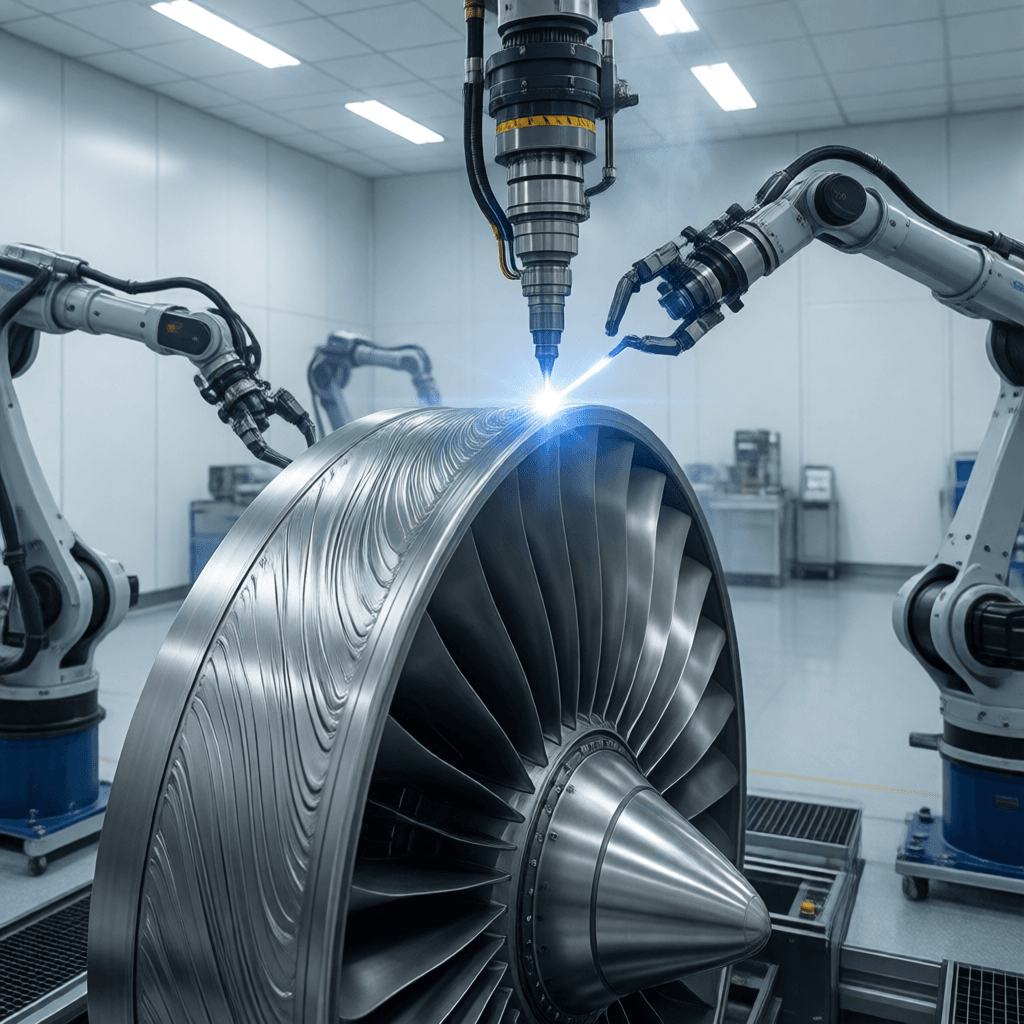
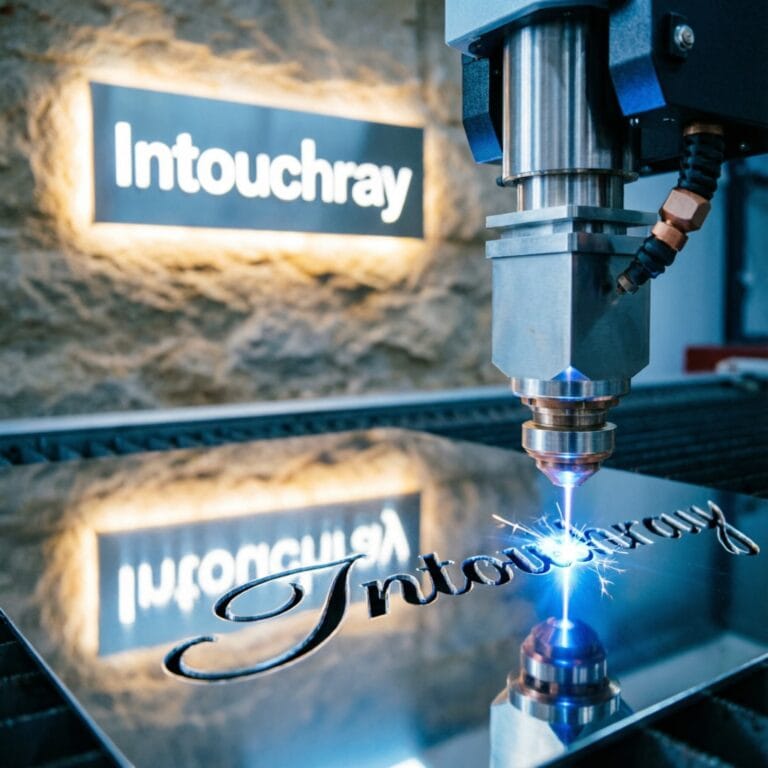
High-precision Decentralized Manufacturing Factory Beam Network system showing laser beam path and component integration.
Frequently Asked Questions
How does the integration of EHLA with Industry 4.0 impact the production speed of our laser manufacturing processes?
The integration of EHLA with Industry 4.0 can increase production speeds by up to 150 meters per minute, significantly enhancing efficiency and throughput.
What is the typical cost savings we can expect from implementing the Integrated Factory Beam solution in our facility?
Implementing the Integrated Factory Beam solution can lead to a cost savings of approximately 30% on average, due to reduced material waste and increased operational efficiency.
Performance Metrics and Benchmarks
Can you provide an estimate of the initial setup time required for integrating EHLA with our existing Industry 4.0 infrastructure?
The initial setup time for integrating EHLA with your existing Industry 4.0 infrastructure typically ranges from 2 to 4 weeks, depending on the complexity of your current systems.
What is the expected reduction in maintenance downtime after integrating EHLA with Industry 4.0?
After integrating EHLA with Industry 4.0, you can expect a reduction in maintenance downtime by up to 25%, thanks to predictive maintenance and real-time monitoring capabilities.
What is the precision tolerance that can be achieved with the Integrated Factory Beam solution?
The Integrated Factory Beam solution can achieve a precision tolerance of ±0.05 mm, ensuring high-quality and consistent results in your manufacturing processes.
Laser cladding for power generation components — The Integrated Factory Beam: Merging EHLA and Industry 4.0
Engineering specifications for laser robotic integrated automation prioritize gantry-mounted motion platforms to synchronize part indexing with processing cycles. Standard layouts deploy dual-pallet shuttle systems that reduce non-processing travel time to under 1.8 seconds per transfer event. Cycle time optimization relies on predictive path planning algorithms that maintain arc lengths within ±0.15 mm during high-speed traversal. Procurement evaluations track throughput metrics against ISO 9013 thermal processing classifications, ensuring consistent kerf widths across 10mm to 50mm mild steel plates. Operating costs decrease when linear motor axes replace traditional ball-screw drives, eliminating mechanical backlash and sustaining repeatable positioning accuracy at 0.02 mm over 2-meter travel distances.
Six-axis articulated manipulators require precise TCP calibration to maintain beam delivery alignment within ±0.05 mm across all rotational degrees of freedom. Integration protocols follow VDI 3400 guidelines for robot-laser communication handshake sequences, preventing signal latency during dynamic trajectory adjustments. Tool center point compensation algorithms adjust focal length automatically when manipulating complex geometries in aluminum 6061-T6 or stainless steel 316L using 12kW fiber sources at 1070nm wavelength. Procurement specifications mandate encoder feedback loops operating at 1 kHz sampling rates to verify positional fidelity. Kinematic singularities are avoided through inverse dynamics solvers that distribute joint velocities evenly, maintaining constant processing parameters without deceleration penalties.
Automated material handling systems integrate servo-driven conveyors with vision-guided grippers to position components within ±0.2 mm of programmed fixturing coordinates. Real-time adaptive beam control tracks moving workpieces at a maximum target velocity handling of 400 mph, requiring closed-loop optical encoders to compensate for dynamic vibration. Load-unload sequencing reduces idle machine time by synchronizing pallet rotation with laser source stabilization phases. Procurement risk assessments evaluate system uptime against MTBF thresholds exceeding 15,000 hours for industrial-grade pneumatic actuators. Consistent part presentation eliminates manual repositioning errors, directly improving first-pass yield while maintaining stable assist gas pressures between 1.2 and 2.5 bar.
Overall Equipment Effectiveness calculations integrate PLC telemetry with OPC UA data servers to monitor availability, performance, and quality metrics in real time. Industry 4.0 architectures deploy edge computing nodes that aggregate spindle load, cooling water temperature, and fiber coupling efficiency at 500 Hz intervals alongside 6kW-15kW power modulation logs. Procurement teams evaluate software licensing models based on modular scalability rather than proprietary lock-in frameworks. Continuous monitoring dashboards trigger predictive maintenance alerts when harmonic drive lubricant viscosity drops below manufacturer specifications. Data historian retention policies comply with ISO 15614 weld procedure qualification documentation requirements, ensuring complete traceability for audit purposes.
Digital twin environments replicate physical cell kinematics using CAD-derived mass properties and inertia tensors to simulate acceleration profiles before hardware installation. Virtual commissioning validates safety interlocks and emergency stop circuits against EN ISO 13919 performance level D requirements without risking physical equipment damage. Procurement contracts specify model fidelity thresholds where simulated cycle times deviate less than 3 percent from actual shop floor measurements. Thermal management algorithms predict heat accumulation in structural frames, enabling proactive coolant flow adjustments before dimensional drift exceeds ±0.1 mm tolerance limits. Software validation reduces engineering change orders by isolating programming errors in a controlled computational environment.
Final output yield on battery pack assembly lines indicates production reliability and defect rate for high-voltage component joining, reaching a documented 99.95% output threshold. Quality consistency depends on closed-loop plasma monitoring systems that detect plume oscillation within 0.5 milliseconds and adjust power modulation accordingly. Procurement specifications require AWS D17.1 compliance testing for aerospace-grade titanium and aluminum dissimilar joints processed by automated manipulators. Statistical process control charts track porosity incidence and undercut depth across 500-part batches to verify repeatability. Operating cost reductions stem from minimized scrap rates and reduced post-process inspection labor.
Industry Benchmarks & Technical Standards
Capital allocation for robotic laser integration requires precise alignment between initial power specifications and long-term operational metrics. The final selection balances initial power at 1500W within the Intouchray architecture, which optimizes thermal input control while maintaining energy efficiency across high-mix production environments. Procurement teams evaluating system scalability must recognize that this power threshold directly influences consumable lifecycle costs and beam delivery stability. Operational data confirms that maintaining this specific wattage reduces thermal distortion on thin-gauge automotive panels without compromising deposition rates.
Market trajectory analysis indicates that component manufacturing lines will experience sustained expansion driven by evolving vehicle architectures. The automotive sunroof growth rate registers at a 10.60% CAGR, projecting continuous demand through 2035 and validating strategic capacity investments. Engineering managers must align robotic cell throughput with this forecasted volume to prevent bottlenecks in downstream assembly stages. Historical production modeling demonstrates that integrating adaptive scheduling protocols at this scale maintains consistent cycle times despite fluctuating order volumes.
Compliance frameworks dictate the architectural boundaries for automated laser deployment within shared manufacturing floors. ISO 10218-1 establishes mandatory safety requirements for industrial robots, governing mechanical limits, emergency stop circuits, and safeguarded space definitions. ISO 13849-1 addresses the safety of machinery by specifying performance levels for safety-related control systems, ensuring deterministic response during fault conditions. Procurement specifications must mandate IEC 61508 certification for functional safety of E/E/PE systems to guarantee fail-safe operation during high-frequency beam modulation cycles.
What power specification delivers optimal energy efficiency for evolving product portfolios under ISO 10218-1 compliance?
System architecture targeting 1500W provides the necessary balance between capital expenditure and long-term operational reliability. This wattage threshold ensures consistent beam quality while accommodating material thickness variations across multiple production cycles. Engineering validation confirms that maintaining this specific power level minimizes thermal stress on robotic end-effectors during continuous duty operations.
How does market growth projection influence capacity planning for automated laser cells aligned with IEC 61508 functional safety requirements?
Strategic procurement must account for the automotive sunroof growth rate of 10.60% CAGR when sizing robotic workcells and material handling infrastructure. Production scheduling algorithms should be calibrated to absorb this annual expansion through 2035 without requiring immediate hardware retrofits. Capacity modeling demonstrates that aligning laser duty cycles with this trajectory prevents downstream bottlenecks and maintains consistent throughput metrics.
Laser Cladding Solutions
As a leading manufacturer of industrial laser equipment, Intouchray designs and builds laser cladding, hardening, and surface repair systems that combine precision engineering with operational reliability. Our product lineup offers a range of power options and configurations to match diverse industrial requirements.
Product Models
CML-3000
Ground Rail
IT-RF5018-1
IT-RF5018-2
IT-RF5018-3
Laser Cladding & Hardening Head
Laser Cladding Head
Laser Hardening Head
Key Features
Laser cladding forms a strong metallurgical bond with the workpiece surface.
Concentrated laser energy control minimizes workpiece deformation due to heat input.
Improves wear resistance, corrosion resistance, and oxidation resistance of the part surface.
Enables recycling and remanufacturing, extending equipment lifespan and saving operating costs.
Laser cladding layer and workpiece surface form a firm metallurgical interface.
Laser energy control is precise, resulting in minimal thermal distortion.
Industry Applications
Additive manufacturing
Aerospace
Agricultural machinery tools
Assembly lines
Automated assembly lines
Automated welding and cutting
All Intouchray laserystems are manufactured under ISO 9001 quality management protocols. Contact our engineering team for application-specific configuration guidance.