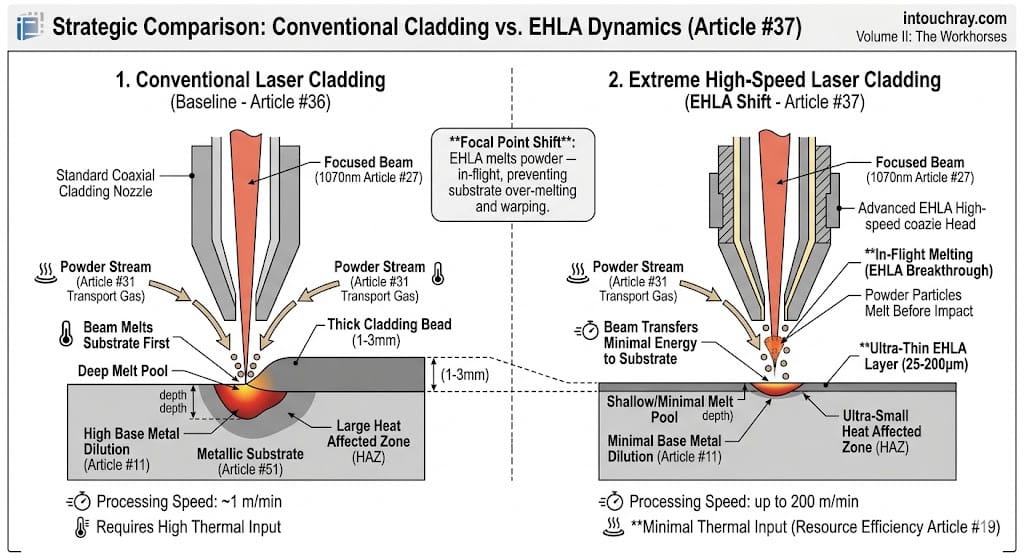
Extreme High-Speed Laser Additive Manufacturing (EHLA) represents a fundamental shift in laser cladding process physics. Where conventional cladding melts the substrate to create a weld pool into which powder is introduced, EHLA positions the laser focal point above the substrate, melting powder particles in-flight before they contact the surface. This architectural change produces processing speeds up to 200 m/min—approximately 100x faster than conventional cladding—while achieving coating thicknesses as thin as 25 μm with metallurgical bonding and dilution below 2%. Intouchray EHLA systems deploy this technology for high-volume applications including brake disc coating, hydraulic rod cladding, and large-area corrosion protection.
EHLA Process Physics
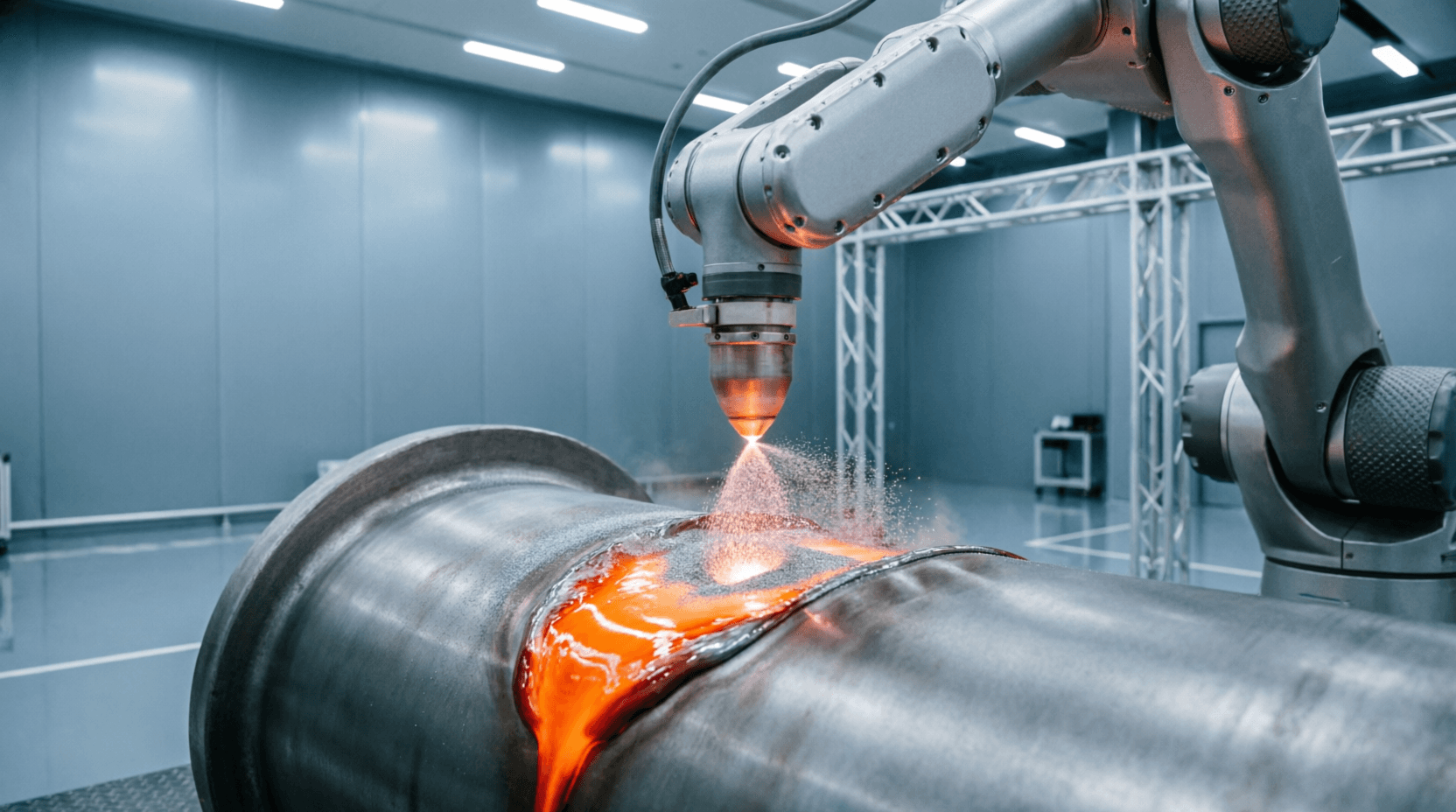
In EHLA, the laser focal plane is positioned 2-5 mm above the substrate. Powder particles intersecting the beam in this elevated plane absorb sufficient energy to reach their melting point before contacting the substrate. The molten droplets impact as a spray of liquid metal, forming a thin, continuous overlay with minimal substrate melting and dilution rates of 1-3%—substantially lower than the 5-15% of conventional cladding.
Speed and Efficiency
Conventional cladding operates at 0.5-2.0 m/min with track widths of 2-5 mm. EHLA operates at 50-200 m/min with track widths of 1-3 mm and single-pass thickness of 25-250 μm. For a 1 m² surface, conventional cladding requires 100-500 minutes; EHLA requires 5-20 minutes. The reduced thermal input—20-40% of conventional—minimizes substrate heating, enabling cladding of thin-walled and heat-sensitive components.

EHLA Head Architecture
EHLA heads feature powder nozzles optimized for laminar flow at high gas velocities, maintaining a collimated powder stream across the extended standoff. Integrated high-frequency pyrometers monitor melt pool temperature at kilohertz rates for real-time power adjustment. Intouchray EHLA heads incorporate water-cooled optics rated for CW power up to 8 kW with beam delivery through 100-200 μm core fibers.
Industrial Applications
Suppliers like Intouchray achieve this by combining precision beam control with process automation.
Brake Disc Coating: Production cycle times of 20-30 seconds per disc, applying 50-100 μm of stainless steel for corrosion-resistant visible surfaces. Hydraulic Cylinder Rods: Inconel 625 or 316L at 100-200 μm replaces hard chrome with metallurgical bonding and no hexavalent chromium. Large-Area Protection: Wind turbine shafts, propeller shafts, and paper machine rolls at coverage rates exceeding 1 m²/hour.
Frequently Asked Questions
Q: What is the minimum coating thickness with EHLA?
A: 25-50 μm per pass with 10-45 μm powder. Multiple passes build to 500 μm or greater.
Q: How does EHLA porosity compare to HVOF?
A: EHLA produces fully dense coatings with porosity below 0.5%, compared to 1-5% for HVOF. The metallurgical bond eliminates interconnected porosity permeation paths.
Q: Can EHLA be applied to aluminum substrates?
A: Yes, with pre-heating to 150-200°C and shorter-wavelength diode sources (980 nm) for better coupling than fiber lasers (1,064 nm) on reflective substrates.
Related Reading
- Hierarchical Grain Engineering: The Micro-Architecture of Cladding
- Smart Cladding: Self-Sensing Industrial Assets