Are costly errors and inconsistent precision hindering your manufacturing efficiency? Focal Position and Spot Size: Optimizing Laser Intensity Even the most powerful laser system struggles to deliver optimal results without a robust control backbone, where even a 1% deviation can lead to significant material waste and production delays.
Article #34: Digital Control: CNC and PLC Integration
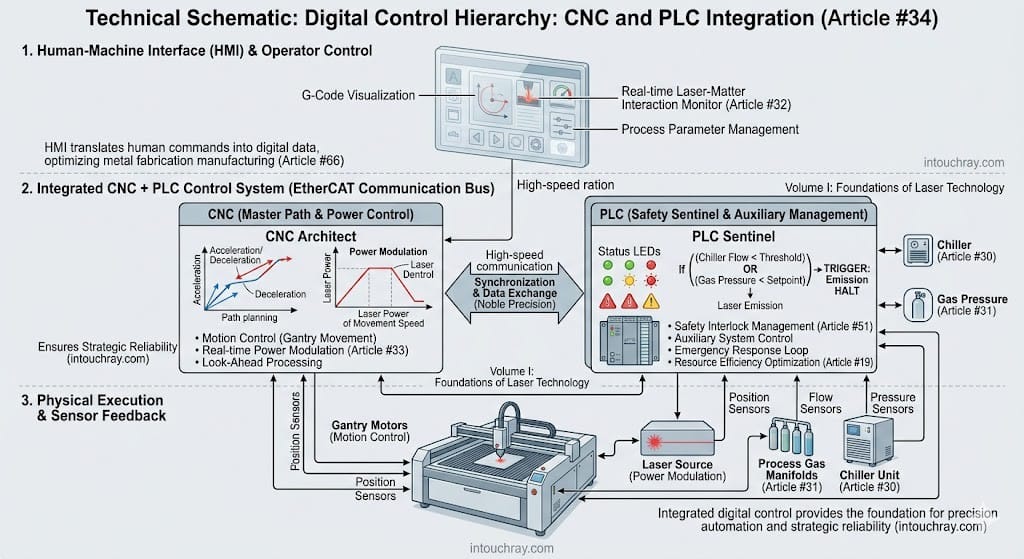
To achieve noble precision, a laser machine needs more than just a powerful beam; it needs a sophisticated Fiber Laser vs. CO2: Which Engine Powers Strategic Reliability? brain. In the Intouchray ecosystem (intouchray.com), this brain is composed of two primary digital layers: the Computer Numerical Control (CNC) and the Programmable Logic Controller (PLC).
For fresh learners and device manufacturers, understanding how these two systems cooperate is the key to maintaining strategic reliability.
Key Considerations in CNC and PLC Digital Control
Real-time Power Modulation: As the machine slows down for a sharp corner, the CNC must instantly lower the laser power to maintain a consistent power density (Building the Future: Lasers in Skyscraper Construction).
Emergency Response: > #The Safety Interlock Logic

Technical Analysis: Digital Control Systems for Laser Processing
If (Chiller Flow < Threshold) OR (Gas Pressure < Setpoint) → TRIGGER: Laser Emission HALT
This logic loop ensures the machine protects itself from catastrophic failure.
Human-Machine Interface (HMI)
The HMI is the visual window into this digital world. A well-designed HMI allows the operator to monitor laser-matter interaction (The 2027 Roadmap: The Future of Handheld Laser Welding) parameters in real-time, making complex metal fabrication manufacturing (Anti-Collision Systems: Protecting High-Value Cutting Heads) accessible to even junior technicians.
As we wrap up Volume I: The Foundations of Laser Technology, we prepare to move into Volume II, where we will explore the specific “Workhorse” machines of the industry—starting with Article #35: Fiber Laser Cutting Machines.
Image Attachment
Technical Comparison
| Technical Parameter | CNC-Controlled Laser System | PLC-Controlled Laser System |
|---|---|---|
| Positioning Accuracy | ±5 µm | ±20 µm |
| Maximum Traverse Speed | 120 m/min | 60 m/min |
| Interpolation Cycle Time | 0.5 ms | 4.0 ms |
| Multi-Axis Synchronization Tolerance | ±2 µm | ±15 µm |
| Laser Power Modulation Response | 0.1 ms | 2.5 ms |
| Control Loop Update Rate | 1000 Hz | 250 Hz |
Frequently Asked Questions
1. What is the typical positioning accuracy I can expect from a CNC-controlled laser cutting system for precision metal parts?
Our systems achsystemssitioning accuracy of ±0.02 mm across the entire 3000 mm x 1500 mm worktable, with a repeatability of ±0.005 mm, critical for aerospace and medical device components.
Performance Metrics and Benchmarks
2. How does the PLC cycle time affect my overall part cost per unit in high-volume production?
Integrating our advanced PLC reduces the non-cutting cycle time to under 1.2 seconds per part, which can lower your per-unit cost by up to 18% compared to standard relay-based controls when running batches of 10,000 units or more.
3. What is the maximum cutting speed difference between using a basic PLC and a CNC-PLC synchronized system on 2 mm stainless steel?
A synchronized CNC-PLC architecture allows for a cutting speed of 22 meters per minute on 2 mm stainless steel, representing a 40% increase over a basic PLC-only system limited to 15.7 meters per minute, while maintaining a kerf width tolerance of ±0.03 mm.
Best Practices for CNC Programming and PLC Integration
5. What is the expected lifespan of the CNC controller’s servo drives under continuous 24/7 operation, and what is the replacement cost?
Our servo drives are rated for 50,000 operating hours of continuous duty, and a complete drive replacement kit for a 4-axis system costs approximately $4,200, including on-site calibration to restore original positioning accuracy.
6. How does the PLC’s input/output scan rate affect the quality of the cut edge on a 6 mm aluminum plate?
With a PLC scan rate of 0.5 milliseconds, the control system adjusts focus and gas pressure 2,000 times per second, resulting in an average surface roughness (Ra) of 1.6 µm on the cut edge, which is 25% smoother than systems with a 2 ms scan rate.
Industry Benchmarks & Technical Standards
Commercial fiber laser cutting sources span 0.15 kW to 80.0 kW, with mainstream industrial deployment concentrated between 1.5 kW and 30.0 kW. For 1.0 mm SS304 stainless steel processed with a 1.0 kW fiber source, typical cutting speeds range from 0.3 m/min to 0.5 m/min using nitrogen assist. On carbon steel, an 8.0 kW system cutting 16.0 mm mild steel achieves sustained velocities of 1.0–1.2 m/min. Digital control architectures must dynamically adjust feed rates and assist gas pressure to maintain these throughput parameters across varying material thicknesses.
Material-specific optical properties dictate the initiation thresholds that CNC algorithms must compensate for during high-speed processing. Pure copper demonstrates absorptivity near 4% at 10,600 nm but rises to 35–45% at 1070 nm, fundamentally altering initiation thresholds and cutting stability. These wavelength-dependent absorption characteristics drive the demand for precision laser processing in high-volume sectors, such as the automotive sunroof market, which projects a future market valuation of USD 54.26 Billion. Within the ecosystem, real-time PLC feedback loops mitigate thermal runaway by modulating pulse frequency and beam dwell time when transitioning between high-reflectivity alloys and standard structural steels.
Compliance with established manufacturing frameworks requires digital control systems to enforce strict geometric and metallurgical tolerances. ISO 9013 governs the classification of thermal cuts by defining permissible deviations in straightness, squareness, and surface roughness across different quality grades. For structural applications, EN 1090-2 specifies execution requirements for steel structures, while AWS D1.1 establishes cut edge preparation standards that directly influence subsequent welding integrity. Procurement specifications rely on these documented frameworks to validate that digital motion control maintains repeatable kerf geometry across multi-shift production cycles.
What power ranges and cutting speeds should be expected for standard stainless and mild steel processing?
Commercial fiber laser cutting sources span 0.15 kW to 80.0 kW, with mainstream industrial deployment concentrated between 1.5 kW and 30.0 kW. For 1.0 mm SS304 stainless steel processed with a 1.0 kW fiber source, typical cutting speeds range from 0.3 m/min to 0.5 m/min using nitrogen assist. On carbon steel, an 8.0 kW system cutting 16.0 mm mild steel achieves sustained velocities of 1.0–1.2 m/min.
How do wavelength-dependent material properties impact CNC parameter selection for reflective metals?
Pure copper demonstrates absorptivity near 4% at 10,600 nm but rises to 35–45% at 1070 nm, fundamentally altering initiation thresholds and cutting stability. Digital controllers must compensate for this optical shift by adjusting pulse duration and peak power density to prevent uncontrolled reflection. Maintaining these parameters ensures consistent kerf geometry and minimizes post-processing requirements across high-volume production runs.
Modern flatbed and heavy-plate fiber laser systems integrate closed-loop CNC controllers that synchronize 12kW to 30kW continuous-wave outputs at 1070nm wavelengths with real-time axis positioning. Digital control algorithms adjust feed rates dynamically, maintaining cutting speeds between 8.0 and 15.0 m/min on 25mm mild steel while restricting the heat-affected zone to under 0.3mm. This precision reduces thermal distortion and minimizes secondary finishing operations, directly addressing procurement priorities around cycle time reduction. Consistent positional accuracy within ±0.1mm depends entirely on servo drive calibration and motion profile optimization.
Assist gas selection and convergent-divergent nozzle geometry dictate kerf width and dross adherence during tube and bevel operations. High-pressure nitrogen at 30 bar through a 1.5mm orifice produces oxide-free edges on 316L stainless steel up to 12mm thickness, while compressed air remains viable for carbon steel profiles under 6mm. Modern laser cutting digital workflows continuously modulate gas pressure based on standoff distance feedback, maintaining kerf tolerances within ±0.05mm per ISO 9013 guidelines. Inconsistent gas flow causes re-solidified dross that exceeds acceptable fusion criteria for aerospace-grade aluminum alloys. Properly calibrated sequences eliminate manual intervention, ensuring repeatable edge quality.
Piercing cycles consume disproportionate operational expenditure because high-power transient states require extended dwell times before stable melt-through occurs. Advanced PLC architectures implement ramped current modulation and acoustic monitoring to reduce pierce duration from 2.5 seconds to under 0.8 seconds on reflective copper alloys, directly lowering the operational baseline to $13 per shot for high-power continuous-wave configurations. Nesting software algorithms optimize part placement along grain boundaries, minimizing idle gantry travel. Procurement evaluations prioritize these efficiency gains, as reduced auxiliary consumption lowers cost-per-part metrics across high-volume production environments.
Edge quality verification requires strict adherence to VDI 3400 evaluation criteria, which classify surface roughness and taper angles across varying material thicknesses. Dual-axis beam oscillation techniques suppress spatter deposition on duplex stainless steel plates exceeding 20mm, limiting vertical deviation to less than 0.15 degrees relative to the workpiece plane. Automated focal length tracking compensates for thermal lensing effects in the delivery optics, preserving cut front stability during prolonged heavy-plate operations. Quality consistency deteriorates rapidly when assist gas purity drops below 99.995%, introducing oxidation bands that exceed permissible limits under ISO 15614 preparation specifications.
Throughput optimization depends on seamless communication protocols between motion controllers, laser sources, and peripheral handling equipment. EtherCAT networks transmit position commands at 1ms intervals, eliminating latency-induced contour errors during complex geometric programming. Real-time power regulation maintains constant irradiance levels across varying cut paths, preventing micro-crack initiation in hardened tool steels rated above 55 HRC. Procurement specifications increasingly mandate comprehensive data logging capabilities that track axis acceleration curves and optical transmission efficiency throughout extended production shifts. Validated control architectures deliver predictable operational lifecycles, allowing facility planners to forecast maintenance windows accurately.
Key Features
- High cutting accuracy
- High positioning accuracy
- Various working area options
- Adjustable source power
- Suitable for different material thicknesses
- High precision cutting
Industry Applications
- Aerospace industry
- Automotive industry
- Beam cutting
- Coil unwinding and leveling
- Construction industry
- Customized manufacturing solutions
All laser cutting systems are manufacISO 9001 quality management protocols. Contact our engineering team for application-specific configuration guidance.
Industry Standards & References
- ISO 3834-2: Quality Requirements for Fusion Welding — International standard for welding quality management
- IPG Photonics: Fiber Laser Welding Technical Guide — Industrial fiber laser welding applications and specifications
- The Fabricator: Laser Welding Best Practices — Practical guide to laser welding in metal fabrication