Laser-Matter Interaction: Absorption, Reflection, and Transmission
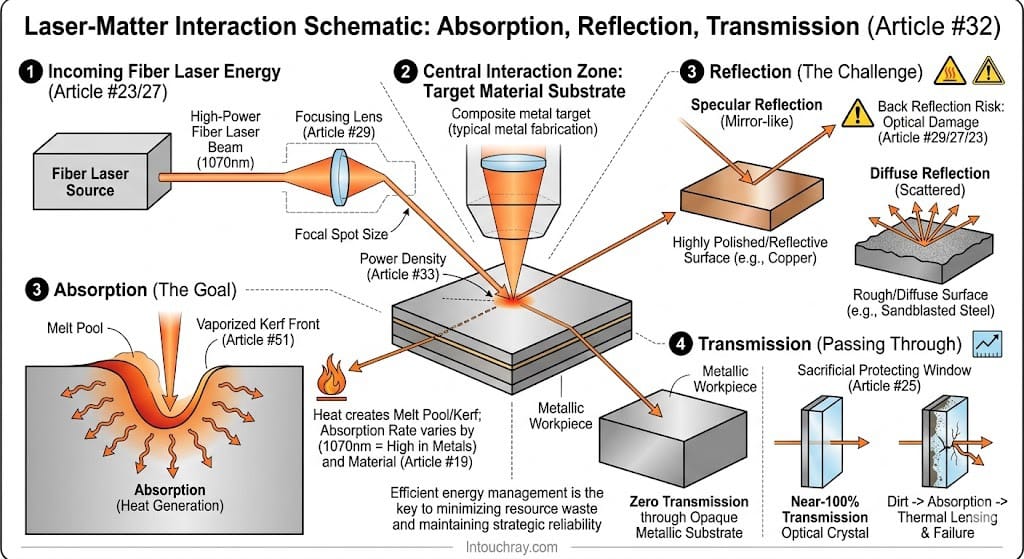
In the world of industrial laser material processing (Article #26), the laser beam is simply a tool for delivering energy. How that energy is received by the material is governed by three physical phenomena: Absorption, Reflection, and Transmission. For fresh learners and device manufacturers, mastering these concepts is essential for achieving noble precision and maintaining the strategic reliability of your Intouchray system (intouchray.com).
- Absorption: The Goal of Processing
Absorption is the process by which light energy is converted into heat within the material. This heat is what creates the melt pool for laser cladding (Article #36) or the kerf for laser cutting (Article #51).
The rate of absorption depends heavily on the laser’s wavelength. The 1070nm (1.07µm) wavelength of a high-power fiber laser is absorbed much more efficiently by metals like steel and stainless steel than the 10.6µm wavelength of older CO2 lasers. This high absorption rate is why fiber lasers can cut thin sheets at significantly higher speeds with lower power consumption, enhancing your resource efficiency (Article #19).
- Reflection: The Fabricator’s Challenge
Reflection occurs when the laser energy bounces off the material surface instead of entering it.
Specular Reflection: Light bounces off like a mirror. This is common when processing highly polished surfaces.
Diffuse Reflection: Light scatters in many directions. This occurs on rougher surfaces like sandblasted steel.
High-reflectivity metals—specifically Copper, Brass, and Aluminum—pose a unique challenge. In the early stages of a cut, these materials can reflect up to 95% of the laser’s energy. If this reflected light travels back through the laser optics (Article #29) and into the fiber cable, it can cause catastrophic damage. Intouchray systems (intouchray.com) utilize advanced back-reflection protection and high-brightness sources to overcome this barrier, ensuring strategic reliability even when processing the most difficult alloys.
- Transmission: Passing Through
Transmission occurs when the laser energy passes through a material without being absorbed or reflected. While metals are opaque and have zero transmission at the 1070nm wavelength, transmission is vital for your auxiliary systems.
Protecting Windows: The sacrificial protecting window (Article #25) must have near-100% transmission. If it becomes dirty or pitted, it begins to absorb energy, causing it to heat up and eventually shatter—a phenomenon known as “thermal lensing.”
- Impact on Cutting and Cladding
The interaction changes as the process begins:
In Laser Cutting: Once the material is pierced and a “keyhole” or melt front is established, the absorption rate increases dramatically because the light “traps” itself within the geometry. This is why a laser needs more power to start a cut than it does to maintain it.
In Laser Cladding: Since we are often working with powder transport (Article #31), the laser must interact with both the moving powder stream and the substrate simultaneously. Balancing the energy absorbed by the powder versus the substrate is the key to a perfect metallurgical bond (Article #11).
Conclusion: Engineering Energy Transfer
Success in metal fabrication manufacturing (Article #66) is about managing energy. By choosing the right wavelength (Fiber) and optimizing your parameters to maximize absorption while minimizing dangerous reflections, you ensure a process built for noble precision. As we move to Article #33, we will look at how we focus this energy into a single, intense point: the science of Power Density.
Image Attachment