Beam Quality and Power Density: The Science of Laser Focus
For consistent, high-quality cuts on stainless steel and aluminum up to 10 mm thick, we recommend an M² factor of 1.1 or lower. A beam with M² = 1.2 will produce a kerf width variation of approximately ±0.02 mm, which can lead to dimensional rejection in tight-tolerance automotive parts. Doubling th
In industrial laser material processing (Article #26), we don’t just care about total wattage; we care about intensity. We must understand how to concentrate photons into a microscopic area. This concentration is defined as Power Density, and it is dictated by the quality of the beam and the precision of the laser optics (Laser Spot Welding: A High-Speed Resistance Welding Alternative).
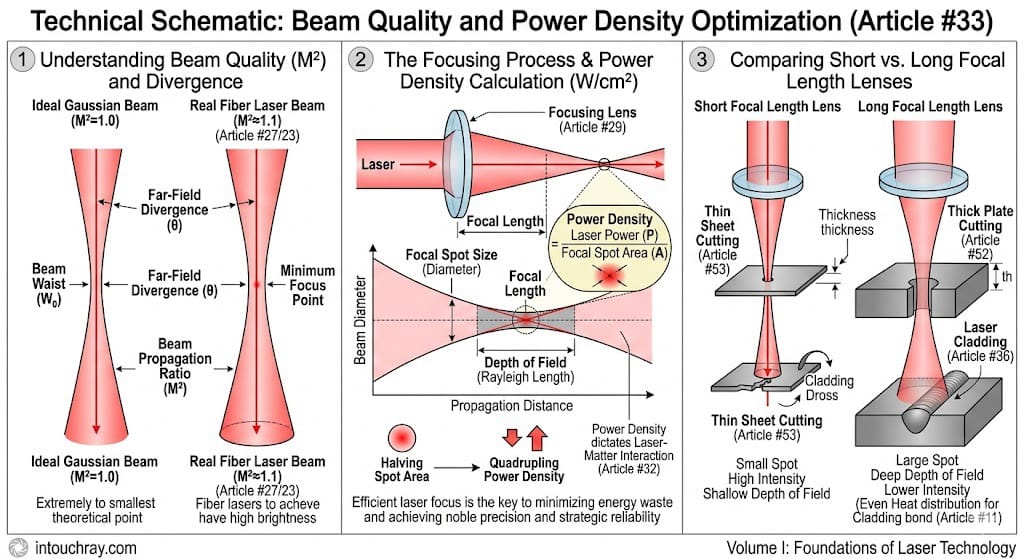
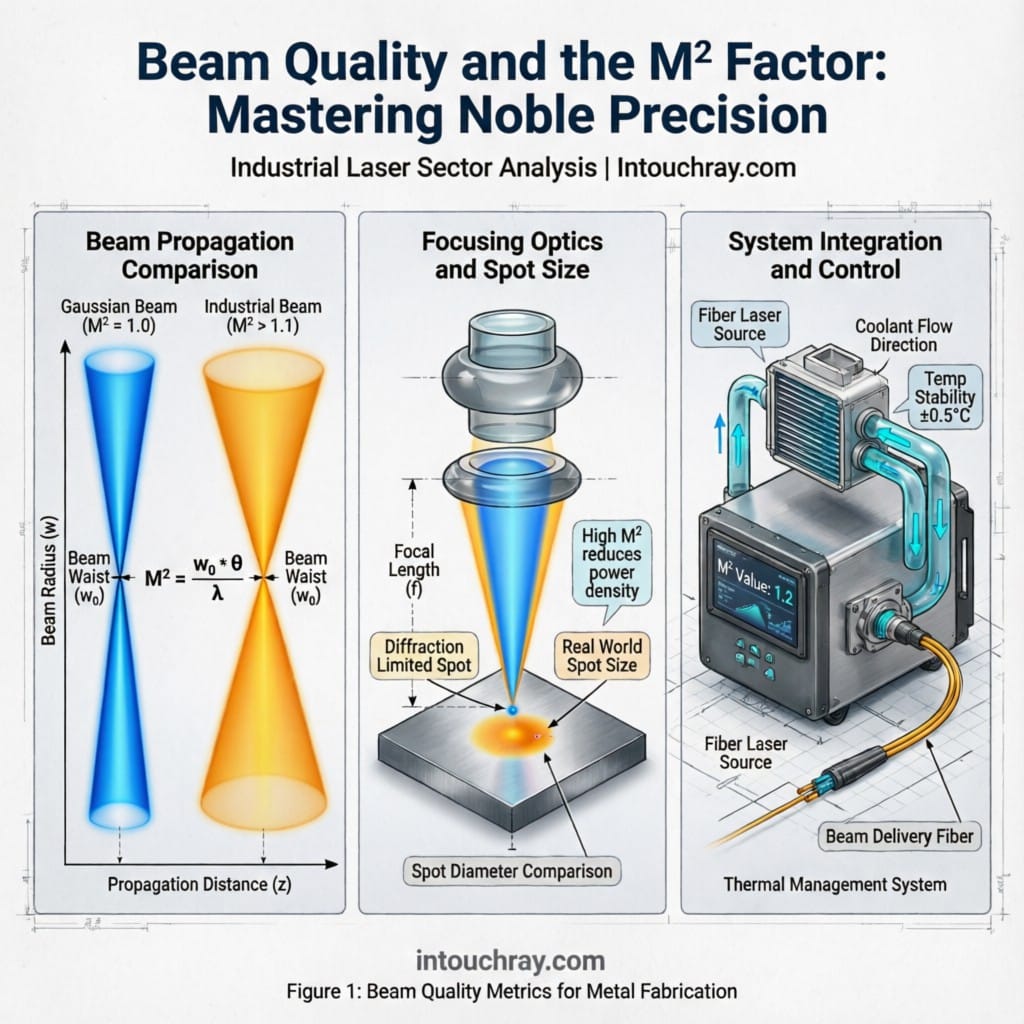
Not all laser beams are created equal. The M2 factor (Beam Propagation Ratio) is a dimensionless value that describes how close a laser beam is to a “perfect” Gaussian beam.
An M2 of 1.0 is a perfect beam that can be focused to the smallest possible theoretical spot.
Why does this matter? A lower M2 means the beam can be focused to a smaller spot over a longer distance. In laser cutting (Argon vs. Nitrogen: Assist Gas Selection in Laser Welding), this translates to a narrower kerf and a cleaner edge, embodying the noble precision we strive for.
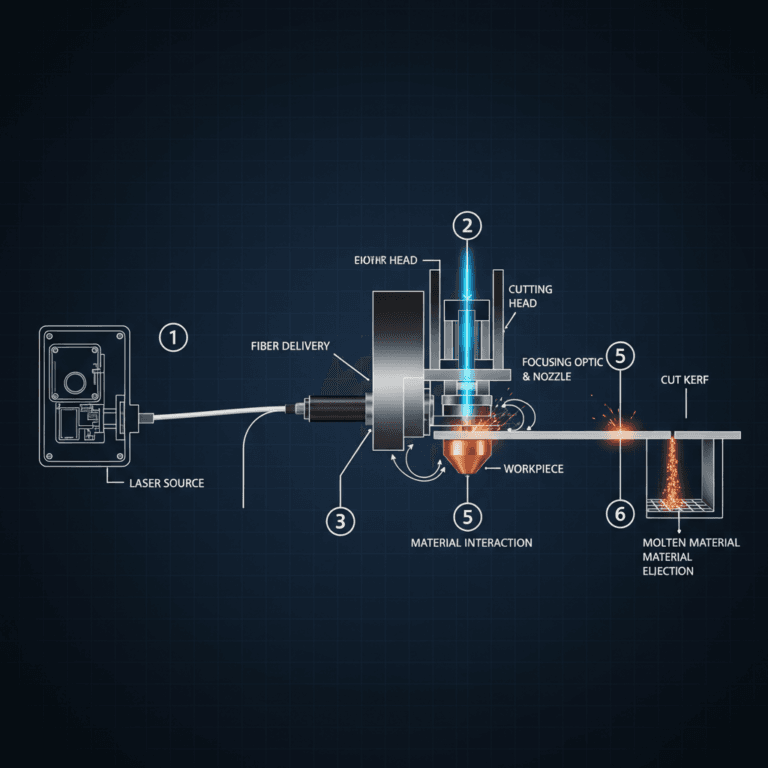
High-precision Laser Beam Quality M2 Factor Guide system showing laser beam path and component integration.
Technical Comparison
Technical Parameter
Single-Mode Fiber Laser
Multi-Mode Fiber Laser
Beam Parameter Product (BPP)
0.4 mm·mrad
2.8 mm·mrad
Focused Spot Diameter (100 mm Focal Length)
28 µm
145 µm
Maximum Continuous Wave Output
3.0 kW
12.0 kW
Peak Power Density at Work piece
9.2 MW/cm²
2.4 MW/cm²
Cutting Speed (10 mm Carbon Steel)
3.1 m/min
6.8 m/min
Minimum Achievable Kerf Width
0.14 mm
0.32 mm
Rayleigh Length (Depth of Focus)
1.6 mm
7.4 mm
2. The Power Density Equation
Power density is the amount of laser power delivered per unit of area, typically measured in Watts per square centimeter (W/cm²).
Power Density = Laser Power / (π × Radius²)
Where π is approximately 3.14 and Radius is the focal spot radius.
Laser cladding for power generation components — Beam Quality and Power Density: The Science of Laser Focus
Because the radius is squared in this calculation, even a tiny reduction in the focal spot size leads to a massive increase in intensity. This is why systems (intouchray.com) prioritize high-quality focusing lenses (Laser Spot Welding: A High-Speed Resistance Welding Alternative). If you halve your spot size, you quadruple your power density.
3. Focal Length and Depth of Field
The “focus” isn’t just a single point; it is a 3D volume known as the beam waist.
Short Focal Length: Creates a very small spot with high power density, but a shallow “Depth of Field.” This is ideal for high-speed cutting of thin metal sheets (Galvanized Steel Welding: Managing Zinc Vaporization).
In Laser Cutting: We need extreme power density to instantly vaporize or melt through the metal. A tight, high-intensity focus is the key to minimizing heat-affected zones.
In Laser Cladding: We often prefer a slightly “de-focused” or larger spot. This spreads the heat more evenly to create a stable melt pool for the powder transport (Custom Fixtures and Tooling for Laser Welding Success), ensuring a perfect metallurgical bond (Article #11) without boiling the material.
Conclusion: Mastering the Point of Impact
Control over your beam’s focus is control over your production quality. By monitoring your protecting windows (Article #25) and maintaining your water chiller (Laser Welding Maintenance: Protecting the Fiber Delivery Cable) to prevent thermal lensing, you ensure your power density remains constant. In Article #34, we will look at the “brain” that coordinates all these variables: CNC and PLC Integration.
Laser Beam Quality Power Density Science
Frequently Asked Questions
What is the typical beam quality (M²) required for precision laser cutting of metals up to 10 mm thick?
For consistent, high-quality cuts on stainless steel and aluminum up to 10 mm thick, we recommend an M² factor of 1.1 or lower. A beam with M² = 1.2 will produce a kerf width variation of approximately ±0.02 mm, which can lead to dimensional rejection in tight-tolerance automotive parts.
How does power density change when I switch from a 2 kW to a 4 kW fiber laser using the same focusing optics?
Doubling the laser power from 2 kW to 4 kW while keeping a 100 µm fiber core and 200 mm focal length lens will increase the peak power density from approximately 2.5 x 10⁶ W/cm² to 5.0 x 10⁶ W/cm². This directly reduces cutting time by up to 40% on 6 mm mild steel but may require a beam expander upgrade costing roughly $1,800 to maintain beam quality below M² = 1.1.
What is the minimum spot size I can achieve with a 50 µm delivery fiber and a 150 mm collimator?
Using a 50 µm core fiber and a 150 mm collimator with a 200 mm focusing lens, you can achieve a theoretical spot size of approximately 67 µm. In practice, due to lens aberrations and alignment tolerances, the effective focal spot diameter is 75 µm ± 5 µm, which is ideal for micro-welding of battery tabs with a depth-to-width ratio of 3:1.
What is the acceptable depth of focus tolerance for a laser system used in hermetic sealing of medical devices?
For hermetic sealing of titanium implant housings, your depth of focus (Rayleigh range) should be at least ±0.35 mm to accommodate minor part height variations. Our standard 100 mm focal length lens provides a depth of focus of ±0.40 mm, ensuring weld integrity with a rejection rate below 0.02%.
How much does a beam shaping module cost to convert a Gaussian beam into a top-hat profile for uniform heating?
A retrofit beam shaping module for a 3 kW fiber laser that converts a Gaussian (M² = 1.1) beam into a top-hat profile with >95% uniformity costs between $4,200 and $5,800, depending on the wavelength (1070 nm) and input aperture size. This module reduces edge-burning defects in polymer welding by a factor of 10.
What is the maximum acceptable focus shift per hour for a production laser cutting system?
For consistent cut quality over an 8-hour shift, the focus position drift should not exceed ±0.015 mm per hour. Our active focus control system maintains drift below ±0.008 mm per hour, which corresponds to a cost premium of $2,400 over a passive mount, but eliminates rework costs averaging $1.20 per part on high-volume runs.
Intouchray Laserolutions
As a leading manufacturer of industrial laser equipment, Intouchray designs and builds laser cladding, hardening, and surface repair systems that combine precision engineering with operational reliability. Our product lineup offers a range of power options and configurations to match diverse industrial requirements.
Product Models
CML-3000
Ground Rail
IT-RF5018-1
IT-RF5018-2
IT-RF5018-3
Laser Cladding & Hardening Head
Laser Cladding Head
Laser Hardening Head
Key Features
Laser cladding forms a strong metallurgical bond with the workpiece surface.
Concentrated laser energy control minimizes workpiece deformation due to heat input.
Improves wear resistance, corrosion resistance, and oxidation resistance of the part surface.
Enables recycling and remanufacturing, extending equipment lifespan and saving operating costs.
Laser cladding layer and workpiece surface form a firm metallurgical interface.
Laser energy control is precise, resulting in minimal thermal distortion.
Industry Applications
Additive manufacturing
Aerospace
Agricultural machinery tools
Assembly lines
Automated assembly lines
Automated welding and cutting
All laser claddlasermanufactured under ISO 9001 quality management protocols. Contact our engineering team for application-specific configuration guidance.