High-power fiber lasers, like the 6kW to 12kW+ systems used by Intouchray for both heavy plate cutting (Article #04) and high-speed robotic cladding (Article #05), generate immense amounts of heat. In a fiber laser, approximately 70% of the input electrical energy is converted into heat rather than light.
If this heat is not dissipated efficiently, it can cause “thermal lensing” (distorting the laser beam, undermining the precise nozzle centering discussed in Article #06), reduce component lifespan, and lead to catastrophic system failure. This article provides a comparative analysis of the two primary thermal management strategies: Water Cooling and Air Cooling, focusing on their suitability for high-kilowatt industrial fiber laser sources.
1. Air Cooling: Simplicity and Mobility for Lower Power
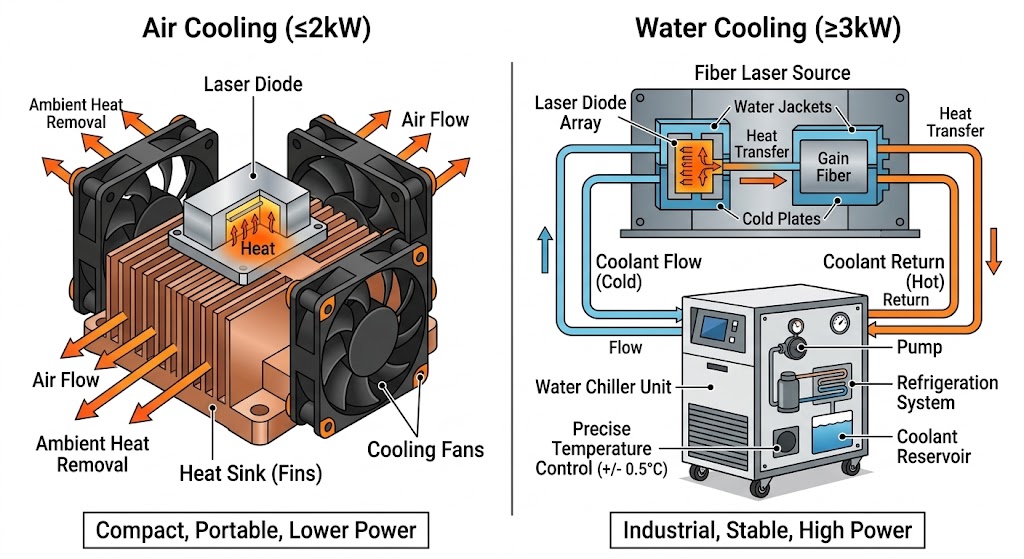
Air cooling systems rely on high-velocity fans and heat sinks (often utilizing copper or aluminum fins) to transfer heat directly from the laser diodes and gain fiber to the surrounding ambient air. It is the most common cooling method for lower-power fiber laser sources (typically below 1.5kW or 2kW).
The Advantages:
Low Cost and Simplicity: Minimal components mean lower initial investment and reduced maintenance (no pumps, filters, or coolant levels to manage).
Mobility: Without external water tanks or plumbing, air-cooled lasers are often smaller and easier to integrate into mobile or handheld systems (e.g., portable laser welding/cleaning units).
Reduced Environment Sensitivity: No risk of coolant freezing in cold environments (a major concern for traditional water chillers).
The Downside (The Power Ceiling):
Air is a relatively poor thermal conductor compared to water. As laser power increases, the surface area of the heat sinks and the volume of air required become unmanageable. Air cooling cannot efficiently dissipate the high heat density generated by kW-class industrial fiber lasers, leading to temperature fluctuations that destabilize the beam and shorten diode life.
2. Water Cooling: Precision and Power for Industrial Scale
Water cooling (or liquid cooling) utilizes a dedicated closed-loop chiller system. Deionized water (or specialized coolant) is pumped directly through cooling plates or jackets surrounding the laser’s most critical, high-heat components (diodes and the fiber optic combiner). The heated water is then cycled back to a chiller unit, where it is cooled via a refrigeration cycle before being redistributed.
The Advantages:
High Thermal Efficiency: Water has excellent thermal conductivity. Liquid cooling can efficiently manage immense heat densities, making it the mandatory standard for high-power fiber lasers (e.g., 3kW and above) used in industrial cutting and cladding (Article #04).
Precise Temperature Stability: Water chillers can maintain the coolant temperature within a extremely narrow range (often +/- 0.5°C or tighter). This stability is critical for preventing thermal lensing, ensuring the beam remains focused and centered (Article #06), and protecting expensive optical components.
Scalability: Liquid systems are easily scaled to handle tens of kilowatts by adjusting the chiller capacity and flow rates.
The Downside:
Complexity and Cost: Requires pumps, reservoirs, filters, and extensive plumbing, increasing both the initial system cost and the ongoing maintenance requirements.
Risk of Condensation: If the coolant is chilled below the dew point of the ambient air, condensation can form on sensitive optical components, leading to damage. High-end industrial lasers require chillers with integrated dew-point monitoring or anti-condensation controls.
Summary Comparison of Characteristics
| Characteristic | Air Cooling (Fans & Heat Sinks) | Water Cooling (Closed-Loop Chiller) |
| Typical Laser Power Range | < 2kW (Low to Medium) | ≥ 3kW (High Power – Industrial Std) |
| Heat Dissipation Capacity | Low to Moderate | Very High |
| Temperature Stability | Moderate (+/- 2°C to 5°C) | Excellent (+/- 0.5°C or better) |
| Initial System Cost | Lower | Higher |
| Maintenance & Complexity | Minimal | High (Coolant, Pumps, Filters) |
| System Footprint | Smaller (Often Integrated) | Larger (External Chiller required) |
| Application Suitability | Mobile, Handheld, Marker lasers | CNC Cutting, Robotic Cladding, Heavy Duty Mfg |
Conclusion: When Does kW Count?
The choice between water and air cooling is rarely a matter of preference; it is dictated by the output power and the application’s demand for stability. For a compact 1kW laser marker or a mobile 1.5kW handheld welder, the simplicity and low maintenance of air cooling are massive advantages.
However, for a 12kW Intouchray fiber laser optimized for cutting 20mm stainless steel (Article #04) or a robotic cladding system demanding continuous 24/7 operation (Article #05), the precise temperature control, high thermal efficiency, and scalability of a water chiller are essential.