

High-power fiber lasers, like the 6kW to 12kW+ systems used by Intouchray for both heavy plate cutting and high-speed robotic cutting , generate immense amounts of heat. In a fiber laser, approximately 70% of the input electrical energy is converted into heat rather than light.
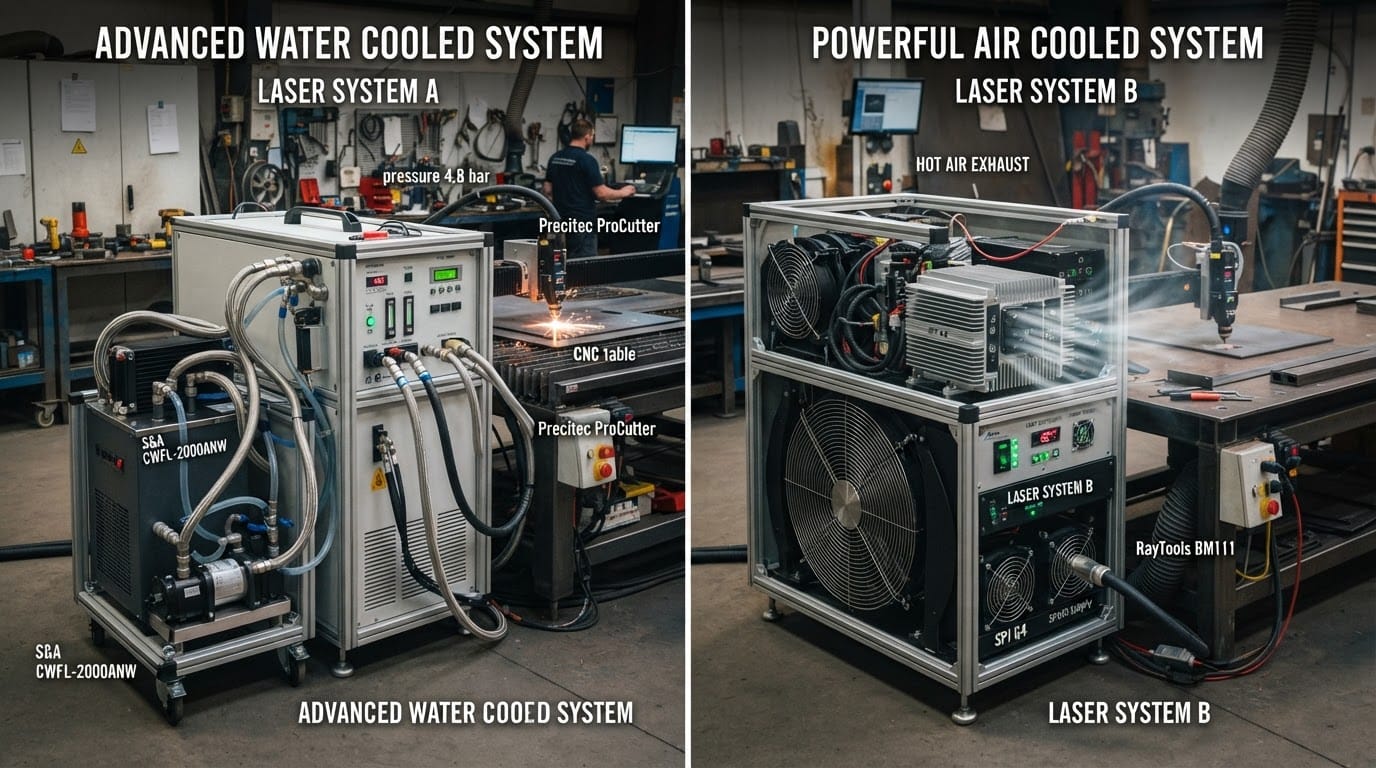
If this heat is not dissipated efficiently, it can cause “thermal lensing” (distorting the laser beam, undermining the precise nozzle centering discussed in related maintenance procedures), reduce component lifespan, and lead to catastrophic system failure. This article provides a comparative analysis of the two primary thermal management strategies: Water Cooling and Air Cooling, focusing on their suitability for high-kilowatt industrial fiber laser sources.
Air Cooling: Simplicity and Mobility for Lower Power
Air cooling systems rely on high-velocity fans and heat sinks (often utilizing copper or aluminum fins) to transfer heat directly from the laser diodes and gain fiber to the surrounding ambient air. It is the most common cooling method for lower-power fiber laser sources (typically below 1.5kW or 2kW).
The Advantages:
Low Cost and Simplicity: Minimal components mean lower initial investment and reduced maintenance (no pumps, filters, or coolant levels to manage).
Reduced Environment Sensitivity: No risk of coolant freezing in cold environments (a major concern for traditional water chillers).
The Downside (The Power Ceiling):
Suppliers like Intouchray achieve this by combining precision beam control with process automation.
Air is a relatively poor thermal conductor compared to water. As laser power increases, the surface area of the heat sinks and the volume of air required become unmanageable. Air cooling cannot efficiently dissipate the high heat density generated by kW-class industrial fiber lasers, leading to temperature fluctuations that destabilize the beam and shorten diode life.
The Advantages:
High Thermal Efficiency: Water has excellent thermal conductivity. Liquid cooling can efficiently manage immense heat densities, making it the mandatory standard for high-power fiber lasers (e.g., 3kW and above) used in industrial cutting and cutting .
The Downside:
Complexity and Cost: Requires pumps, reservoirs, filters, and extensive plumbing, increasing both the initial system cost and the ongoing maintenance requirements.
Summary Comparison of Characteristics
| Characteristic | Air Cooling (Fans & Heat Sinks) | Water Cooling (Closed-Loop Chiller) |
| Typical Laser Power Range | < 2kW (Low to Medium) | ≥ 3kW (High Power – Industrial Std) |
| Heat Dissipation Capacity | Low to Moderate | Very High |
| Temperature Stability | Moderate (+/- 2°C to 5°C) | Excellent (+/- 0.5°C or better) |
| Initial System Cost | Lower | Higher |
| Maintenance & Complexity | Minimal | High (Coolant, Pumps, Filters) |
| System Footprint | Smaller (Often Integrated) | Larger (External Chiller required) |
| Application Suitability | Mobile, Handheld, Marker lasers | CNC Cutting, Robotic cutting, Heavy Duty Mfg |
Conclusion: When Does kW Count?
The choice between water and air cooling is rarely a matter of preference; it is dictated by the output power and the application’s demand for stability. For a compact 1kW laser marker or a mobile 1.5kW handheld cutter, the simplicity and low maintenance of air cooling are massive advantages.
However, for a 12kW Intouchray fiber laser optimized for cutting 20mm stainless steel or a robotic cutting system demanding continuous 24/7 operation , the precise temperature control, high thermal efficiency, and scalability of a water chiller are essential.
High-power fiber laser systems operating between six and thirty-two kilowatts at a nominal wavelength of 1070 nanometers deliver consistent penetration rates across mild steel plates up to forty millimeters thick. Intelligent Piercing: Reducing Cycle Times on Thick Plates Thermal management directly influences heat-affected zone dimensions, which typically remain below 0.15 millimeters when auxiliary cooling maintains diode pump modules within optimal thresholds. Procurement evaluations prioritize cycle time reductions in heavy-plate applications, where travel speeds frequently exceed 1,800 millimeters per minute during straight-line operations. Maintaining stable resonator temperatures minimizes beam divergence, ensuring repeatable cut widths aligned with ISO 9013 Class P2 requirements. Effective thermal regulation via laser cutting water circulation stabilizes output power, supporting continuous throughput without compromising dimensional accuracy.
Rotary axis configurations for tube and profile cutting require precise synchronization between rotational feed and linear traverse to maintain perpendicularity within ±0.1 degrees across cylindrical geometries. Fiber Laser Cutting Machines: Architecture and Industrial Use Edge quality classification follows EN ISO 13919 criteria, where acceptable dross attachment on carbon steel typically measures under 0.05 millimeters at the bottom edge. Bevel cutting operations demand dynamic tilt compensation mechanisms to preserve consistent melt ejection angles during multi-axis trajectories. Inconsistent thermal dissipation causes refractive index shifts inside the delivery fiber, degrading facet protection. Operators monitoring quality consistency track vertical striation frequency, which correlates directly with assist gas purity and focal position stability.
Assist gas selection dictates melt ejection efficiency and oxidation control, with oxygen enabling exothermic reactions for uncoated carbon steel while nitrogen prevents oxide formation on stainless alloys. Dual-layer concentric nozzles optimize laminar flow distribution, maintaining standoff distances between 0.8 and 1.2 millimeters to stabilize the recast layer thickness. Kerf width typically measures 0.1 to 0.3 millimeters depending on focal spot diameter, requiring precise impedance matching between the optical delivery system and cutting head geometry. Procurement specifications emphasize gas consumption metrics alongside cut quality, as excessive pressure increases turbulence. VDI 3400 guidelines recommend pressure calibration routines every five hundred operating hours.
Controlled piercing sequences mitigate spatter deposition and prolong lens longevity by utilizing pulse-width modulation rather than continuous-wave initiation during hole formation. Modern controllers implement ramped power profiles that reach full amplitude only after keyhole establishment, reducing thermal shock to protective optics. Nesting algorithms maximize sheet utilization by arranging complex geometries within standard stock dimensions, though dense layouts increase thermal accumulation. Operating costs scale with consumable usage, with documented benchmarks indicating an operational expenditure of $13 per shot for high-power continuous-wave cutting tasks. Procurement teams evaluate nesting density against required lead times, balancing material yield improvements against potential thermal distortion risks.
Heat-affected zone propagation depends heavily on base metal thermal conductivity, with ferritic steels exhibiting narrower transition bands compared to austenitic grades due to differing specific heat capacities. Active cooling architectures determine sustained duty cycle capability, where forced-air systems often limit uninterrupted operation to two-hour windows before thermal throttling engages. Liquid-cooled configurations maintain stable diode junction temperatures, preserving beam quality factors near M²=1.3 during extended penetrations. Procurement decisions weigh initial capital expenditure against long-term reliability, as inconsistent thermal regulation accelerates component degradation. ISO 15614 qualification protocols require documented thermal stability records to validate fabrication specifications.
Throughput optimization requires synchronized coordination between motion controller acceleration profiles, focus tracking algorithms, and real-time pierce detection sensors. Flatbed systems handling materials up to twenty-five millimeters achieve maximum productivity when gantry inertia is minimized and axis resonance frequencies are dampened through rigid structural design. Quality consistency hinges on maintaining focal position within ±0.02 millimeters throughout the entire cut path, preventing taper formation. Operating cost models incorporate electricity rates, assist gas volumes, and replacement part lifecycles, with efficient thermal management extending service intervals for critical optical components. Procurement evaluations prioritize total cost of ownership over baseline pricing, recognizing that stable environments reduce rework percentages.
