

Fiber Laser Source and Beam Delivery
The fiber laser cutting machine begins at the source: a doped optical fiber pumped by laser diodes to produce a 1,064nm beam. Active fibers are typically ytterbium-doped, converting approximately 30% of electrical input into usable laser light. This high wall-plug efficiency is the primary economic advantage over CO₂ lasers, which achieve 10–15% — the fiber laser’s 25–30% efficiency translates directly to lower electricity cost per cut meter in production.
Beam delivery from the source to the cutting head uses a transport fiber — a flexible optical cable that carries the laser from the stationary source cabinet to the moving gantry head. This fiber-based delivery architecture eliminates the mirrors and bellows that CO₂ systems require to route the 10,600nm beam through a moving gantry. Fiber delivery means no mirror alignment, no bellows degradation, and no beam path purge gas — reducing both maintenance frequency and operating cost. Intouchray fiber laser cutting systems use IPG, Raycus, or MAX laser sources at power ranges from 500W to 12kW, with positioning accuracy of ±0.03mm across the full work envelope.
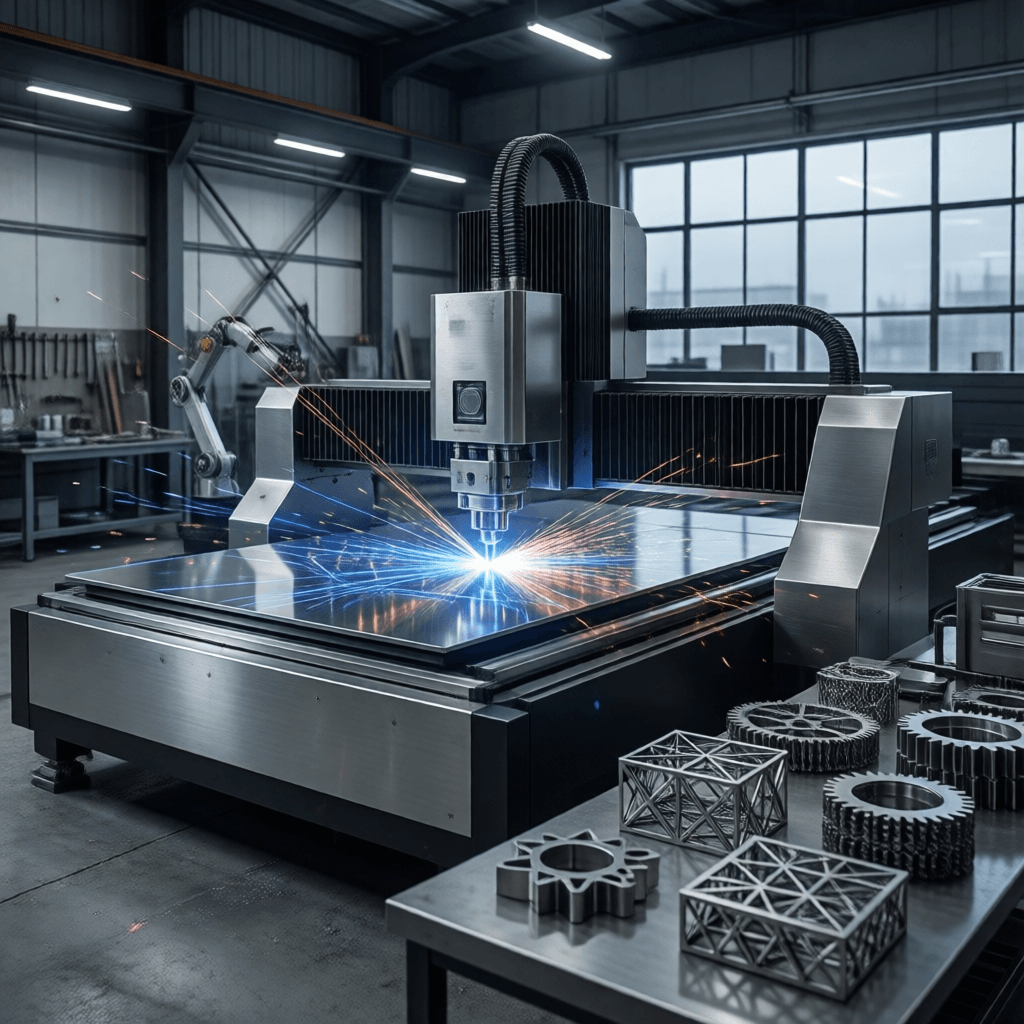
Motion System and Work Envelope
The cutting head moves on a gantry — either a bridge-type (moving table, fixed gantry) for smaller formats up to 3,000mm × 1,500mm, or a flying-optic type (moving gantry, fixed table) for larger formats up to 12,000mm × 2,500mm. Flying-optic designs keep the workpiece stationary, which is critical when cutting heavy plate — a 20mm × 2,500mm × 6,000mm steel plate weighs approximately 2.4 metric tons and must not move during cutting.
Linear motors or precision-ground ball screws drive each axis. Acceleration rates of 1.5–2.5G enable the rapid traverse between cut paths that determines net throughput on nested sheets. On a typical 2,500mm × 1,250mm sheet of 3mm stainless steel with 80–120 nested parts, traverse time between parts accounts for 15–25% of total cycle time — faster acceleration directly reduces this non-cutting time. Intouchray systems achieve rapid traverse speeds up to 120 m/min on X and Y axes, with the Z-axis (focal height) following material surface variations through capacitive height sensing at 200 Hz.
Cutting Head and Assist Gas
The cutting head contains the focusing lens (or collimating and focusing lens pair), the nozzle, and the capacitive height sensor. Focus spot size is typically 0.1–0.3mm diameter, producing power densities exceeding 10⁶ W/cm² at the workpiece — sufficient to melt any metal almost instantly. The assist gas flows coaxially through the nozzle at 8–20 bar: oxygen for mild steel (exothermic reaction adds approximately 40% to effective cutting power), nitrogen for stainless steel and aluminum (inert, prevents oxidation on cut edge), and compressed air for non-critical applications where edge discoloration is acceptable.
Nozzle standoff — the gap between nozzle tip and workpiece — is maintained at 0.5–1.5mm by the capacitive height sensor. Variations in sheet flatness, particularly on hot-rolled plate with mill scale, require the Z-axis to track at high frequency to maintain consistent standoff and therefore consistent cut quality. A collision that drives the nozzle into the workpiece triggers an emergency stop; Intouchray systems include a breakaway nozzle mount that limits damage to a consumable component rather than the entire cutting head assembly.
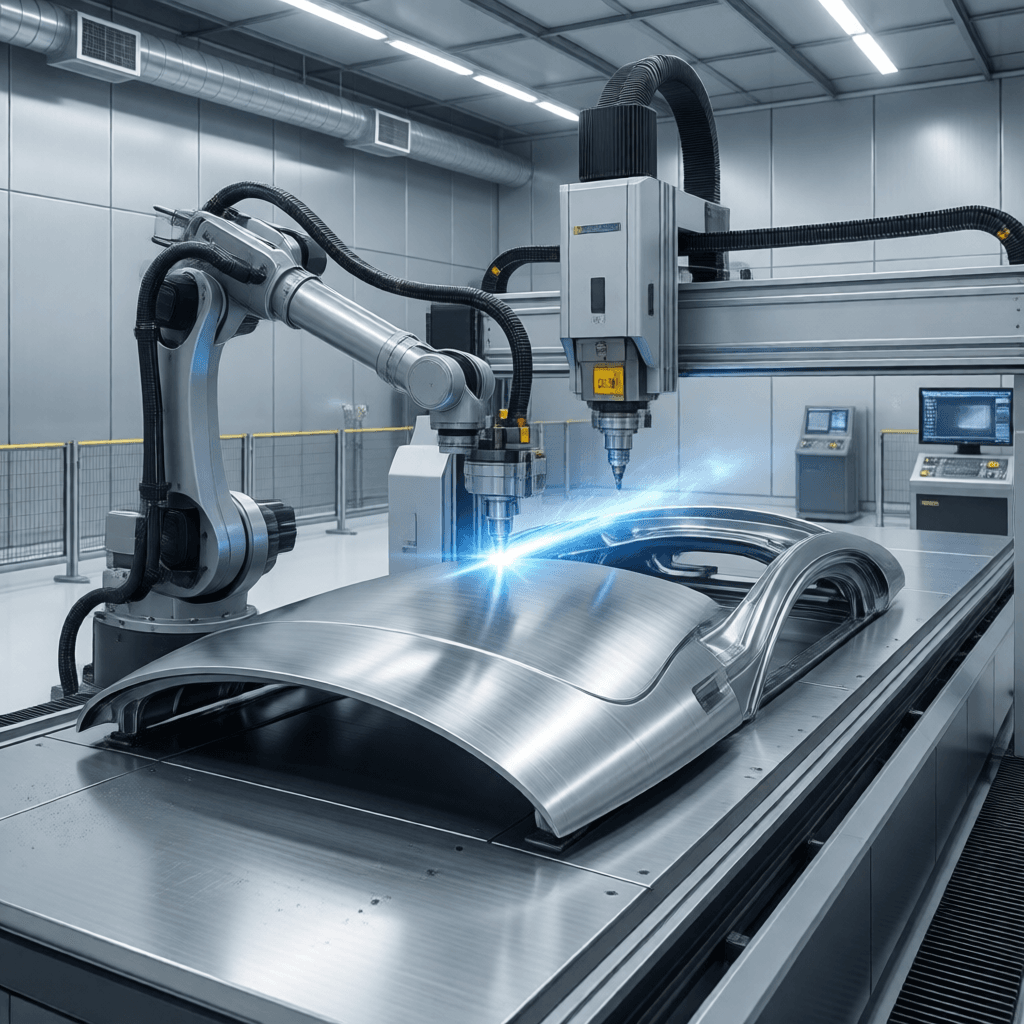
Applications Across Industries
Sheet metal fabrication: Job shops processing mixed materials — mild steel, stainless, aluminum — benefit from the fiber laser’s ability to cut reflective materials without the downtime that CO₂ systems require for tuning. A 4kW fiber laser cuts 1mm stainless steel at 25 m/min and 10mm mild steel at 2.5 m/min, covering the full thickness range typical in job shop work.
Automotive: Body panel prototyping, chassis bracket production, and exhaust system component cutting at Tier 1 and Tier 2 suppliers. The fiber laser’s narrow kerf (0.1–0.3mm) enables tight nesting of parts on sheet, improving material utilization by 3–8% compared to plasma cutting with its wider kerf (1.5–3mm).
Agricultural and construction equipment: Cutting of 6–20mm mild steel and HARDOX wear plate for buckets, blades, frames, and structural components. The 6kW and 12kW power options on Intouchray fiber laser systems cover this thickness range with edge quality that eliminates secondary machining for most structural applications.
Frequently Asked Questions
What is the maximum thickness a fiber laser can cut?
A 12kW fiber laser cuts mild steel up to 30mm, stainless steel up to 25mm, aluminum up to 25mm, and brass/copper up to 12mm. Practical production limits are typically lower — 20mm mild steel at a speed that makes economic sense compared to plasma. For thicknesses beyond 30mm in mild steel, plasma remains more cost-effective due to higher cutting speeds at extreme thickness.
What maintenance does a fiber laser cutting machine require?
Primary maintenance items are protective window replacement (typically every 200–400 hours depending on cutting environment cleanliness), nozzle changes (consumable item, replaced as needed), chiller filter cleaning, and periodic lens inspection. There are no laser gas refills, no mirror alignments, and no resonator maintenance — the fiber laser source is sealed and maintenance-free for its rated lifetime (typically 100,000 hours for the pump diodes). Intouchray includes a spare parts kit and maintenance schedule with each system.
Fiber laser vs. plasma — when is each appropriate?
Fiber laser is superior for thicknesses up to 20mm in mild steel and all thicknesses in stainless and aluminum — it delivers narrower kerf, better edge quality, and higher precision. Plasma becomes more cost-effective above 20mm mild steel due to lower capital cost and higher cutting speeds at extreme thickness. For mixed-thickness job shops, the fiber laser’s ability to cut thin material at high speed AND moderate-thickness plate with good edge quality often justifies the higher capital cost through reduced secondary operations and better material utilization.
