Laser Cladding and Sustainability: Driving the Circular Economy through Remanufacturing and Resource Efficiency
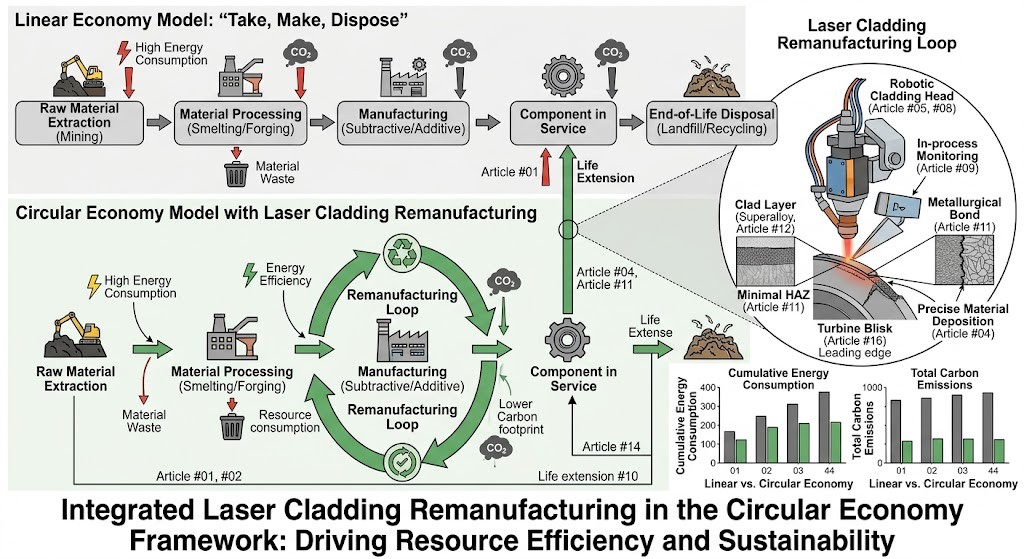
In the face of global climate change and resource scarcity, industrial sectors are under increasing pressure to adopt sustainable practices. The traditional linear economy model—”take, make, dispose”—is proving unsustainable, particularly for high-value, material-intensive industries like aerospace (Article #16), oil & gas (Article #15), and heavy machinery.
The alternative is the Circular Economy, which aims to decouple economic growth from resource consumption by keeping products, components, and materials at their highest utility and value at all times. High-power fiber laser cladding (Article #02, #08) has emerged as a critical enabling technology for this transition. By offering precise, high-quality remanufacturing capabilities, laser cladding transforms restoration from a temporary fix into a noble strategy for achieving industrial sustainability.
- Remanufacturing: Extending Lifecycle and Preserving Value
The cornerstone of laser cladding’s contribution to sustainability is its ability to restore worn or damaged high-value components to “as-new” or even “better-than-new” condition.
Life Extension (Article #11, #13): As detailed throughout this series, laser cladding applies dense, metallurgically bonded (Article #11) wear- and corrosion-resistant coatings (Article #12, #13). This directly extends the operational life of critical assets, such as turbine blisks (Article #16) or hydraulic stabilizers (Article #15), by factors of 2x to 10x.
Avoiding Replacement: Extending component life eliminates the need to manufacture replacement parts. This avoids the massive energy consumption and carbon emissions associated with raw material extraction (mining), smelting, forging, and rough machining required to create a new component from scratch.
- Resource Efficiency and Waste Reduction
Beyond life extension, the laser cladding process itself (Article #03, #04, #08) is inherently more resource-efficient than traditional repair or manufacturing methods.
Additive vs. Subtractive: Laser cladding is an additive process, depositing material only where needed. Traditional manufacturing often involves subtractive machining, where a large portion of the initial material is wasted as chips and swarf. Even traditional repair methods like TIG welding (Article #01) often require excessive over-building, necessitating significant post-process machining and material waste.
Precise Material Deposition (Article #03, #04): High-power fiber lasers allow for extremely precise control over the clad layer thickness (Article #04) and geometry (Article #03). This minimizes the amount of valuable alloy powder (e.g., Inconel 718, Waspaloy, Article #12) or carbide MMC (Article #13) required, reducing material consumption and cost. Low-dilution parameters (Article #04) further ensure that the properties of the expensive cladding material are maximized, not wasted through substrate mixing.
Reduced Consumables and Pollution (Article #01): Compared to traditional processes like hard chrome plating, laser cladding is a “dry” process. It eliminates the use of toxic chemicals, heavy metals (like hexavalent chromium), and large volumes of contaminated rinse water, significantly reducing industrial pollution and hazardous waste disposal requirements.
- Energy Efficiency and Lower Carbon Footprint
Calculating the total carbon footprint of a component repair requires looking at the entire lifecycle.
Process Energy Efficiency (Article #02, #08): High-power fiber lasers are significantly more energy-efficient (wall-plug efficiency) than older laser types (like CO₂) or traditional arc welding processes. This reduces the direct energy consumption during the cladding operation itself.
Lifecycle Energy Savings: The most significant energy savings, however, come from avoided manufacturing. The energy required to cladd and restore a 50kg superalloy blisk is orders of magnitude lower than the energy required to mine, smelt, forge, and machine a new 50kg blisk.
- Integration with Digitalization (Article #10)
The sustainability benefits of laser cladding are amplified when integrated with Industry 4.0 technologies (Article #10).
Predictive Maintenance: Using data from adaptive control systems (Article #09) and digital twins (Article #10), operators can predict exactly when a component needs remanufacturing, optimizing the maintenance cycle to maximize component life while preventing catastrophic, energy-intensive failures.
Optimized Process Parameters: Machine learning algorithms can analyze Big Data from cladding operations to continuously optimize parameters (Article #04), further reducing material waste and energy consumption.
Conclusion: Remanufacturing a Sustainable Future
Laser cladding is far more than a technical solution for surface engineering; it is a fundamental strategy for achieving industrial sustainability. By enabling high-quality, precise remanufacturing, high-power fiber laser technology keeps high-value assets in productive service for longer, drastically reducing resource consumption, waste, and carbon emissions. Integrating these noble capabilities with digital process control (Article #09) and circular business models (Article #18) unlocks immense economic and environmental value. Laser cladding adoption is essential for building a resilient, resource-efficient, and sustainable industrial future, proving that remanufacturing is not just about saving parts—it’s about saving the planet.
Image Attachment