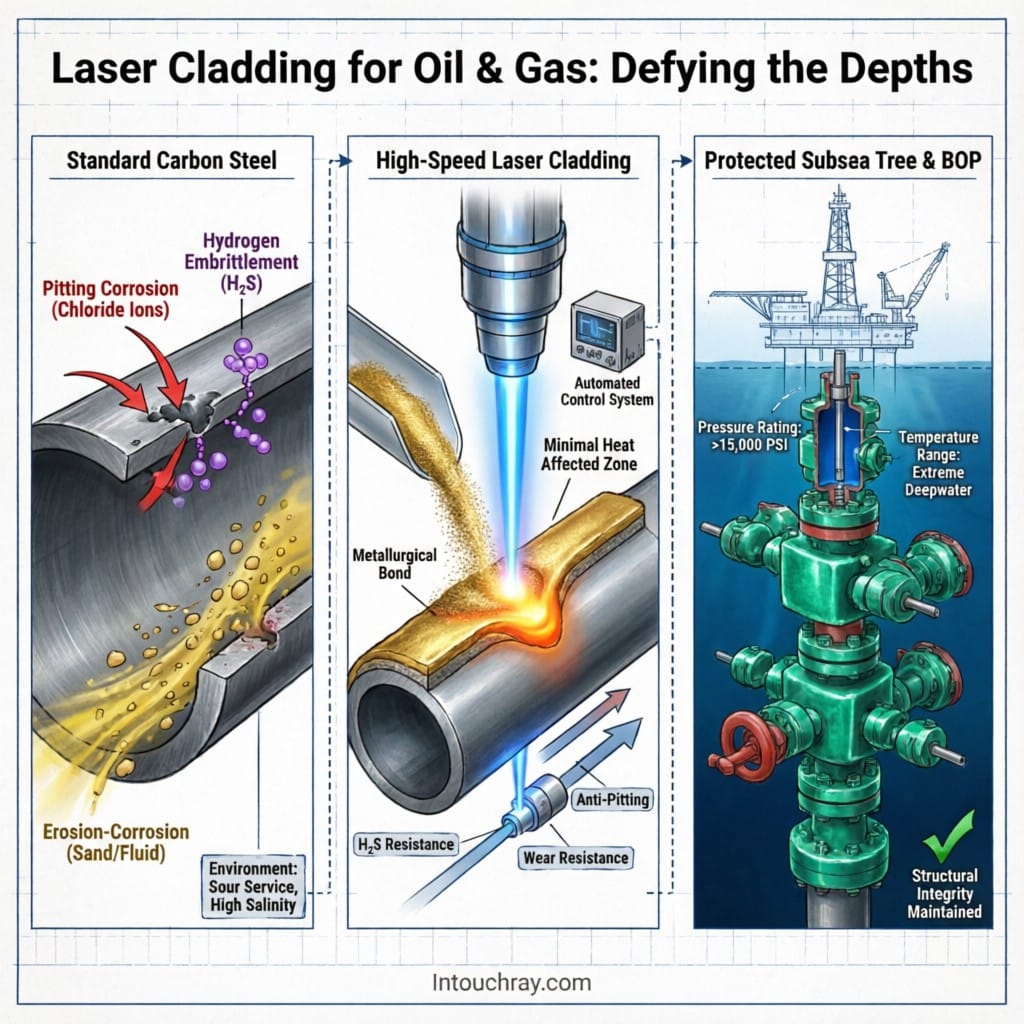
In the Oil and Gas sector, equipment must survive “Sour Service”—environments rich in Hydrogen Sulfide (H₂S), high-salinity seawater, and pressures exceeding 15,000 PSI. A single valve failure on an offshore platform can lead to catastrophic environmental damage and millions in lost resource efficiency (#19).
High-Speed Laser Cladding (Article #33) has become the gold standard for protecting subsea trees, drill pipes, and blowout preventers (BOPs).
- The Corrosion Challenge: Pitting and Stress
Offshore components face a “Triple Threat” that standard carbon steel cannot survive:
Pitting Corrosion: Chloride ions in seawater create microscopic holes that compromise structural integrity.
Hydrogen Embrittlement: In “Sour” wells, hydrogen atoms penetrate the steel, making it brittle and prone to sudden cracking.
Erosion-Corrosion: High-velocity sand and fluids inside the pipe physically “scrub” away protective oxide layers.
- The Solution: Superalloy Overlays
Traditional welding (GTAW/GMAW) often results in high “dilution,” where the base steel mixes too much with the protective coating, weakening it. Intouchray laser systems offer noble precision by keeping dilution below 5%.
Inconel 625 Cladding: The industry favorite. This nickel-based superalloy is nearly immune to seawater corrosion and H₂S cracking.
Stellite Overlays: Used for valve seats and pump internals where extreme hardness and wear resistance are required.
Complex Geometries: Our multi-axis CNC-PLC systems (Article #34) allow us to clad the internal bores of pipes and valve bodies where manual welding is impossible.
- Strategic Reliability: Reducing Heat-Affected Zones (HAZ)
In high-pressure oil equipment, the “Heat-Affected Zone” is a liability. Excessive heat from traditional welding can change the grain structure of the steel, creating “soft spots” where the pipe might burst.
The Laser Advantage: Because the laser beam is so concentrated (Article #45), the heat is localized. The substrate maintains its original mechanical properties, ensuring the strategic reliability of the pressure-containing vessel.
- Replacing Thermal Spray and Chrome Plating
For decades, the industry relied on HVOF (High-Velocity Oxy-Fuel) spraying. However, HVOF creates a “mechanical bond” that can leak under high pressure.
The Intouchray Difference: Laser cladding creates a Metallurgical Bond. Even at 20,000 PSI, the protective Inconel layer will not delaminate from the steel. This is essential for subsea components that must stay at the bottom of the ocean for 25+ years without maintenance.
- Economic Impact: Life Extension
By cladding a standard carbon steel component with a 1.5mm layer of Inconel 625, we achieve the performance of a solid superalloy part at 30% of the cost.
Uptime: Reducing the frequency of “Pulling the String” (removing drill pipe for inspection).
Sustainability: Reducing the need for virgin “Exotic Metals” by using them only where the surface meets the sea.
Conclusion: Halfway to Mastery
Article #50 marks the midpoint of our journey. We have transitioned from basic physics to saving critical infrastructure in the world’s harshest environments. In Article #51, we will look at Laser Cladding in the Aerospace Industry, where every gram of weight and every micron of thickness is a matter of flight safety.
Image Attachment