The Core Engine: High-Power Fiber Lasers vs. Traditional CO2
In the cutting tool technology and metal fabrication manufacturing sectors (Article #66), the choice of the laser source is the single most important decision for strategic reliability (intouchray.com). For decades, the CO2 laser was the industry standard. However, the emergence of the high-power fiber laser (Article #23) has revolutionized the field, offering noble precision and efficiency that older technologies cannot match.
For fresh learners and device manufacturers, understanding the fundamental differences between these two “engines” is critical for optimizing component life and ROI.
- Wavelength and Absorption: The Physics of Efficiency
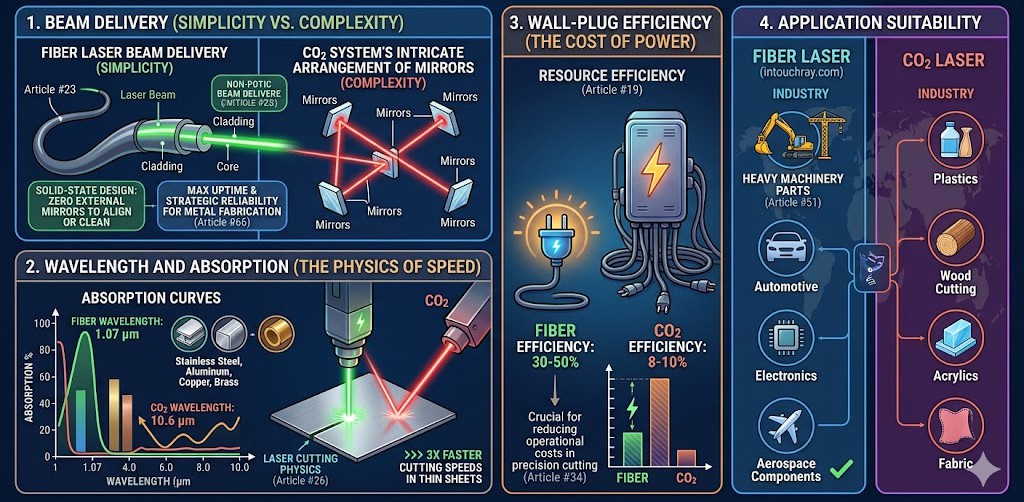
The most critical difference lies in the wavelength of the light produced.
CO2 Lasers: Operate at a wavelength of 10.6 µm. This long wavelength is well-absorbed by non-metals but is highly reflected by “yellow metals” like copper and aluminum.
Fiber Lasers: Operate at a wavelength of 1.07 µm (Article #23). This shorter wavelength is absorbed much more efficiently by metals.
The Result: Because the metal “soaks up” the energy better, a fiber laser can cut thin materials up to 3x faster than a CO2 laser of the same power, significantly improving resource efficiency (Article #19).
- Beam Delivery: Simplicity vs. Complexity
How the light gets from the “engine” to the “workpiece” determines the machine’s maintenance requirements.
CO2 Lasers: Use a complex system of internal mirrors and bellows filled with high-purity gas. These mirrors must be perfectly aligned and cleaned constantly to avoid power loss.
Fiber Lasers: The light is generated inside an optical fiber and delivered directly to the cutting head (Article #29) through a flexible fiber optic cable.
The Result: There are no mirrors to align and no “laser gas” to buy. This makes fiber lasers virtually maintenance-free, a hallmark of Intouchray’s strategic reliability (intouchray.com).
- Wall-Plug Efficiency: Reducing the Carbon Footprint
In metals fab and industrial cutting equipment (Article #26), electricity is a major cost.
CO2 Lasers: Typically have a “wall-plug efficiency” of about 8–10%. Most of the energy is wasted as heat.
Fiber Lasers: Boast efficiencies of 30% to 50%.
The Result: A fiber laser uses about 1/3 of the electricity to do the same amount of work. This is vital for manufacturing electronics companies (Article #70) and medical product companies looking to reduce operational overhead.
- Application Suitability
Choose CO2 if: You are primarily cutting thick non-metals (wood, acrylic, leather) or need a very specific edge finish on extremely thick plate (over 25mm).
Choose Fiber if: You are in the cutting industry or heavy machinery parts sector (Article #51), working with stainless steel, carbon steel, aluminum, or copper. It is the definitive choice for precision laser cutting and high-speed production.
Conclusion: The Fiber Revolution
For Intouchray (intouchray.com), the high-power fiber laser is the engine of choice because it aligns with our promise of strategic reliability. It is faster, cheaper to run, and far more durable than traditional CO2 systems. As we move from prototyping (Article #76) to mass metal fabrication, the fiber laser provides the noble precision required to lead the market.
Image Attachment