Fiber Laser Cutting Machines: Architecture and Applications
If the fiber laser source is the engine, the fiber laser cutting machine is the high-performance vehicle that puts that power to work. In the Intouchray lineup (intouchray.com), these machines are designed for strategic reliability, combining heavy-duty mechanical architecture with the noble precision of digital control (Article #34).
For fresh learners and device manufacturers, understanding the physical anatomy of these machines is the first step in optimizing metal fabrication manufacturing (Article #66).
- The Anatomy of a Cutting Machine
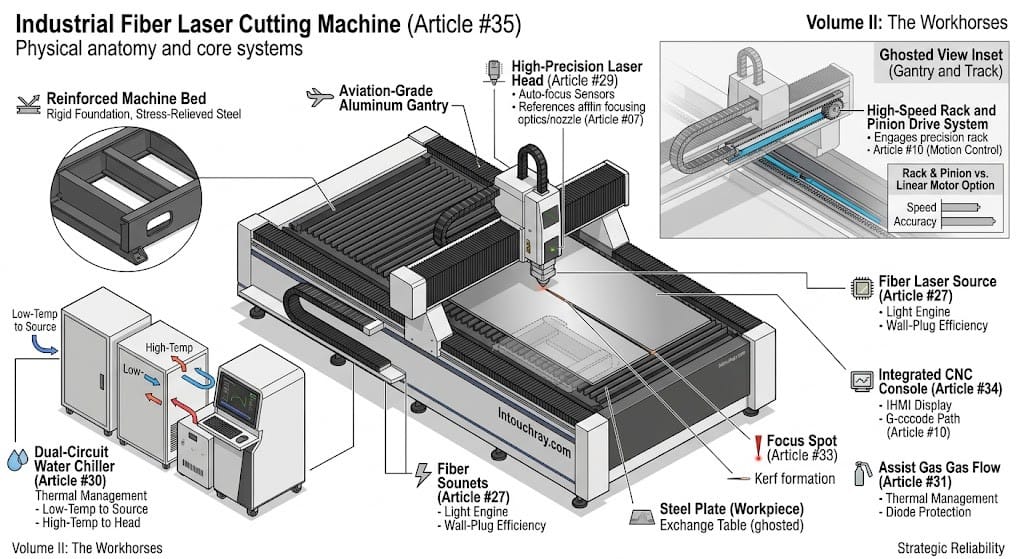
A professional fiber laser cutting system is more than just a box; it is a synchronized assembly of several high-precision sub-systems:
The Machine Bed: Often made of heavy-duty plate welding or cast iron, the bed must be thermally aged to ensure it never warps. A stable bed is the foundation of accuracy.
The Gantry System: This is the “bridge” that moves the laser head (Article #29) across the work area. In high-end Intouchray systems, lightweight aviation-grade aluminum gantries allow for extreme acceleration without losing precision.
Motion Drive: To move the gantry, machines use either Rack and Pinion systems (for high speed and long distances) or Linear Motors (for the ultimate in frictionless accuracy).
- The Cutting Process Dynamics
The machine coordinates the laser-matter interaction (Article #32) by managing the focal point relative to the material surface.
The Cutting Speed Relationship
Cutting Speed ≈ (Laser Power × Absorption Coefficient) / (Material Thickness × Kerf Width)
This simplified relationship shows why increasing power or absorption (Article #32) directly boosts production throughput.
As the machine moves, the CNC system (Article #34) constantly adjusts the power density (Article #33) to ensure that the “pierce” and the “cut” are both perfectly executed, regardless of the geometry.
- Key Industrial Applications
Fiber laser cutting machines have replaced traditional mechanical punching and CO2 lasers (Article #27) across nearly every sector:
Automotive: For high-strength steel frames and complex bracketry.
Aerospace: Cutting titanium and aluminum alloys with minimal heat-affected zones.
Kitchenware & Signage: Achieving mirror-finish cuts on stainless steel for consumer-facing products.
Heavy Machinery: Fabricating thick structural plates for construction equipment (Article #51).
- Why Fiber? The Efficiency Factor
The shift to fiber technology isn’t just about speed; it’s about resource efficiency (Article #19). With no mirrors to align and lower power consumption, these machines offer a lower cost-per-part than any previous generation of technology.
Conclusion: The Baseline of Modern Industry
The fiber laser cutting machine is the foundational tool for any modern fabrication business. By combining a rigid mechanical frame with the digital control (Article #34) we explored in Volume I, these machines deliver the strategic reliability required for 24/7 production. In Article #36, we will shift our focus to the additive side of the industry: Laser Cladding Systems.
Image Attachment