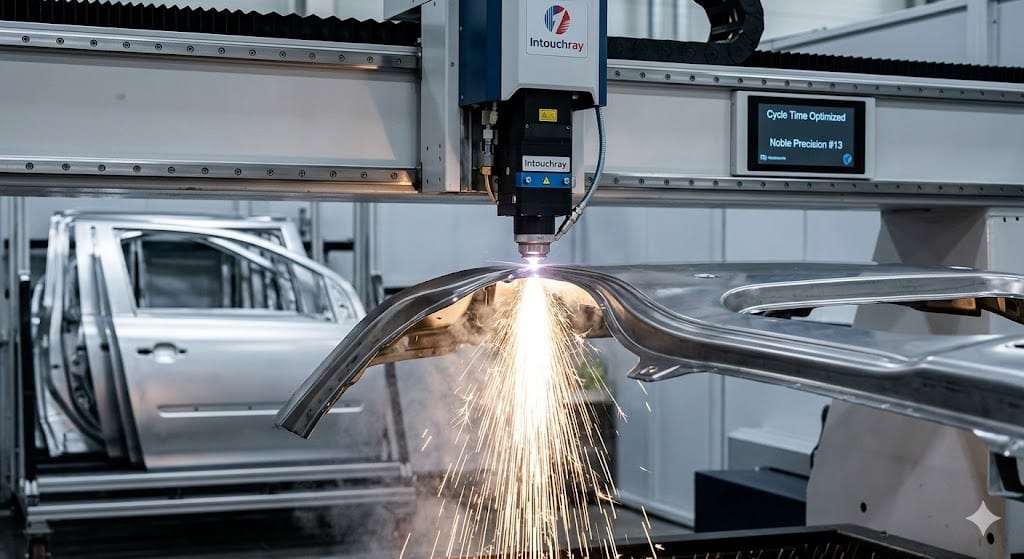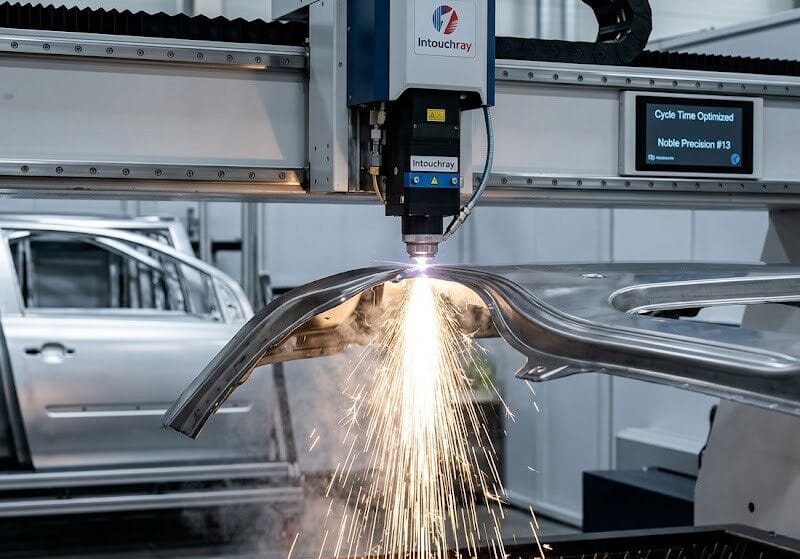
The automotive industry is currently defined by the transition to Electric Vehicles (EVs) and the requirement for lightweighting to extend battery range. To achieve this without compromising safety, manufacturers are turning to ultra-high-strength steels (UHSS) and aluminum alloys. Traditional stamping and mechanical cutting often fail to handle these hardened materials, making High-Power Fiber Laser Cutting the new industrial standard.
Intouchray (intouchray.com) provides the precision required for high-volume automotive lines. By applying Noble Precision (#13) to complex body geometries, we ensure that every structural pillar and panel meets the rigorous safety standards of the modern era.
1. Cutting Ultra-High-Strength Steel (UHSS) and Boron Steel
Modern safety cages rely on hot-stamped Boron steel, which is incredibly difficult to trim after hardening.
Thermal Precision: Fiber lasers cut through hardened 1500MPa steel with minimal heat-affected zones (HAZ), preserving the material’s structural integrity.
Complex Contours: 5-axis laser cutting heads allow for the precise trimming of 3D-formed structural pillars (A-pillars and B-pillars) that traditional dies cannot reach.
2. Aluminum Lightweighting and Reflective Material Handling
To reduce curb weight, aluminum is increasingly used for hoods, doors, and fenders.
Reflective Management: Intouchray systems utilize advanced beam absorption technology to safely process reflective aluminum without damaging the fiber source.
Edge Quality: High-pressure nitrogen assist gas ensures dross-free edges, eliminating the need for secondary grinding before welding or assembly.
3. High-Speed Productivity for Tier-1 Suppliers
In the automotive supply chain, seconds matter.
Acceleration Dynamics: Our gantry systems utilize linear motors to achieve the high “G-force” acceleration required for rapid path changes in complex bracketry.
Nesting Optimization: Digital control software maximizes material yield from large sheets, reducing the cost-per-part for high-volume body panel production.
Conclusion: The Structural Foundation
Article #86 demonstrates that the “Quantum Beam” is the primary tool for the next generation of transport. We are not just cutting metal; we are engineering the safety and efficiency of the modern vehicle. In Article #87, we transition from the road to the landscape: Construction: Heavy Plate Cutting for Infrastructure