The agricultural industry demands machinery that can withstand some of the harshest operational environments on earth. Fiber Laser vs. CO2: Which Engine Powers Strategic Reliability? Tractors, combine harvesters, and specialized implements must endure extreme mechanical loads, abrasive dust, high humidity, and corrosive chemical exposure.
The longevity and downtime of this equipment are directly proportional to the structural integrity of its foundation: the heavy steel chassis and frames. Focal Position and Spot Size: Optimizing Laser Intensity Traditional fabrication methods, relying on manual cutting or plasma systems, often struggle to balance the requisite material thickness with necessary precision.
Intouchray (intouchray.com) brings Noble Precision (#13) to the heartland. By utilizing ultra-high-power fiber laser systems, we enable agricultural OEMs and specialized fabricators to process heavy-gauge structural steel with the accuracy typically reserved for fine mechanics, ensuring the Strategic Reliability required for modern farming operations.
Agricultural frames are constructed from high-strength, low-alloy (HSLA) steels, often ranging from 15mm to over 25mm in thickness.
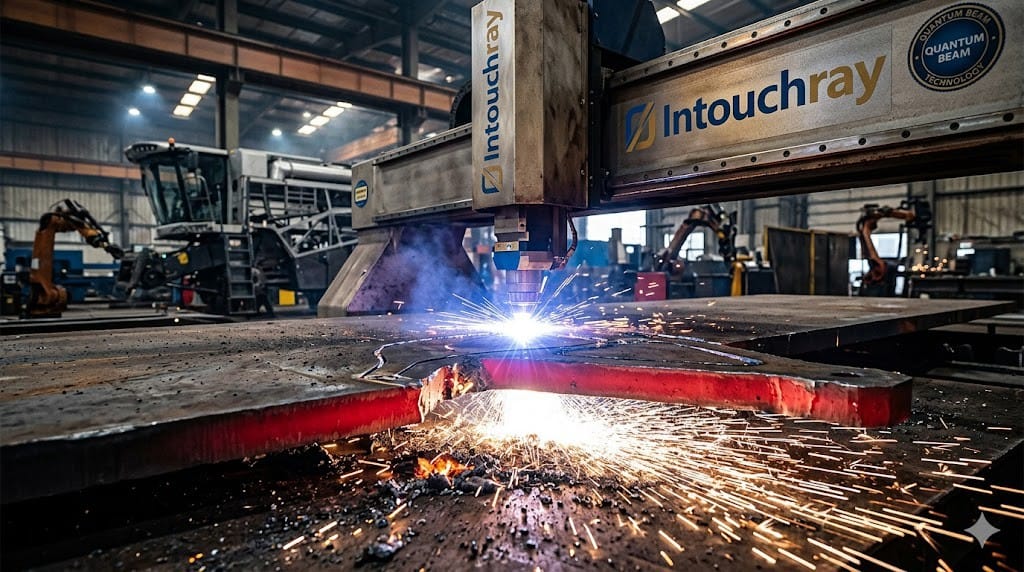
Rapid Piercing and Concentrated Energy: Intouchray’s multi-kilowatt fiber lasers utilize advanced piercing algorithms that reduce cycle times by over 50% compared to traditional CO₂ systems. The concentrated energy of the Quantum Beam cuts cleanly through thick structural plate, minimizing thermal input.
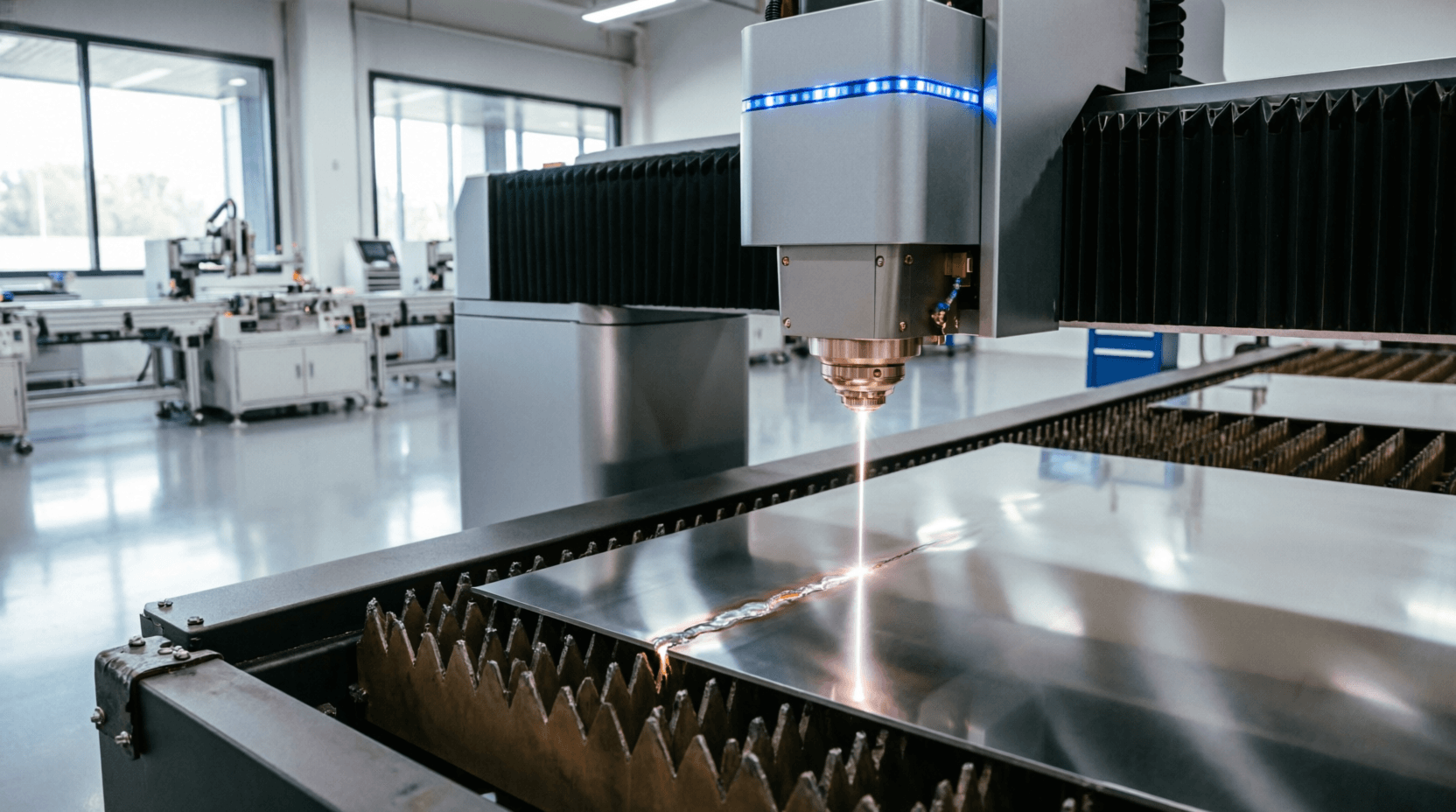
A high-tech fiber laser cutting machine processing stainless steel with zero visible sparks and a pr
Technical Comparison
Technical Parameter
Standard 6 kW Fiber Laser
High-Power 15 kW Fiber Laser
Laser Output Power
6 kW
15 kW
Maximum Cutting Thickness (Structural Steel)
25 mm
45 mm
Cutting Speed at 12 mm Thickness
3.8 m/min
9.1 m/min
Positioning Accuracy
±0.03 mm
±0.02 mm
Repeatability
±20 µm
±10 µm
Single-Pass Weld Penetration Depth
8 mm
18 mm
2. Complex Beveling for High-Strength Weld Preparations
A frame is only as strong as its joints. Agricultural machinery is subjected to severe multi-directional stress, meaning weld penetration is non-negotiable.
Single-Pass Beveling: Integrating a 5-axis bevel head (as discussed in Volume V) allows fabricators to create precise V, Y, K, or X-groove weld preparations in a single pass. This eliminates the need for secondary beveling operations with handheld tools or dedicated edge mills.
3. Precision Tolerance and Repeatability
Agricultural equipment design is moving toward modularity and interchangeability of parts across different models.
Sub-Millimeter Positional Accuracy: Whether cutting a pattern of 50 holes for a hydraulic manifold or trimming a complex curved bracket for a three-point hitch, maintains tolerances that ensure every part fits perfectly during final assembly, eliminating the “field fitting” common with rougher cut methods.
Fleet Consistency: By synchronizing digital CAD files directly with the machine controller, a fabricator can produce a batch of 100 identical frame components with zero deviation, ensuring that replacement parts fit perfectly years down the line, supporting long-term fleet maintenance.
Conclusion: Durability Forged in Light
Article #92 demonstrates that the foundation of a modern agricultural powerhouse is no longer forged by “rough and tumble” fabrication, but by the precise application of light. By mastering heavy structural cutting, helps build the machines that feed the world. In Article #93, we transition from the field to the ocean: Shipbuilding: Plasma Replacement with High-Power Fiber Lasers.
Image Attachment
A High Power Gantry Style Fiber Laser System Is Cutting A Chassis Gusset (1024×572px)
Frequently Asked Questions
What is the typical wall thickness of the steel used in your agricultural machinery chassis?
The typical wall thickness of the steel used in our agricultural machinery chassis is 8 millimeters, ensuring optimal strength and durability.
Can you provide the maximum load capacity that your chassis can support?
Our chassis are designed to support a maximum load capacity of 15,000 kilograms, making them suitable for a wide range of heavy-duty agricultural applications.
What is the tolerance level for the laser cutting process used in manufacturing the frames?
The tolerance level for the laser cutting process used in manufacturing our frames is ±0.1 millimeters, ensuring precise and accurate cuts.
How long does it typically take to manufacture a custom chassis from order to delivery?
From the time we receive your order, it typically takes us 4 weeks to manufacture and deliver a custom chassis, depending on the complexity of the design and current production schedules.
What is the cost per unit for a standard chassis with a 3-meter length?
The cost per unit for a standard chassis with a 3-meter length is $2,500, including all necessary components and finishing processes.
Industry Benchmarks & Technical Standards
Modern heavy-gauge steel processing for agricultural chassis relies on ultra-high-power industrial fiber laser systems operating at a 40kW fiber laser power output. This power threshold enables consistent penetration through structural plates exceeding 30 mm while maintaining kerf widths within ±0.15 mm tolerances. The integration of a 14m x 2.5m machine bed enables fabricators to execute full-length chassis stringers or high-volume multi-part nesting for wearparts fabrication without intermediate material handling. Such configurations reduce secondary logistics costs and improve throughput by aligning laser source power rating specifications directly with large-format structural demands.
Operational efficiency in structural frame manufacturing scales directly with the newly commissioned fiber laser power rating of 40kW, which demonstrates industry adoption of ultra-high power sources for heavy plate and wearpart cutting. The laser bed working dimensions of 14m x 2.5m allow full-sheet or extended length steel plate processing without secondary handling, minimizing edge deformation and preserving dimensional stability across the entire blank. Material yield optimization is achieved through advanced nesting algorithms that leverage the full footprint to maximize part density per sheet. engineering validation confirms that these baseline specifications align with projected annual tonnage and nested part complexity.
Compliance with ISO 9013 establishes the baseline classification for thermal cuts, defining permissible deviations in straightness, squareness, and surface roughness for load-bearing frame components. For structural assembly, EN 1090-2 dictates the execution requirements for steel structures, mandating specific cut quality classes (EXC1 through EXC4) that dictate allowable edge preparation before welding. Additionally, AWS D1.1 governs the structural welding code for steel, requiring laser-cut edges to meet strict bevel angle and root face tolerances to ensure full-penetration joint integrity. Adherence to these frameworks ensures that fabricated agricultural chassis meet fatigue life expectations under cyclic field loading.
What laser power output is required for cutting heavy-gauge agricultural chassis components?
Industrial applications for structural steel and wearparts require a 40kW fiber laser power output to maintain consistent penetration and edge quality across material thicknesses exceeding 30 mm.
How does machine bed size impact material handling and production throughput?
A 14m x 2.5m machine bed dimensions configuration enables full-sheet or extended length steel plate processing without secondary handling, which reduces crane dependency and minimizes edge deformation during fabrication.
Flatbed fiber laser systems operating at 12kW to 30kW output with a 1070nm wavelength enable precise kerf management for structural steel chassis fabrication. Cutting speeds typically range from 8 to 15 m/min on 12mm mild steel when utilizing high-pressure nitrogen assist gas, which suppresses oxidation and minimizes the heat affected zone to under 0.2mm per EN ISO 13919 Class C specifications. Nozzle standoff distance and concentricity directly influence dross adhesion and edge squareness, requiring automated height control within ±0.1mm tolerance. Thermal compensation routines automatically offset focal length drift during extended production cycles, ensuring dimensional repeatability meets ±0.15mm geometric tolerances. Procurement evaluations for laser cutting agricultural components should verify that dynamic focus adjustment maintains consistent cut quality across varying plate thicknesses, reducing secondary deburring operations and improving overall line throughput.
Tube and bevel cutting applications demand synchronized multi-axis motion control to maintain perpendicularity and angular accuracy during complex frame joint preparation. High-frequency soft piercing techniques reduce thermal shock on hardened steels, preventing nozzle damage and maintaining cut initiation tolerances within ±0.05mm. Advanced nesting algorithms optimize material utilization by accounting for kerf width variations and thermal expansion coefficients, typically achieving 88% yield rates on S355JR profiles. Rotary axis synchronization eliminates stagger marks at part boundaries, while adaptive power scaling compensates for wall thickness inconsistencies in hollow sections. Operating expenditure models must incorporate the verified energy consumption metric of $13 per shot for continuous-wave processing, allowing accurate ROI forecasting for high-volume production runs. Edge quality classification according to ISO 9013 Grade Q2 requires minimal taper angle deviation, ensuring seamless downstream assembly without manual rework.
Heat input regulation remains critical when processing high-strength low-alloy steels commonly specified for tractor chassis and implement frames. Pulsed beam modulation and optimized traverse velocity between 4 and 10 m/min restrict microstructural transformation, preserving tensile strength values defined in ASTM A572 Grade 50. Cross-flow assist gas delivery eliminates recast layers and prevents oxide formation along vertical cut faces, directly supporting ISO 15614 qualification requirements for downstream fabrication workflows. Real-time plasma monitoring detects pierce failures instantly, triggering automatic parameter recovery to prevent scrap generation and maintain uninterrupted workflow continuity. Procurement teams evaluating capital equipment must prioritize gantry rigidity and closed-loop position feedback to sustain repeatable cycle times exceeding 2,500 parts per shift. Consistent dimensional stability across batch production reduces fixturing adjustments and accelerates lean manufacturing transitions.
Key Features
High cutting accuracy
High positioning accuracy
Various working area options
Adjustable source power
Suitable for different material thicknesses
High precision cutting
Industry Applications
Aerospace industry
Automotive industry
Beam cutting
Coil unwinding and leveling
Construction industry
Customized manufacturing solutions
All laser cutting systems are manufactured under ISO 9001 quality management protocols. Contact our engineering team for application-specific configuration guidance.