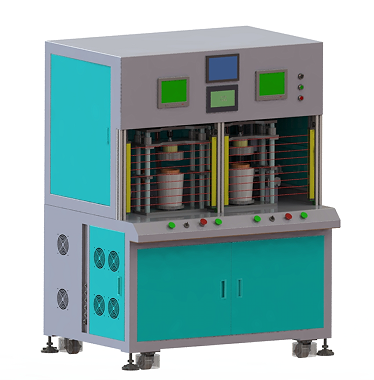
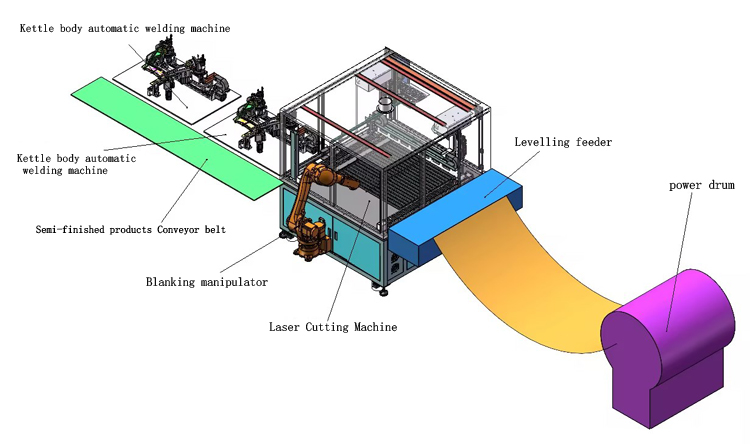
As a leading laser equipment supplier, we specialize in dual-station enclosed laser welding machines tailored for high-efficiency, precision-driven production of kettles and thermal containers. Combining advanced automation, enclosed safety design, and dual-station flexibility, these systems are engineered to meet the rigorous demands of modern manufacturing. Below, we outline the key features and competitive advantages of our cutting-edge solutions.
Key Features
1.Dual-Station Synchronized Operation
Two independent welding stations enable simultaneous processing of multiple kettles or components, reducing idle time and boosting throughput by up to 50%.
Automated loading/unloading systems allow seamless transitions between workpieces, minimizing manual intervention.
2.Fully Enclosed Safety Design
Sealed Chamber: Prevents laser radiation, fumes, and debris from escaping, ensuring operator safety and compliance with CE/OSHA standards.
Fire-Resistant Materials: Flame-retardant enclosure components mitigate risks during high-power welding operations.
3.Ultra-High Precision Welding
Achieves micron-level accuracy (±0.03 mm) with fiber laser sources (1–3 kW) and automated motion control, ideal for intricate seams and micro-joints in stainless steel, aluminum, and coated materials.
Minimal heat-affected zone (HAZ) ensures minimal thermal distortion, preserving structural integrity and aesthetic quality of kettle surfaces.
4.Non-Contact Welding Technology
Eliminates mechanical stress on delicate components, preventing cracks or deformations common in thin-walled kettle designs.
Capable of welding complex geometries, including curves, angles, and hard-to-reach areas, via flexible fiber optic beam delivery.
5.Smart Automation and Control
AI-Driven Optimization: Real-time adjustments compensate for material inconsistencies or thermal warping, ensuring consistent weld quality.
User-Friendly Interface: LCD touchscreens and pre-programmed welding parameters simplify operation for diverse materials (e.g., stainless steel, titanium, copper).
6.Environmental and Energy Efficiency
Fume Extraction Systems: Integrated filters capture particulates and gases, maintaining clean air quality and compliance with environmental regulations.
Energy-efficient fiber lasers reduce power consumption by 30% compared to CO₂ lasers.
Competitive Advantages
1.Superior Productivity
High-Speed Welding: Processes materials at speeds exceeding 20 m/min, significantly outpacing traditional TIG or MIG methods.
24/7 Operation: Robust design and automated workflows enable continuous production cycles.
2.Cost Efficiency
Reduced Labor Costs: Dual-station automation cuts manual labor requirements by up to 60%.
Material Savings: Precision welding minimizes scrap rates, while intelligent nesting software optimizes material usage.
3.Enhanced Weld Quality
Airtight and Watertight Seals: Produces bubble-free, smooth welds critical for kettle durability and leak-proof performance.
No Post-Processing: Burr-free edges and uniform weld seams eliminate the need for grinding or polishing.
4.Versatility for Complex Applications
Welds dissimilar materials (e.g., stainless steel to copper) and handles varying thicknesses (0.5–8 mm), ideal for multi-layer kettle components.
Suitable for vacuum or inert gas environments, enabling welding of oxidation-sensitive materials.
5.Future-Proof Scalability
Modular design allows upgrades (e.g., higher-power lasers, robotic arms) to adapt to evolving production needs.
Compatible with Industry 4.0 platforms for real-time monitoring and predictive maintenance.
Applications in Kettle Manufacturing
Seam Welding: Precision joining of kettle bodies and lids with airtight seals.
Handle and Spout Assembly: Strong, aesthetic welds for ergonomic components3.
Multi-Layer Insulation: Welding of vacuum-insulated layers in high-end thermal containers.
Specification Comparison
| Specification | Single Station Kettle Welder | Double Station Kettle Laser Welding Machine |
|---|---|---|
| Welding stations | 1 | 2 |
| Cycle time (per kettle) | 45–60 seconds | 22–30 seconds |
| Laser power | 1000–1500 W | 1500–3000 W |
| Weld speed (seam) | 30–50 mm/s | 50–80 mm/s |
| Weld penetration depth | 0.8–1.2 mm | 1.0–1.8 mm |
| Positioning accuracy | ±0.05 mm | ±0.02 mm |
| Annual throughput (8h shift) | 480–640 units | 960–1300 units |
| Floor space required | 4.5 m² | 7.0 m² |
Frequently Asked Questions
What is the maximum welding speed per station for the Double Station Kettle Laser Welding Machine?
The machine achieves a maximum welding speed of 120 mm per second per station, enabling full kettle circumference welding in under 8 seconds.
What is the achievable weld seam consistency tolerance across both stations?
The system maintains a weld seam position tolerance of ±0.05 mm across both stations, ensuring identical weld quality for every kettle body produced in a dual-cycle operation.
What is the estimated annual production capacity for standard 1.8L kettles?
At a 95% uptime rate, the double station design yields an annual output of approximately 420,000 standard 1.8L kettles, doubling single-station throughput while requiring only 30% more floor space (4.2 m² total footprint).
What is the typical laser source power and its associated operating cost per hour?
The machine is equipped with a 1500W fiber laser source, producing an operating cost of roughly $2.80 per hour per station when factoring in power consumption, assist gas, and scheduled maintenance at standard industrial electricity rates.
What is the changeover time between different kettle diameters?
Tool-less changeover between kettle diameters ranging from 120 mm to 200 mm takes less than 4 minutes per station, with automatic fixture adjustment and recipe recall reducing operator intervention by 60%.
What is the warranty coverage and expected service interval for the laser source?
The laser source carries a 24-month or 20,000 operating hours warranty (whichever comes first), with recommended preventive maintenance every 2,000 hours of operation to maintain the specified ±0.02 mm repeatability.