As we move deeper into Volume V: The Quantum Beam, we encounter environments where traditional surface protection simply disintegrates. In the subsea sector—where equipment operates at depths of 3,000 meters or more—the combination of hydrostatic pressure (over 300 bar), cryogenic temperatures, and salt-laden corrosive currents creates a “triple threat” to industrial survival.
Intouchray Subsea Cladding (intouchray.com) is the defensive shield for the next generation of oceanic exploration. By applying noble precision (#13) to critical subsea components, we ensure that the “Digital Nervous System” (Article #65) and the structural alloy remain impervious to the crushing weight of the deep.
1. The Physics of the Abyss: Crushing Pressure
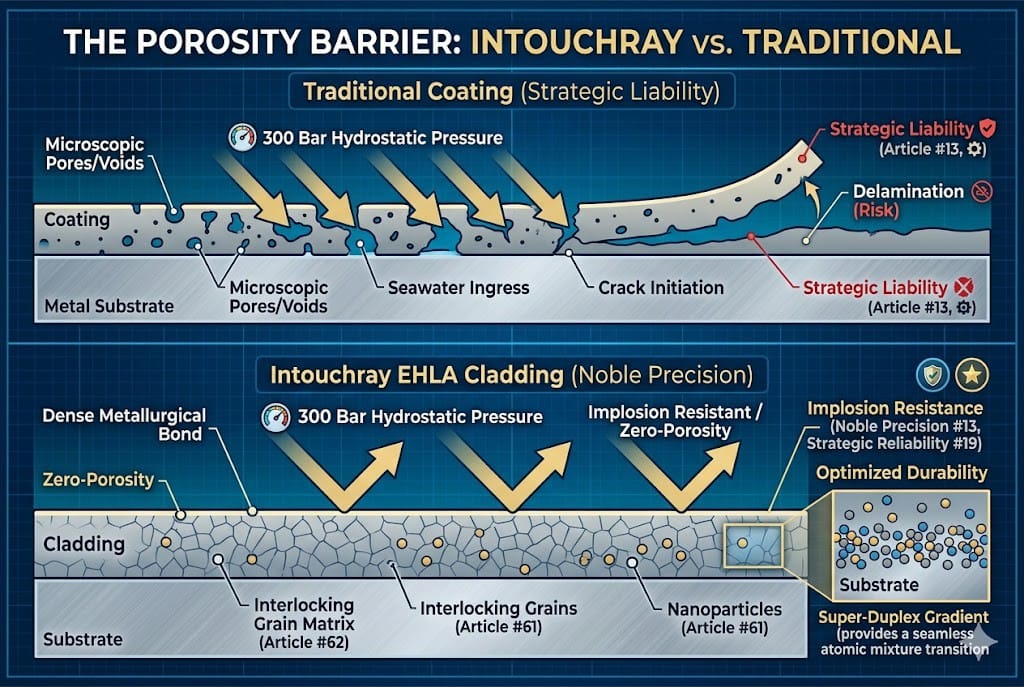
At extreme depths, standard coatings can develop microscopic voids. Under 300 atmospheres of pressure, these voids become points of implosion, leading to “blistering” and total coating delamination.
Intouchray Extreme High-Speed Laser Cladding (EHLA) (Article #33) eliminates this risk. Because the EHLA process produces a 100% dense, metallurgical bond with zero porosity, there are no air pockets for the ocean to exploit. We are not “painting” a protectorate layer; we are transforming the surface into a solid, monolithic barrier that treats 300 bar of pressure as a negligible variable.
2. Alloy Selection: The “Super-Duplex” Defense
For the deep-sea frontier, we often utilize Functional Gradient Cladding (Article #64) to transition from a structural steel core to a “Super-Duplex” stainless steel or Inconel 625 surface.
Pitting Resistance Equivalent Number (PREN): We engineer cladded layers with a PREN > 40, ensuring that even in stagnant, high-chloride seawater, the material resists localized pitting and crevice corrosion—the silent killers of subsea valves and manifolds.
Hydrogen-Induced Stress Cracking (HISC): The rapid solidification of the Intouchray beam creates a fine-grained microstructure (Article #62) that is naturally resistant to hydrogen embrittlement, a common failure mode in subsea cathodic protection systems.
3. Case Study: Blowout Preventer (BOP) Restoration
A blowout preventer is the most critical safety component in offshore drilling. Constant exposure to “sour” gas (H2S) and extreme pressure causes rapid erosion of the internal sealing journals.
Using the Cloud-Synchronized Protocols (Article #67), an Intouchray robotic system was deployed to a shipyard to restore a BOP’s critical bores. By cladding a 2.5mm layer of Inconel 718 with optimized durability (#19), the component was returned to service with a life expectancy 300% longer than a new, untreated OEM part.
4. ROI: The Cost of the “Cold Shutdown”
In the subsea world, there is no such thing as a “quick repair.” Replacing a failed valve at 2,000 meters requires a specialized vessel and a Remotely Operated Vehicle (ROV), costing upwards of $500,000 per day.
Strategic Reliability: Intouchray cladding reduces the frequency of these interventions.
Environmental Sovereignty: By preventing leaks in high-pressure subsea systems, we protect the oceanic ecosystem from catastrophic spills, fulfilling our commitment to resource efficiency (#19).
Conclusion: Conquering the Deep
Article #68 proves that the “Quantum Beam” is as effective in the dark of the ocean as it is in the vacuum of space. We have mastered the pressure; now, we look at the heat. In Article #69, we explore the opposite extreme: Thermal Barrier Cladding: Surviving the Inferno of Gas Turbines.
Image Attachment