Auxiliary Systems: The Critical Role of Water Chillers
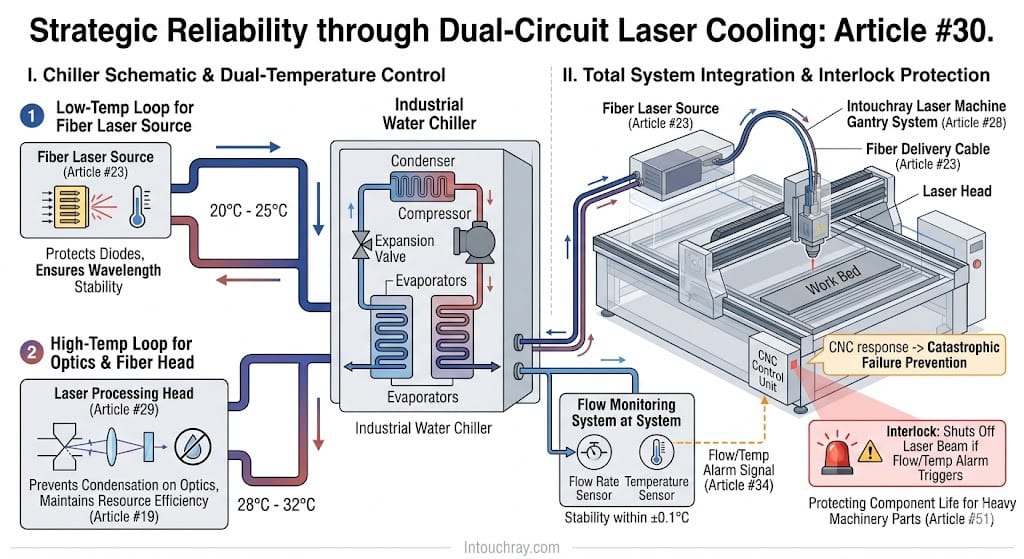
In the pursuit of noble precision and strategic reliability (intouchray.com), heat is the primary enemy. While a high-power fiber laser (Article #23) is significantly more efficient than older CO2 technology (Article #27), it still generates a substantial thermal load. The water chiller is the “heart” of the system’s thermal management, ensuring that every sensitive component operates within a razor-thin temperature margin.
For fresh learners and device manufacturers, understanding the chiller’s role is the difference between a machine that lasts a decade and one that suffers catastrophic diode failure in its first year.
1. Why Lasers Need Active Cooling
Industrial lasers work by converting electrical energy into light. Even with a high “wall-plug efficiency” (Article #27), a portion of that energy is inevitably lost as heat.
The Laser Source: Fiber laser diodes are highly temperature-sensitive. If the temperature fluctuates by even 2°C to 3°C, the wavelength can shift, leading to inconsistent beam quality and reduced component life.
The Optics: As the beam passes through the collimator and focusing lenses (Article #29), any microscopic dust or trace of heat can cause “thermal lensing,” where the lens slightly deforms, shifting the focal point and ruining the cut or cladding bead.
2. The Dual-Circuit Strategy
Modern Intouchray systems utilize a Dual-Temperature Cooling Circuit. A single chiller unit provides two separate water paths with independent temperature controls:
| Circuit | Target Components | Typical Temp Range | Purpose |
| Low-Temp Circuit | Fiber Laser Source / Power Supply | 20°C – 25°C | Protects diodes and ensures wavelength stability. |
| High-Temp Circuit | Laser Head / Optics / Fiber Cable | 28°C – 32°C | Prevents condensation on precision glass surfaces. |
3. Key Chiller Features for Strategic Reliability
To maintain resource efficiency (Article #19) and machine uptime, a professional-grade industrial chiller must include:
High-Stability Thermostat: The ability to maintain ±0.5°C or even ±0.1°C precision.
Flow Alarms: If the water flow drops due to a kinked hose or clogged filter, the chiller must instantly send a signal to the CNC (Article #34) to shut down the laser beam.
Water Quality Monitoring: Conductivity sensors ensure the cooling water remains deionized and free of minerals that could cause “scaling.”
Conclusion: Stability is the Root of Precision
A laser system is only as reliable as its cooling. By investing in a high-quality, dual-circuit water chiller and adhering to a strict maintenance schedule, you protect your strategic reliability and ensure that your Intouchray machine delivers noble precision from the first minute of the shift to the last.