Mastering the Cut: The Critical Role of Laser Nozzle Centering
In the world of high-precision fiber laser cutting, maintaining a pristine beam and stable process parameters (Article #4) is only half the battle. To ensure consistent part quality, dimensional accuracy, and clean edges, operators must master one often-overlooked procedure: Laser Nozzle Centering.
As discussed in Article #4 regarding 20mm stainless steel, parameter optimization is essential. However, even with perfect parameters, an uncentered nozzle will introduce instability and defects, especially as laser power increases (a trend discussed in Article #5). Nozzle centering is not just a maintenance task; it’s a critical adjustment that directly impacts the kerf formation and the assist gas dynamics, which are crucial for heavy plate cutting (Article #4).
- What is Laser Nozzle Centering and Why Does it Matter?
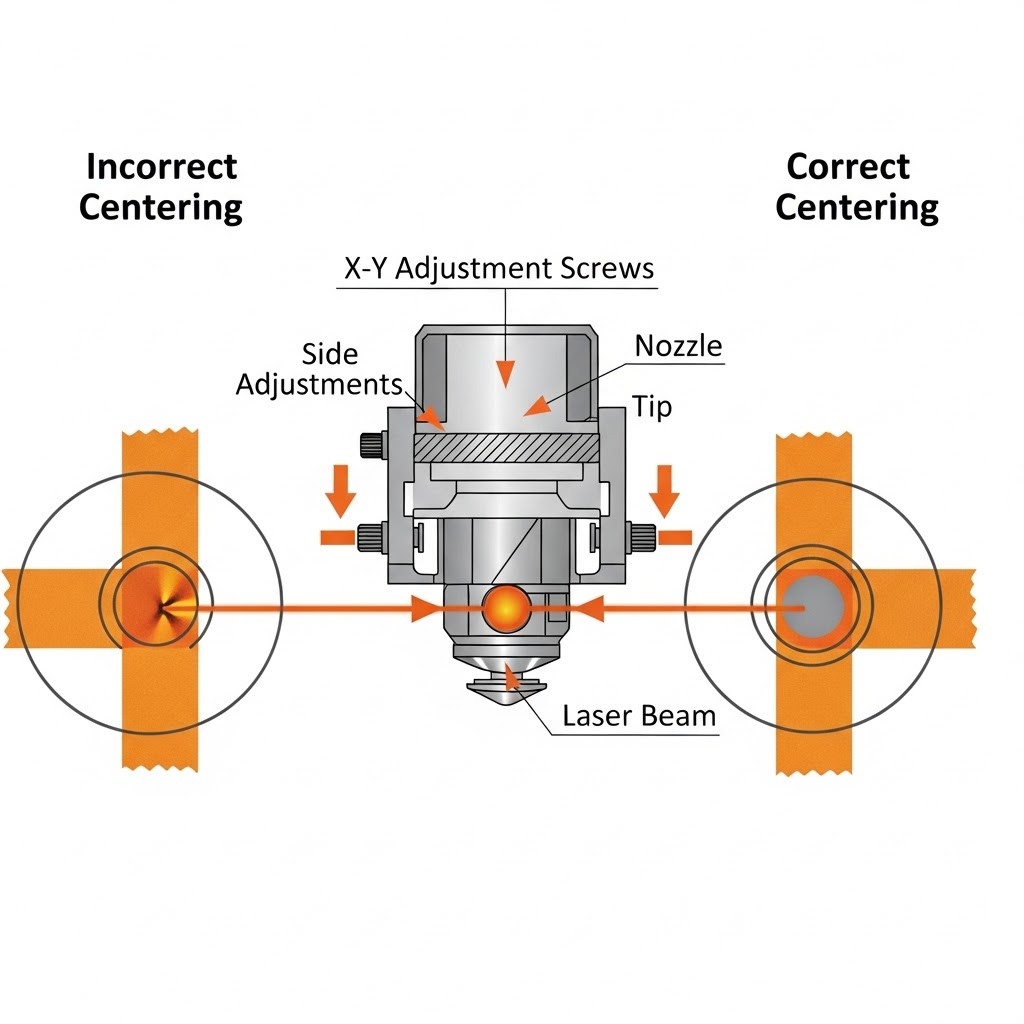
A laser nozzle is essentially a consumable tip at the end of the cutting head that shapes the assist gas jet (Article #4) and protects the internal optics. Centering involves meticulously aligning the nozzle’s central aperture with the exact optical axis of the focused laser beam.
When the nozzle is off-center, several negative consequences arise:
Asymmetric Kerf: The laser beam might clip one side of the nozzle opening. This distorts the energy profile, leading to an unequal kerf width or an angled cutting edge (beveling).
Assist Gas Turbulence: Assist gas (e.g., Nitrogen or Oxygen, Article #4) doesn’t flow uniformly. This turbulence disrupts the removal of molten metal, causing rougher edges, excessive dross, and even ‘burn-through’ defects.
Reduced Consumable Life: A misaligned beam can strike and overheat the nozzle tip itself, significantly shortening its lifespan and increasing operational costs.
Cutting Instability: An uncentered nozzle can cause unpredictable cutting behavior, making it difficult to achieve consistent results, particularly on thicker materials where tolerances are tighter (Article #4).
- The Traditional Manual Centering Process
Historically, nozzle centering has been a manual, iterative process. It typical involves:
Beam Spot Check: An operator fires a low-power beam pulse (often on a piece of adhesive tape) and visually inspects the resulting ‘burn mark’ relative to the nozzle opening.
Mechanical Adjustment: Small set screws or adjustment knobs on the cutting head are used to move the nozzle horizontally in X and Y directions.
Repeat & Refine: This process is repeated multiple times, making increasingly finer adjustments until the burn mark is perfectly concentric within the nozzle aperture.
While effective, this manual method is time-consuming, requires operator skill, and must be performed frequently, especially after nozzle changes or crashes, impacting machine uptime and overall productivity (a metric emphasized in Article #5 for robotic cells).
- Advancing with Technology: Automated Nozzle Centering
Modern high-performance fiber laser systems, like those offered by Intouchray, are moving beyond manual alignment. Advanced cutting heads now incorporate integrated sensors and vision systems to automate the centering process:
Camera-Based Systems: A high-resolution camera images the nozzle tip and the laser spot simultaneously. Sophisticated software algorithms then calculate the required X/Y adjustments and automatically actuate motorized drives to recenter the nozzle.
Sensor-Based Systems: Other systems utilize capacitance or force sensors to detect the nozzle’s position and provide feedback for automated or guided centering.
Automated systems significantly reduce the time required for centering (often to under a minute), minimize operator error, ensure peak cutting performance, and maximize machine utilization, which is essential for achieving high ROI in large-scale automation environments (Article #5).
Conclusion
Achieving the perfect cut is not solely dependent on high-power laser sources or sophisticated motion systems (Article #5). Maintaining proper nozzle centering is a fundamental requirement for process stability and consistent quality. Whether utilizing traditional manual methods or advanced automated systems, ensuring that the laser beam and the assist gas jet are perfectly co-axial is essential for maximizing the capabilities of any fiber laser cutting machine.
Image Attachment