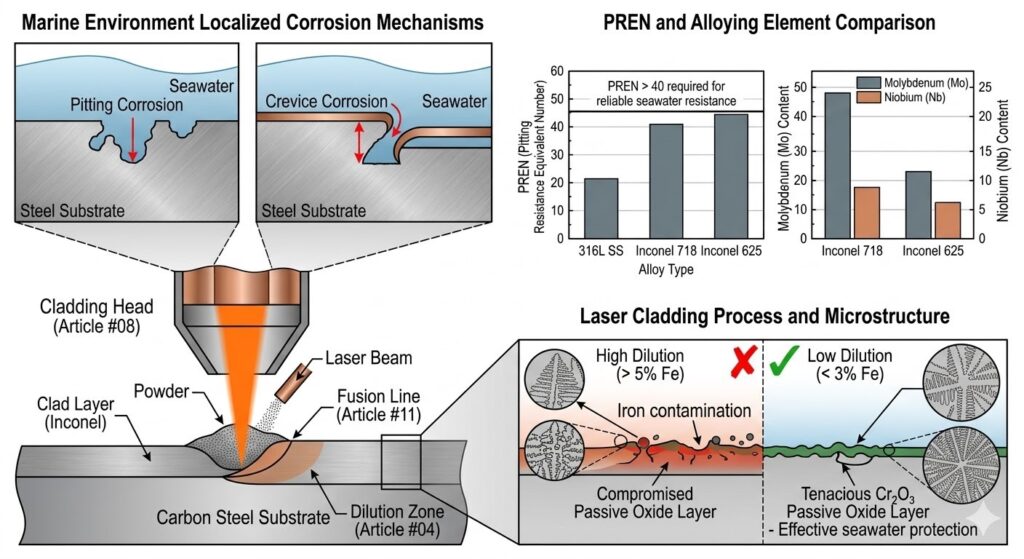
Corrosion is the single greatest threat to subsea engineering and marine infrastructure. Components like hydraulic piston rods on offshore platforms, riser clamps, and propeller shafts are constantly exposed to the harsh, chloride-rich environment of seawater. This exposure triggers pitting, crevice corrosion, and stress corrosion cracking (SCC), rapidly degrading performance and leading to catastrophic failure.
Traditional solutions, such as chrome plating, are insufficient for long-term submersion and pose significant environmental risks (Article #01). Laser cladding (using high-power fiber lasers, Article #02, #08) has emerged as the premier technology for applying dense, metallurgically bonded (Article #11) corrosion-resistant alloys (CRAs). Among these, nickel-based superalloys—specifically Inconel 625 and Inconel 718—stand out as the definitive materials for combatting marine corrosion.
1. The Chemistry of Resistance: How Inconel Works
Inconel alloys derive their extraordinary corrosion resistance from their high nickel (Ni) and chromium (Cr) content.
Nickel (Ni): Provides the base matrix (a stable austenite phase) and offers fundamental resistance to reducing acids and caustic environments.
Chromium (Cr): A critical alloying element that forms a passive, tenacious, and self-healing oxide layer (Cr₂O₃) on the surface, blocking further oxidation and corrosion.
However, for marine environments, simple stainless steels (which rely only on Cr) are often inadequate against localized attack. This is where Inconel superalloys excel.
2. Deep Dive: Inconel 625 vs. Inconel 718
While both are nickel-chromium-molybdenum alloys, they have distinct metallurgical profiles and optimal applications.
Inconel 625: The Corrosion Champion
Inconel 625 is generally considered the premier choice for pure corrosion resistance in marine applications.
Key Alloying Element: Molybdenum (Mo, ~9%) and Niobium (Nb, ~3.5%). These elements are added specifically to enhance localized corrosion resistance.
Mechanism: Mo and Nb stabilize the passive Cr oxide layer and significantly increase resistance to pitting (Pitting Resistance Equivalent Number, PREN, often >45) and crevice corrosion in seawater.
Typical Applications: Hydraulic rods for wave energy converters, offshore valves, subsea manifolds, and components directly exposed to tidal splash zones.
Inconel 718: High Strength with High Resistance
Inconel 718 is a precipitation-hardening alloy, designed when high mechanical strength must be combined with good corrosion resistance.
Key Alloying Element: Higher iron (Fe, up to 20%), with significantly more Niobium (Nb, ~5%) and some Titanium (Ti) and Aluminum (Al).
Mechanism: Strength is achieved through heat treatment, precipitating gamma prime (γ’) and gamma double prime (γ”) phases within the nickel matrix. This provides exceptional yield strength and fatigue resistance while maintaining noble corrosion behavior.
Typical Applications: High-load propeller shafts, riser clamps, and structural components in marine machinery requiring superior strength and durability.
PREN Comparison Table
| Alloy | Typical Composition (Ni/Cr/Mo) | PREN Range | Primary Application Focus |
| Carbon Steel (Substrate) | Bal / <1 / <1 | Low | Base Material |
| 316L Stainless Steel | 12 / 17 / 2.5 | 23 – 26 | Mild Corrosion |
| Inconel 718 | Bal / 19 / 3 | ~32 – 38 | High Strength + Corrosion |
| Inconel 625 | Bal / 22 / 9 | >45 | Peak Corrosion Resistance |
PREN = %Cr + 3.3 x %Mo + 16 x %N. PREN values >40 are typically required for reliable long-term resistance in seawater.
3. Laser Cladding Inconel: Process & Metallurgy for Marine Service
Applying Inconel clad layers requires careful parameter selection (Article #03, #04) and process monitoring (Article #09) to optimize performance:
Low Dilution is Critical (Article #04)
Dilution introduces iron (Fe) from the carbon steel substrate into the Inconel layer. High iron content compromises the passive oxide layer, drastically reducing the PREN. Successful marine cladding must maintain dilution below 5% (often <3%) to ensure the clad layer retains the chemical composition and corrosion performance of the source powder.
Managing Residual Stress (Article #17)
The significant difference in coefficient of thermal expansion (CTE) between Inconel alloys and carbon steel can create high tensile residual stresses at the interface (Article #11). These stresses must be managed via optimization of deposition strategy, pre-heating, or interpass temperature control to prevent delamination or Stress Corrosion Cracking (SCC) in service.
Conclusion
For critical components in marine engineering, the corrosion battle is won or lost at the material surface. By utilizing high-power fiber laser cladding (Article #08) and carefully selecting either Inconel 625 (for peak pitting resistance) or Inconel 718 (for strength-corrosion synergy), manufacturers can apply dense, metallurgically bonded (Article #11) protective coatings that far exceed traditional options. Combatting corrosion with these advanced superalloys is an essential strategy for ensuring the long-term reliability and safety of offshore and subsea infrastructure.