Laser Cladding for the Mining Industry: Reclaiming the Earth
In the deep-earth environments of global mining, machinery faces a brutal combination of high-impact abrasion, chemical corrosion, and extreme mechanical stress. Traditionally, when a hydraulic cylinder or a drill bit wore down, it was scrapped.
Today, High-Speed Laser Cladding (Article #33) allows for the “rebirth” of these components, offering resource efficiency (#19) that traditional hard-facing simply cannot match.
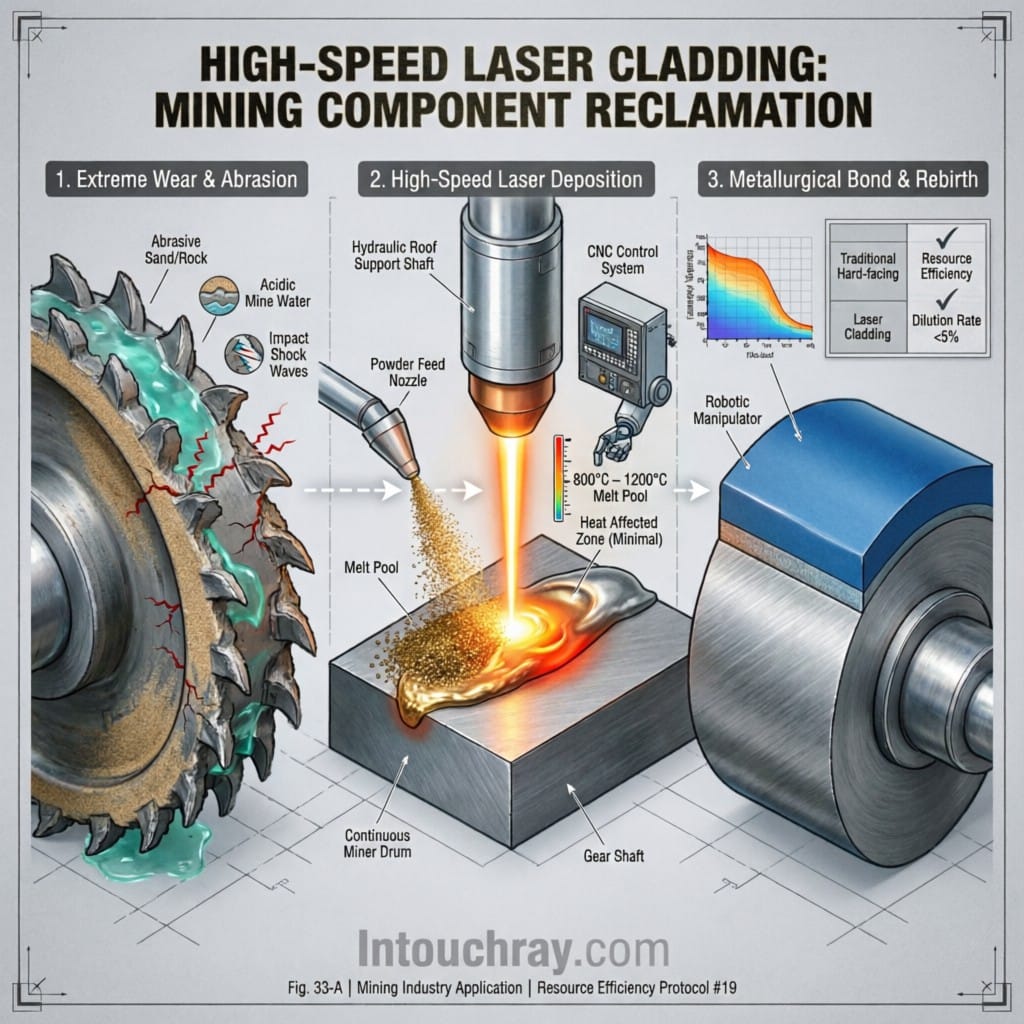
- The Challenge: Extreme Wear and Abrasion
Mining components—such as hydraulic roof supports, continuous miner drums, and large-scale gear shafts—operate in a “closed-loop” of destruction.
Abrasive Wear: Sand, rock, and mineral dust act as sandpaper, grinding down steel surfaces.
Corrosive Fluids: Highly acidic or alkaline mine water eats away at protective coatings.
Impact Loading: Sudden, heavy shocks can cause traditional brittle coatings to “spall” or flake off.
- Why Laser Cladding Wins in Mining
Traditional repair methods like HVOF (High-Velocity Oxy-Fuel) or Chrome Plating are increasingly being replaced by Intouchray laser cladding systems for three specific reasons:
Metallurgical Bond: Unlike plating, which is a physical layer, cladding creates a true metallurgical weld with the base metal. It will not peel under high pressure.
Low Heat Input: Because the laser is so precise (Article #45), it does not warp the massive shafts. This maintains the strategic reliability of the original part’s dimensions.
Material Versatility: We can apply specialized powders like Tungsten Carbide or Cobalt-based alloys exactly where the wear is highest.
- Case Study: Hydraulic Cylinder Re-manufacturing
Hydraulic cylinders in underground mines are the “muscles” of the operation. If they leak due to corrosion, the entire mine line stops.
The Old Way: Hard Chrome Plating. It is environmentally toxic and prone to “pitting” in salt-heavy mine water.
The Intouchray Way: High-speed cladding with a specialized Stainless Steel/Carbide blend.
The Result: 5x the lifespan in corrosive environments and a 60% reduction in total repair costs.
- High-Speed Cladding (EHLA) in the Field
The mining industry requires speed. EHLA (Extreme High-Speed Laser Additive Manufacturing) allows us to clad large surfaces at rates exceeding 100 meters per minute.
This reduces the “Cycle Time” (Article #18) for large shaft repairs from days to hours.
The resulting layer is extremely dense with near-zero porosity, preventing sub-surface corrosion.
- Environmental and Economic Impact
By “up-cycling” a worn component instead of buying a new one, mining companies achieve noble precision in their financial planning:
Carbon Footprint: Re-manufacturing a part uses 80% less energy than forging a new one from raw ore.
Inventory Control: Instead of waiting 6 months for a replacement part, a laser cladding system can have the part back in service in 48 hours.
Conclusion: The New Standard for Heavy Industry
The mining sector is the ultimate proving ground for Intouchray technology. If a cladding layer can survive a kilometer underground, it can survive anywhere. In Article #50, we will explore Laser Cladding for the Oil and Gas Industry, focusing on high-pressure valves and offshore corrosion protection.
Image Attachment