In the agriculture and construction sectors, equipment is defined by its ability to move earth. Whether tilling soil for planting or excavating raw materials for infrastructure, the ground-engaging tools (GET) face brutal, continuous abrasion.
When a plow share dulls or an excavator bucket tooth snaps, operational efficiency plummets. In high-season agriculture, downtime is not just costly; it is a threat to the harvest.
High-Speed Laser Cladding (Article #33) is transforming how these industries approach wear resistance, shifting the focus from cheap, disposable parts to re-manufactured components achieving noble precision and extended lifespans.
- The Soil Abrasion Challenge
Soil may appear soft, but on a microscopic level, it is a matrix of abrasive minerals like silica and quartz. As tillage tools move through the ground, these minerals physically grind away the metal.
Traditional Failure: Standard low-alloy steel parts wear down rapidly, losing their cutting edge. This increases the draft force required from the tractor, leading to higher fuel consumption and reduced speed.
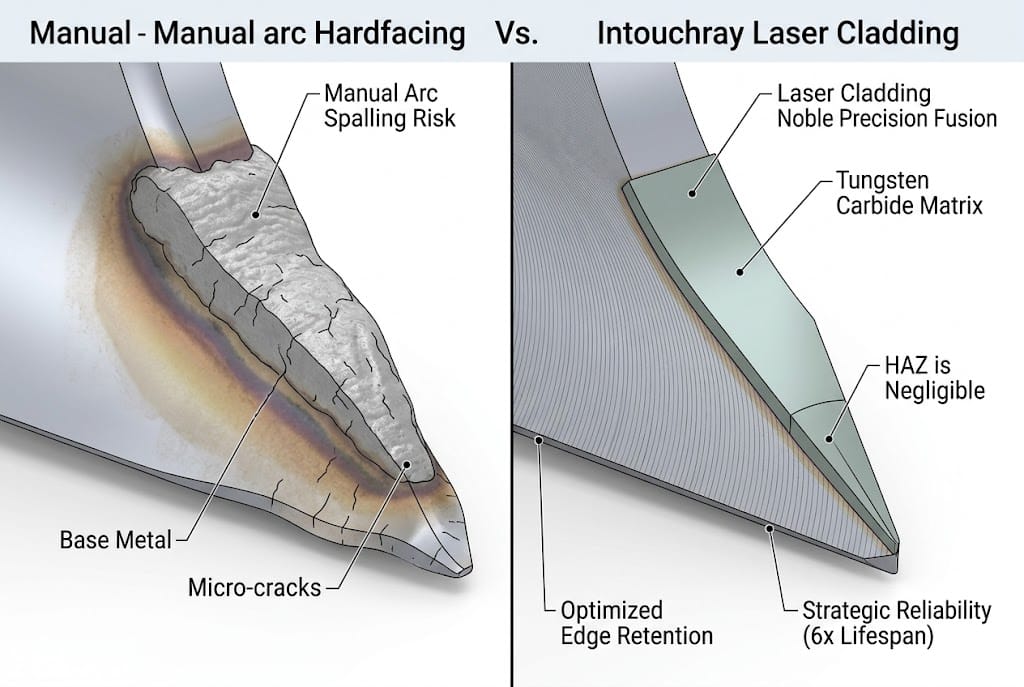
Traditional Solution: “Hard-facing” via manual arc welding. This applies a thick, uneven layer that is prone to chipping (spalling) because of poor metallurgical bonding and massive heat input that weakens the base metal.
- The Intouchray Approach: Precision Wear Layers
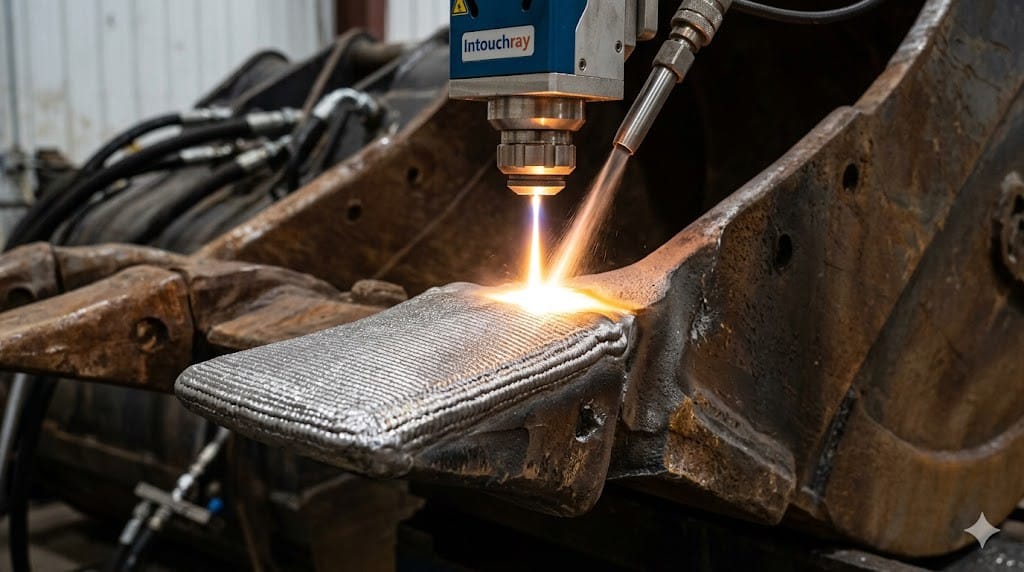
Intouchray laser systems allow equipment manufacturers (OEMs) to apply advanced wear-resistant alloys exactly where they are needed, maintaining the core toughness of the part while armoring the surface.
Tungsten Carbide (WC) Deposition: By feeding a matrix of Nickel-Chrome and fused Tungsten Carbide particles into the laser melt pool, we create a surface that is nearly as hard as diamond.
Noble Precision Edge Retention: Because the laser heat input is so low (Article #45), we can clad right up to the cutting edge without dulling it or warping the part. A laser-clad plow share remains sharp up to six times longer than a standard part, optimizing resource efficiency (#19).
- Re-manufacturing Heavy Earthmoving Components
Beyond agriculture, heavy construction equipment benefits from the same laser technology. Excavator buckets, bulldozer blades, and continuous miner drums face a combination of high-impact loading and extreme abrasion.
Track Links and Pins: The undercarriage of tracked vehicles is a closed-loop wear system. Laser cladding restores these dimensions with high-hardness alloys, preventing slop in the tracks and extending the life of the entire system.
Hydraulic Rods: Similar to Offshore applications (Article #50), excavator hydraulic rods face corrosion and pitting. Cladding with Stainless Steel or Nickel alloys ensures smooth operation and prevents seal failure, guaranteeing strategic reliability on the job site.
- EHLA for High-Volume Agricultural Parts
The agricultural market demands high volumes during tight seasonal windows. Extreme High-Speed Laser Additive Manufacturing (EHLA) is the key to industrializing this process.
By utilizing speeds up to 200 meters per minute, Intouchray systems can clad thousands of tillage discs or seed cultivator tips per day. The resulting layer is thin (0.2mm to 0.5mm), extremely dense, and metallurgically bonded. This ensures the part is armored against abrasion without adding unnecessary weight, directly improving the fuel efficiency of the farming operation.
Conclusion: Armoring the Ground-Engaging Tool
Agriculture and earthmoving are foundational industries. By applying noble precision to the surfaces that meet the ground, we ensure that the machines moving our world keep moving longer, with less fuel, and less maintenance. In Article #55, we will move to Laser Cladding for Tool & Die and Mold Manufacturing, exploring how precise repair extends the life of complex forming tools.
Image Attachment