We explore how advanced laser processing is integrating into the future of manufacturing and Industry 4.0.
The first nine articles of this series have detailed the precision of laser cladding (Article #01-04), its robotic and gantry scaling (Article #05, #08), essential subsystems like nozzle centering (Article #06) and cooling (Article #07), and the intelligence of adaptive control (Article #09). These are the pillars of modern laser manufacturing. However, the true transformation of the industrial landscape is happening now, as these isolated solutions integrate with the broader digital ecosystem: Industry 4.0.
Industry 4.0, or the Fourth Industrial Revolution, is characterized by interconnectivity, automation, machine learning, and real-time data data sharing. For advanced laser processing, this integration means moving beyond machine-level intelligence (Adaptive Control – Article #09) to system-wide synchronization. The future of laser cutting, welding, and cladding isn’t just faster or more precise; it is connected, predictive, and agile.
- Digital Twins and Process Simulation
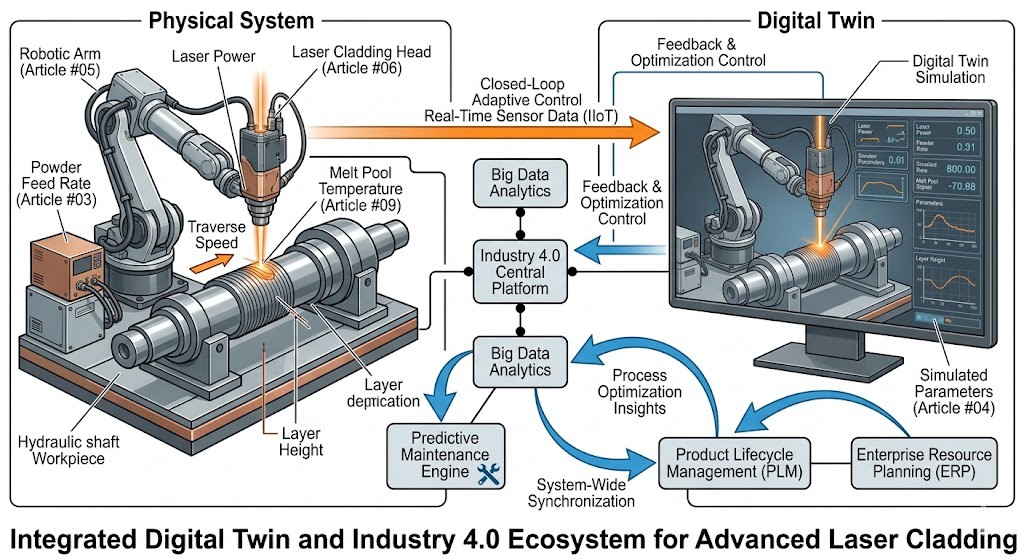
One of the most powerful enablers of Industry 4.0 is the Digital Twin. This is a virtual mirror of the entire laser processing system, from the physical machine geometry (Gantry Article #08 or Robot Article #05) to the real-time metallurgical interaction of the laser and material (Article #04).
By leveraging data collected from in-process monitoring (Article #09), manufacturers can create highly accurate digital twin simulations. This allows operators to visualize and validate complex tool paths, simulate heat accumulation on difficult-to-cladding substrates, and optimize laser parameters (Article #04) entirely in a virtual environment before any material is processed. This capability virtually eliminates ‘trial-and-error’ setup, slashing development time and material waste while ensuring ‘first-time-right’ quality on critical components.
- The IIoT: Interconnected Systems
The Industrial Internet of Things (IIoT) connects the laser machine, sensors, and peripherals (like the water chiller from Article #07 or powder feeder from Article #03) to a central network. This connectivity allows data to flow seamlessly between the physical equipment and enterprise-level software systems (like MES or ERP).
This system-wide view transforms production. An IIoT-connected laser gantry (Article #08) can automatically adjust its processing speed based on real-time feedback from a downstream quality inspection station, or a robotic cladding cell (Article #05) can order its own replacement consumables (Article #06) directly from a supplier when sensor data indicates high wear.
- Big Data and Predictive Maintenance
A single high-power fiber laser system with integrated adaptive control (Article #09) generates gigabytes of data every hour. When scaled across a factory connected via IIoT, this is Big Data.
By applying advanced analytics and machine learning algorithms to this vast data pool, manufacturers can move beyond reactive or preventative maintenance to Predictive Maintenance. Instead of replacing a laser nozzle (Article #06) or checking water chiller levels (Article #07) according to a fixed schedule, the system can predict exactly when a component will fail. By analyzing subtle patterns in power consumption, vibration, or temperature, maintenance can be scheduled during planned downtime, eliminating catastrophic system failures and maximizing overall equipment effectiveness (OEE).
- Machine Learning and the Autonomous Factory
The ultimate goal of Industry 4.0 integration is the smart, autonomous factory. As machine learning models process Big Data, they go beyond optimizing the parameters for a single component (Article #04) and begin to optimize entire production flows.
A factory might feature multiple laser systems (Article #05, #08) processing different parts. A smart factory system can autonomously reroute workloads based on real-time equipment availability, optimize energy consumption by scheduling high-power operations for off-peak hours, or instantly adapt to a new customer design by automatically generating tool paths and selecting parameters validated on the digital twin.
Conclusion: The Future is Now
The integration of advanced laser materials processing with the technologies of Industry 4.0 is not a distant future; it is already transforming leading-edge manufacturing facilities today. By harnessing the power of interconnectivity, real-time data, digital twins, and predictive analytics, companies can unlock levels of agility, efficiency, and quality that were previously impossible, defining the future of advanced manufacturing.
Image Attachment