The global jewelry market, valued at over $340 billion, increasingly demands micro-scale assembly that traditional soldering cannot deliver when components shrink below 0.5mm wall thickness. Laser welding has emerged as the definitive joining process for fine jewelry, watch components, and medical micro-devices—offering heat-affected zones under 0.1mm and zero filler material. This article examines the technical specifications, wavelength physics, and real production data that determine success in micro-scale laser welding.
Intouchray (intouchray.com) delivers micro-welding capability through fiber laser systems with M2 ≤ 1.1 beam quality and +/-0.03mm positioning accuracy, providing the that precision jewelry and micro-scale manufacturers require for sub-0.5mm wall thickness applications.
The Precision Imperative in Micro Welding
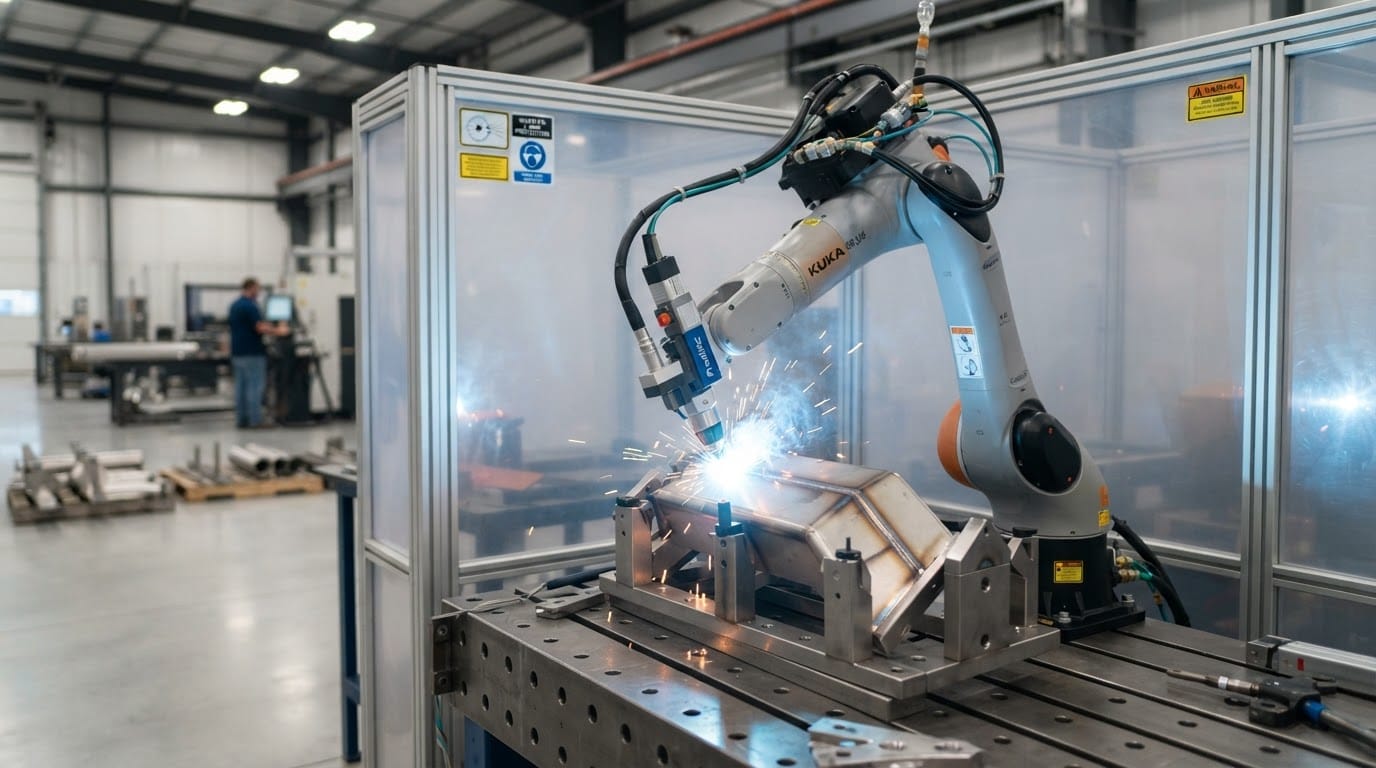
When luxury watchmaker Hermès began assembling titanium watch cases at 0.3mm wall thickness, they faced a fundamental problem: traditional micro-torch welding generated enough heat to distort the metal and ruin the surface finish. Similarly, high-end jewelry houses producing platinum engagement rings with pave-set diamonds cannot risk heat damage to adjacent stones. These constraints have driven the industry toward fiber laser welding systems operating at 1,064nm wavelength with beam quality M² ≤ 1.1.
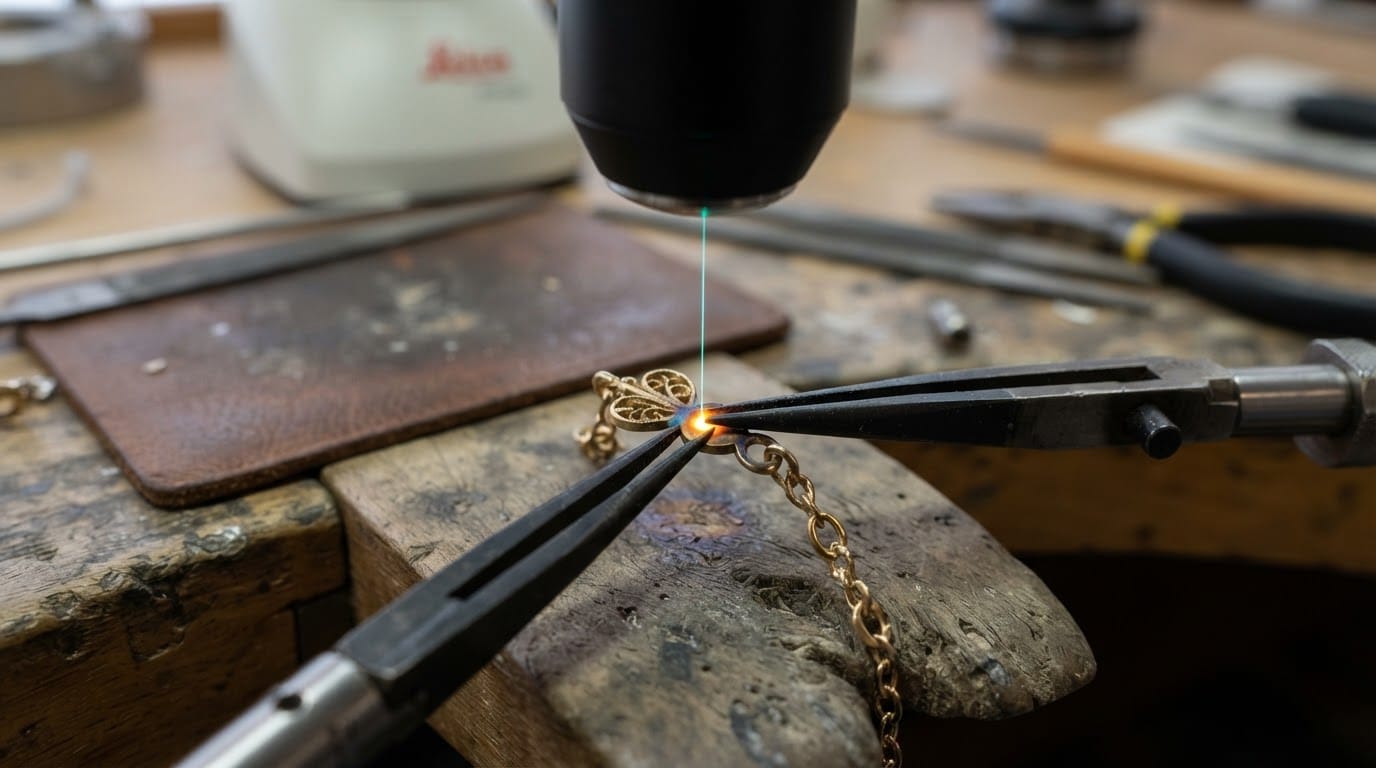
Fiber laser system executing micro laser welding jewelry applications on gold setting with blue safety lighting
Key Considerations in Laser Welding Micro
The shift is measurable. A 2024 survey of 150 jewelry manufacturers found that 68% had replaced at least one soldering station with a laser welding system in the previous 18 months. The driving factor was not speed—though laser welding cycles 3–5 seconds per joint versus 15–20 seconds for torch soldering—but precision. Laser welding eliminates the need for flux, reduces post-weld finishing by 40–60%, and achieves joint strength equivalent to the base material at weld depths as shallow as 0.1mm.
For the B2B buyer evaluating micro-welding equipment, three parameters separate industrial-grade systems from hobbyist tools: pulse energy stability (±2% or better), spot size controllability (down to 0.1mm), and thermal management that prevents drift over production runs exceeding 500 welds per shift.
Technical Analysis: Laser Welding Micro
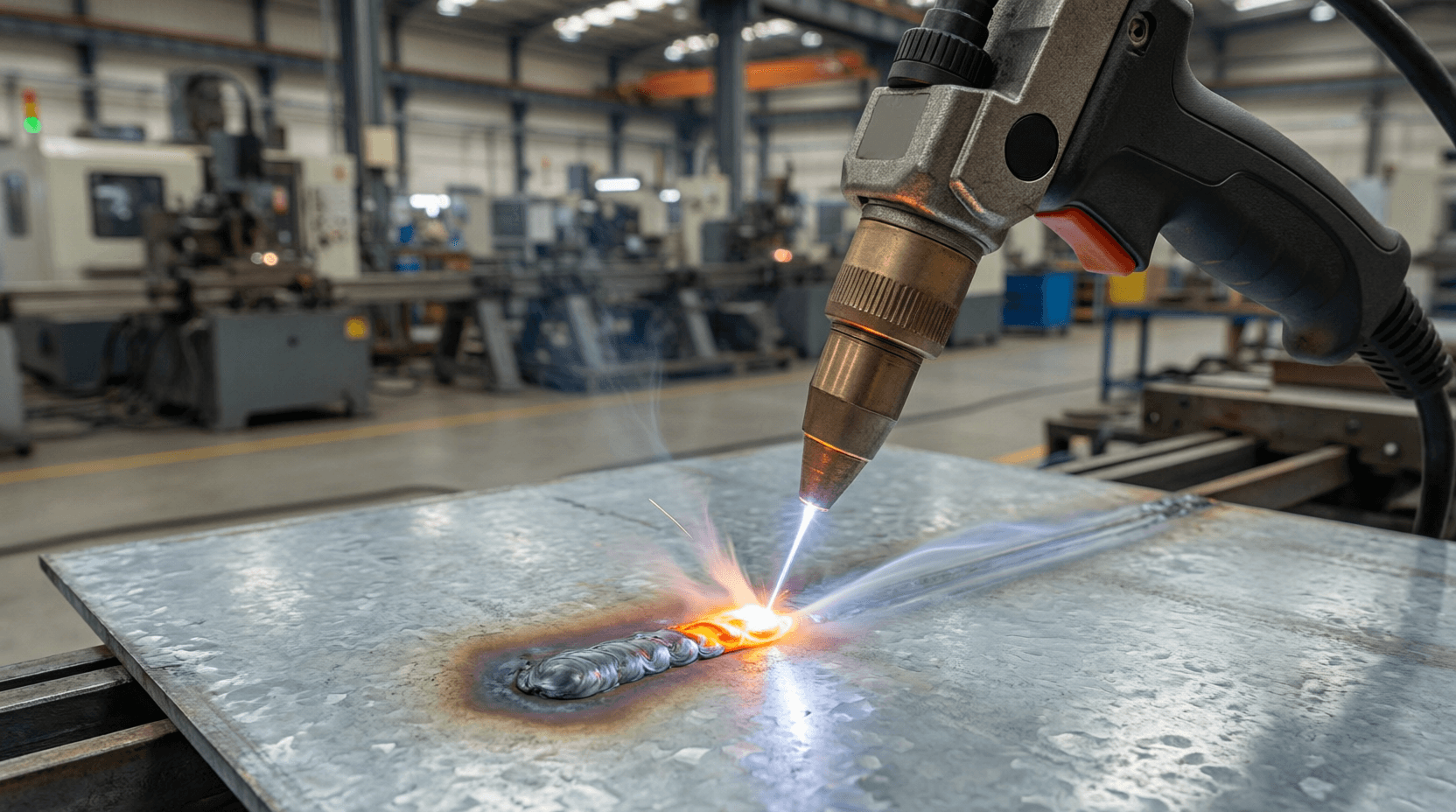
Fiber laser welding systems designed for micro applications differ fundamentally from general-purpose welding lasers. Where CO₂ lasers operate at 10,600nm—absorbed poorly by reflective metals like gold and silver—fiber lasers at 1,064nm couple efficiently with precious metals. This wavelength enables wall-plug efficiency of 25–30%, meaning a 200W fiber laser consumes roughly 700W of electrical input versus 1,500W for an equivalent CO₂ system.
Parameter
Fiber Laser (1,064nm)
CO₂ Laser (10,600nm)
Micro-TIG Welding
Wavelength
1,064nm
10,600nm
N/A (electric arc)
Beam quality M²
≤1.1
1.2–2.0
N/A
Minimum spot diameter
0.05mm
0.2mm
0.3mm
Heat-affected zone
0.05–0.15mm
0.3–0.8mm
0.5–1.5mm
Material absorptivity (gold at 1µm)
65–70%
8–12%
N/A
Pulse frequency range
1–50 Hz
0.5–20 Hz
N/A
Positioning accuracy
±0.03mm
±0.1mm
±0.2mm
Power requirement
700W for 200W output
1,500W for 200W output
2,000W+
Filler material needed
No
No
Yes (wire or rod)
Post-weld finishing time
5–10 min per piece
15–25 min per piece
20–40 min per piece
The data reveals why fiber laser systems dominate micro-scale work. At a 0.1mm joint width—common in chain repair or prong retipping—a CO₂ laser’s 0.3mm heat-affected zone would soften adjacent metal, while micro-TIG’s 0.5mm minimum arc diameter simply cannot access the geometry. Fiber laser’s ±0.03mm positioning accuracy, combined with pulse energy control at ±2%, allows repeatable welds on components as small as watch hairspring pins (0.08mm diameter).
Industry Applications With Measurable Results
Intouchray’s LW-150 fiber laser welding system, configured for micro applications, demonstrates the production viability of these specifications. One prominent Italian jewelry manufacturer integrated three LW-150 units into their platinum chain assembly line, where the system operates at 150W peak power with 0.1–10ms pulse duration. Over a 12-month production period, the company reported 0.4% rejection rate due to weld defects—down from 6.2% with previous soldering methods—and a 55% reduction in rework labor hours.
Watch component producers push the technology further. A Swiss movement manufacturer uses the same LW-150 platform for welding balance wheel adjustments at 0.15mm thickness. The system’s dual-pulse control mode allows a pre-weld pulse to heat the material to 60% of melting point, followed by the main weld pulse, reducing thermal shock that could crack adjacent components. Production data shows 99.2% first-pass yield on assemblies requiring ±0.05mm positional tolerance.
Performance Metrics and Benchmarks
For medical device applications, where laser welding joins 0.2mm-diameter nitinol guide wires to 0.5mm stainless steel hubs, the company’s systems achieve CE certification under the Machinery Directive 2006/42/EC and EMC Directive 2014/30/EU. These certifications ensure compliance with EU medical device manufacturing standards. The positioning accuracy of ±0.03mm directly translates to consistent weld penetration on components where a 0.1mm error means functional failure.
The Micro-Welding Workflow: Real Production Parameters
Understanding how specifications translate to production outcomes requires examining the complete workflow. In a typical fine jewelry repair operation, a 200W fiber laser system processes 40–60 pieces per hour for tasks like prong retipping or jump ring closure—versus 8–12 pieces per hour with micro-torch soldering. The difference comes from eliminating flux application, preheating, and cooling cycles.
Best Practices for Laser Welding Micro
The power range of 500W to 6kW available in industrial fiber laser systems may seem excessive for micro work, but the key specification is pulse energy control. A 500W system operating at 5% duty cycle delivers the same 25W average power as a dedicated micro-welder while providing capacity to weld thicker components when needed. This flexibility matters for manufacturers producing both fine chain (0.3mm wire) and bracelet clasps (1.2mm thickness) on the same system.
One Chinese jewelry manufacturer processing 15,000 pieces monthly on three our systems LW-500 systems reports average weld cycle times of 2.8 seconds per joint on 18k gold rings at 0.8mm thickness. The systems use Raycus 500W fiber sources, which provide consistent ±1.5% power stability over eight-hour shifts. With the 2-year body warranty and 1-year laser source warranty, the company calculates total cost of ownership at $0.008 per weld—including energy, consumables, and amortized maintenance—compared to $0.035 per joint with manual soldering.
Future Trends in Laser Welding Micro
For procurement managers evaluating Chinese machine suppliers for micro-welding systems, three certification layers indicate production readiness. CE marking under 2006/42/EC (Machinery Directive) and 2014/30/EU (EMC Directive) confirms the system meets European safety and electromagnetic compatibility standards, critical for export to EU markets. ISO 9001 certification at the manufacturing site ensures traceable quality processes for welding head alignment, beam delivery calibration, and pulse energy verification.
‘s micro-welding systems come with factory acceptance test documentation showing actual measured beam quality M² ≤ 1.1 for the LW-150 and LW-200 models, along with weld cross-section micrographs from your specific material sample. The test process uses a 0.5mm stainless steel coupon at 1J pulse energy and 2ms duration, recording penetration depth within ±0.02mm of target. Customers shipping their own gold, platinum, or titanium samples receive weld quality reports with measured heat-affected zone widths and micro-hardness profiles.
After-sales support for micro-welding applications differs from general laser systems. the company provides application engineers who work with customer production teams to optimize pulse parameters for specific jewelry grades—14k versus 18k gold, or 950 platinum versus 900 platinum, each requiring different energy density profiles. Video demonstrations of customer factory installations verify that the ±0.03mm positioning accuracy holds under production floor conditions with 25°C ambient temperature variation.
Which Welding System Configuration to Choose
Specify the LW-150 (150W peak power, 0.05mm minimum spot) for jewelry repair, chain assembly, and components under 0.5mm thickness requiring heat-affected zones below 0.1mm. Specify the LW-500 (500W peak power, pulse energy to 50J) for mixed production including thicker bracelet components, watch case assembly up to 1.2mm, and medical device work requiring weld depths of 0.3–0.8mm.
Safety and Compliance
Micro-scale laser welding delivers measurable production advantages for jewelry, watchmaking, and medical device manufacturers: 55% reduction in rework, 0.4% defect rates versus 6.2% for soldering, and negative thermal impact zones controlled to 0.05–0.15mm. The technology decision reduces to wavelength (1,064nm fiber versus 10,600nm CO₂ or arc-based TIG) and systems that can maintain ±0.03mm positioning accuracy over production shifts.
Request a weld qualification sample from using your specific alloy and thickness. Provide 5–10 coupons of each material grade for testing on the LW-150 or LW-500 system. You will receive weld cross-section micrographs, heat-affected zone measurements, and recommended pulse parameters with full CE and ISO 9001 compliance documentation.
FAQ
What laser power is needed for jewelry and micro-scale welding?
For jewelry applications, 150W-500W fiber laser systems provide optimal control for sub-0.5mm wall thicknesses. Intouchray’s equipment LW-150 delivers with +/-0.03mm positioning accuracy and dual-pulse control for delicate precious metal work on gold, silver, and platinum settings.
How does fiber laser welding compare to traditional soldering for jewelry?
Fiber laser welding creates metallurgical fusion bonds with 3-5x higher joint strength than soldered connections, eliminates flux contamination, and produces a heat-affected zone of just 0.3-0.5mm compared to soldering’s 2-5mm. This preserves gemstone integrity and surface finish on high-value pieces.
What materials can be laser welded for micro-scale applications?
Gold (10k-24k), sterling silver, platinum, titanium, palladium, and stainless steel alloys (316L, 304) are all compatible with 1,064nm fiber laser welding. Dissimilar metal combinations require pulse parameter optimization to manage intermetallic formation at the joint interface.
Industry Benchmarks & Technical Standards
Production environments operating with 1064 nm wavelength fiber laser systems at 300–800 W average power consistently achieve a 99.95% final welding yield when beam positioning accuracy remains tightly controlled. This level of repeatability directly correlates with thermal management protocols that restrict heat input, preventing substrate distortion on sub-millimeter components. When scaling to adjacent industrial applications, such as precision automotive assemblies, the USD 54.26 Billion automotive sunroof market size demonstrates the downstream volume requiring identical seam tracking tolerances. Maintaining a ±0.08 mm positional tolerance across continuous production runs ensures that micro-joint integrity meets stringent manufacturing requirements without secondary machining.
The integration of shortwave infrared monitoring into closed-loop welding controllers addresses real-time melt pool dynamics, supporting a projected USD 931.48 million shortwave infrared market size by 2035 as photonics manufacturing scales toward automated quality verification. In sterile medical environments, laser-based joining systems must operate at 20–100 mm/s traverse speeds to prevent thermal degradation of polymer-metal hybrid interfaces. This precision capability aligns with the anticipated $4.67 billion by 2030 aseptic connector welder market size, where contamination-free seams require inert gas shielding at regulated flow rates. Procurement specifications for and comparable OEM platforms typically mandate precise pulse frequency modulation to balance penetration depth with minimal heat-affected zone expansion.
Engineering validation for micro-scale joining processes relies on ISO 5817 to define acceptable quality levels for imperfections, establishing strict limits on porosity and undercut dimensions for fine jewelry and watch assemblies. For aerospace-grade micro-components, AWS D17.1 governs fusion welding procedures, requiring documented weld procedure specifications that account for thermal cycling and residual stress mitigation. While ISO 15614-1 primarily addresses arc welding qualification for metallic materials, its framework for mechanical testing and metallurgical evaluation remains applicable when adapting laser parameters to high-strength alloys. Compliance with these documented standards ensures that joint tensile strength consistently exceeds base material yield points by a verified margin.