In the aerospace industry, where engine components operate at temperatures exceeding the melting point of their own alloys, there is zero room for error. When a single turbine blade costs thousands of dollars to manufacture, scrapping a part due to microscopic wear is a failure in resource efficiency (#19).
Today, Laser Directed Energy Deposition (L-DED), a form of high-precision cladding (Article #33), has revolutionized the MRO (Maintenance, Repair, and Overhaul) sector. It allows for the microscopic “rebirth” of critical flight hardware, offering noble precision that traditional welding cannot match.
- The Aerospace Challenge: HAZ and Superalloys
Aerospace components are often made from “exotic” materials like Titanium alloys and Nickel-based superalloys (Inconel). These materials are highly sensitive to heat.
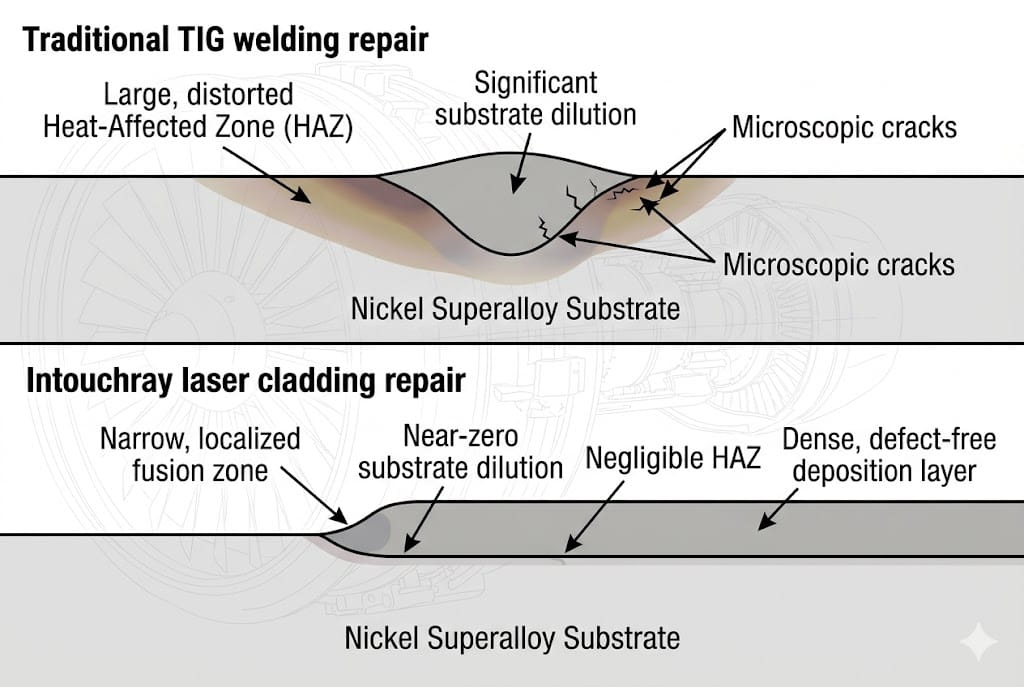
The Problem with TIG: Traditional Arc Welding inserts massive amounts of heat into the part. This creates a large Heat-Affected Zone (HAZ), which can cause warping, grain growth, and fatal “hot cracking” in flight.
The Laser Solution: Because the laser beam is intensely focused (Article #45), the energy is localized. We melt only a microscopic layer of the surface. The resulting repair has a negligible HAZ, preserving the strategic reliability and fatigue life of the original component.
- Turbine Blisk and Blade Repair
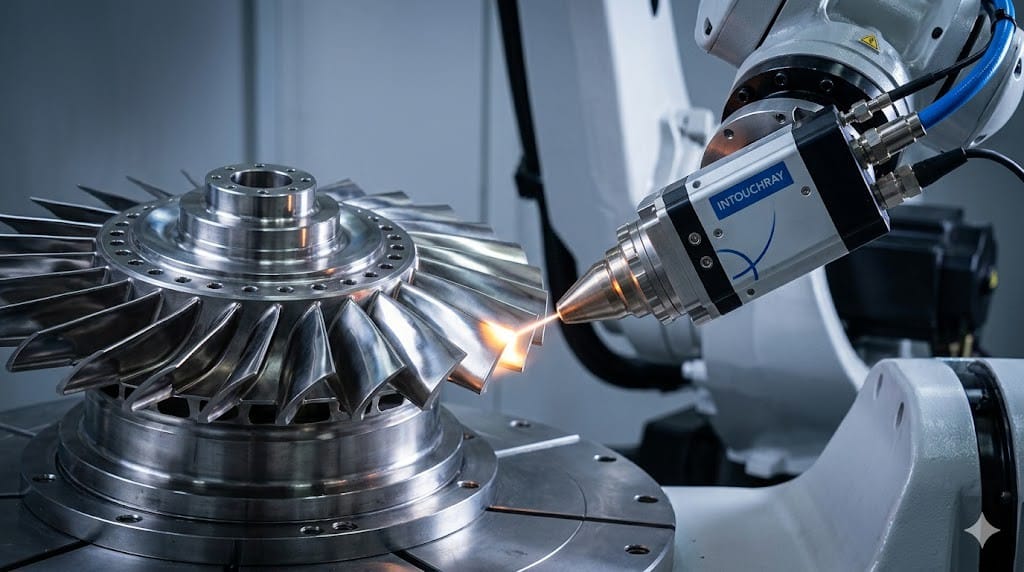
The most demanding application for laser cladding is the repair of aero-engine “Blisks” (Bladed Disks) and individual turbine blades.
Leading Edge Erosion: As a jet engine ingests air, dust and debris erode the leading edges of the compressor blades. This ruins the aerodynamics, decreasing fuel efficiency.
The Repair: Intouchray high-power fiber lasers build up these edges, often using a matching superalloy powder. The new material is integrated at the molecular level, restoring the original airfoil geometry with a fusion zone that is virtually invisible under magnification.
- Re-manufacturing Landing Gear Components
Landing gear act as the “brakes” for hundreds of tons of aircraft. The hydraulic cylinders and axle shafts must endure high-impact abrasion during every takeoff and landing.
For decades, these parts were protected by “Hard Chrome Plating,” an environmentally toxic process prone to “spalling” (flaking) under load.
The Intouchray Way: High-speed laser cladding with Cobalt or Nickel-based alloys provides superior corrosion and wear resistance. Unlike plating, the laser-clad layer creates a metallurgical bond that will not peel, even under maximum landing impact.
- Thin-Wall Repair and Complex Geometries
Modern aerospace engineers utilize lightweight, thin-walled structures to improve fuel economy. Repairing these parts without burn-through is exceptionally difficult.
Our CNC-PLC controlled systems (Article #34) allow for closed-loop, real-time control of the laser power and powder feed. This “Cold Cladding” approach ensures that even 1mm thick walls can be repaired with zero distortion, maintaining the flight certification of the assembly.
Conclusion: Saving Flight Time and Capital
Aerospace MRO is defined by its respect for the original engineering. Laser cladding is not just a repair method; it is an optimization tool that extends the life of multi-million dollar assets. By applying Inconel 718 or Ti-6Al-4V exactly where it is needed, we defy the scrap heap. In Article #52, we will move to Laser Cladding for the Automotive Industry, focusing on high-volume production of engine valves and transmission shafts.
Image Attachment