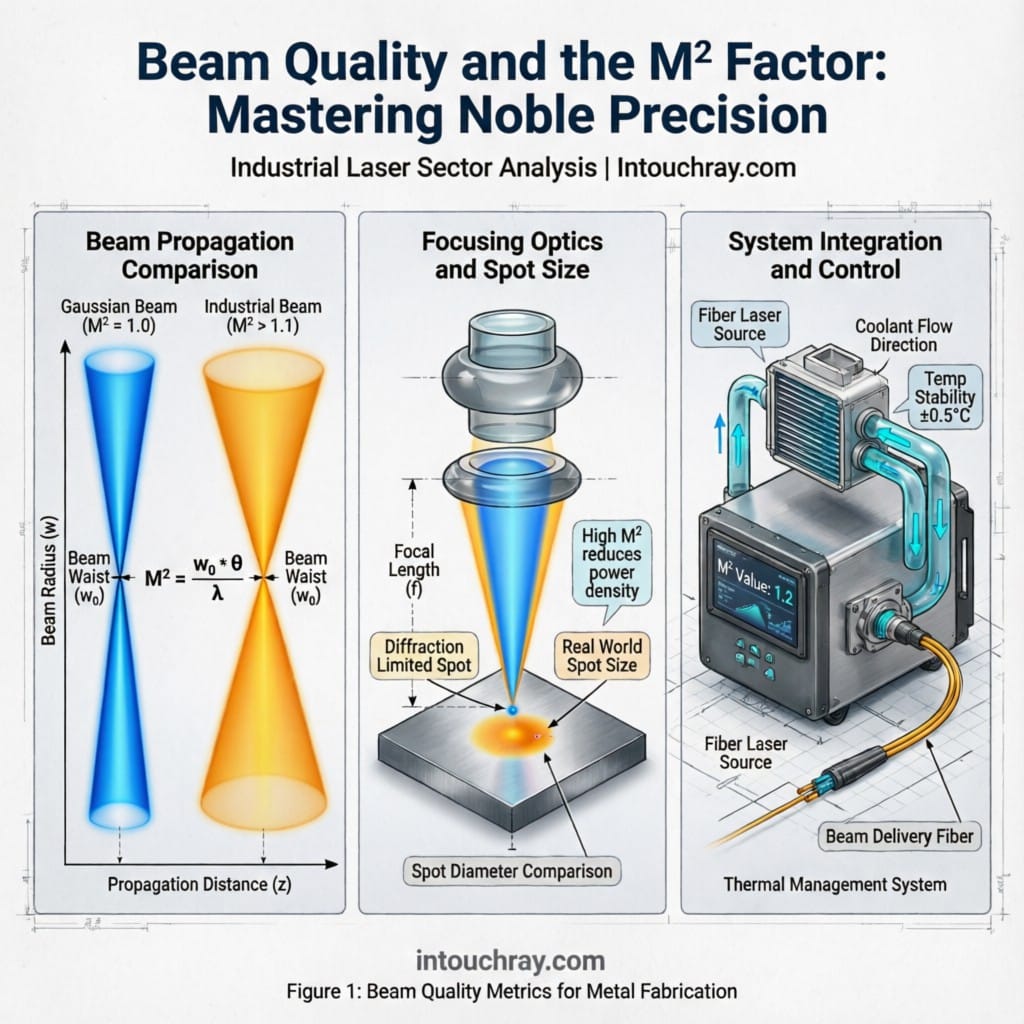
In the industrial laser sector (intouchray.com), we often talk about “raw power.” However, for fresh learners and device manufacturers, power is useless if it cannot be focused effectively. Beam Quality, expressed primarily through the M2 factor (M-squared), is the measure of how “perfect” a laser beam is compared to a theoretical Gaussian beam.
Understanding M2 is the difference between a rough industrial grade and the noble precision required for high-tech metal fabrication manufacturing (Article #66).
1. The M2 Factor: The Quality Score
The M2 factor is a dimensionless value that describes how close a laser beam is to being a “perfect” diffraction-limited Gaussian beam.
M2 = 1.0: The “perfect” laser. It is a theoretical ideal that follows the laws of physics to the absolute limit. It can be focused to the smallest possible spot size.
M2 > 1.1 to 1.5: Excellent quality, typical of high-end fiber laser sources (Article #27).
M2 > 2.0: Lower quality beams that diverge more quickly and cannot be focused as tightly.
A lower M2 value means the beam stays “tighter” over a longer distance, which is the cornerstone of strategic reliability.
2. The Beam Parameter Product (BPP)
Before we can define M2, we must look at the BPP. It is the product of the beam’s smallest radius (the waist, w0) and its far-field divergence angle (θ).
The Beam Quality Relationship
M2=λπ⋅w0⋅θ / λWhere λ is the wavelength. This formula tells us that as M2 increases, either the spot size or the divergence (or both) must also increase, making the laser less “precise.”
3. Why $M^2$ Matters for Your Process
High beam quality (M2 close to 1) provides three critical advantages in the Intouchray ecosystem:
Power Density: A lower M2 allows you to focus the beam into a smaller area. Because power density is Power / Area, halving the spot size quadruples the intensity on the material.
Depth of Field: High-quality beams have a longer “Rayleigh Length.” This means the beam stays in focus for a longer vertical distance, making the process more forgiving if the material is slightly uneven (Article #43).
Working Distance: Better beam quality allows the laser head (Article #29) to be placed further from the workpiece without losing precision, protecting the optics from “spatter” and heat.
4. Real-World Comparison: Fiber vs. CO2
The transition from CO2 to Fiber Lasers was largely driven by M2. While a CO2 laser might have an M2 of 1.5 to 2.0, a single-mode fiber laser can achieve an M2 of 1.1. This is why a 2kW fiber laser can often out-cut a 4kW CO2 laser—it simply focuses its energy with more noble precision.
5. Maintaining Strategic Reliability
Beam quality can degrade over time. If your optics (Article #29) are dirty or if the water chiller (Article #30) is not maintaining a stable temperature, the laser source can undergo “thermal lensing,” which increases the M2 and ruins your cut quality. Monitoring your M2 is the ultimate way to ensure resource efficiency (Article #19).
Conclusion: The Soul of the Machine
M2 is the invisible metric that defines the limits of what a machine can do. By selecting sources with superior beam quality, Intouchray systems provide the foundation for the most demanding industrial tasks. In Article #46, we will shift from the beam to the material, exploring Material Reflectivity and Absorption.
Image Attachment