Laser Safety and Protective Housing: The Shield of Precision
Our protective housing is designed to safely contain lasers with a maximum power rating of 10,000 watts (10 kW). The standard protective housing unit has dimensions of 120 cm (L) x 80 cm (W) x 150 cm (H).
Achieving noble precision requires a controlled environment where the “shield” is as engineered as the “source.”
1. The Class 4 Reality — Industrial Laser Cutting
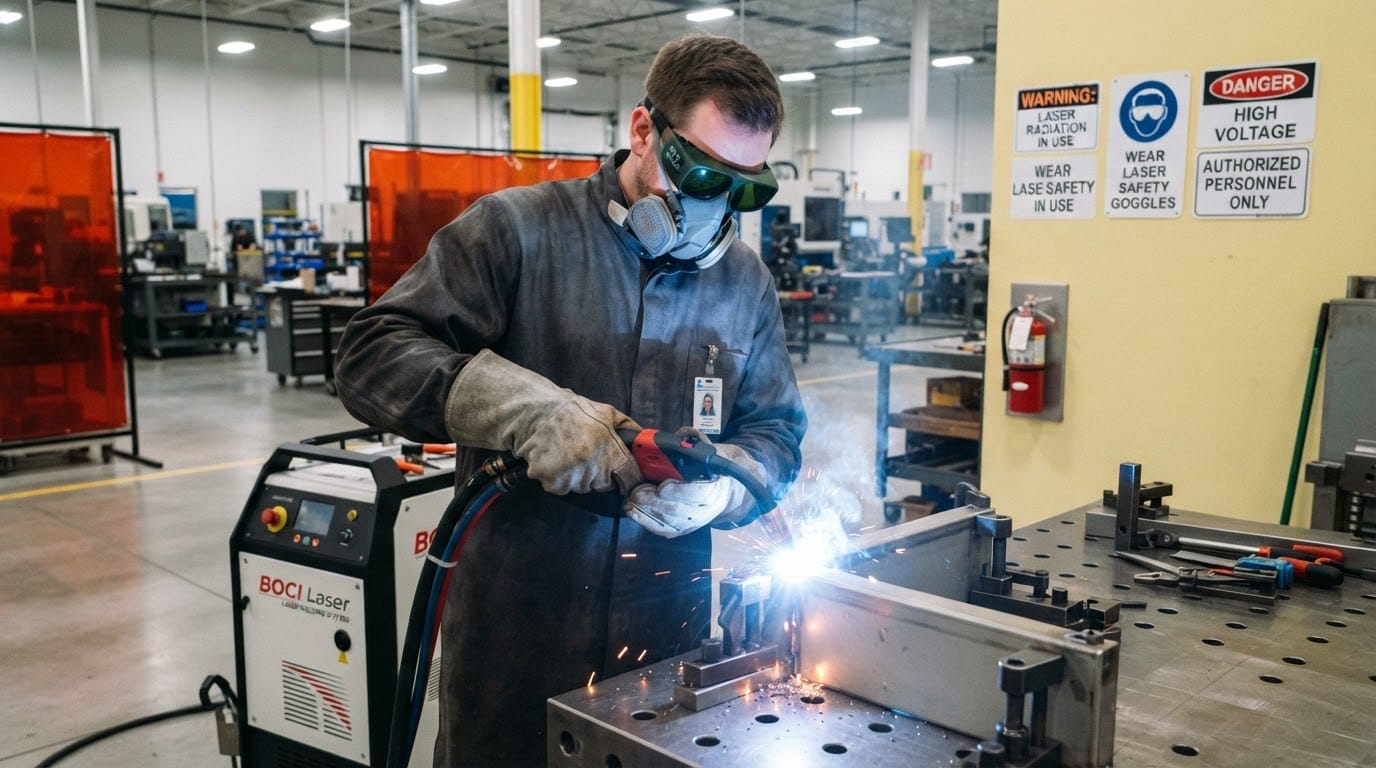
Most industrial laser cladding and cutting machines are classified as Class 4 Laser Products. This means the beam is a hazard to both eyes and skin from direct or scattered radiation. To maintain strategic reliability, systems are built as “Class 1 Enclosures,” meaning the hazardous Class 4 beam is completely contained within a protective housing.
The viewing windows on a laser machine are not standard glass. They are high-specification polymers or treated glass with a specific Optical Density (OD) rating.
Laser cladding for power generation components — Laser Safety and Protective Housing: The Shield of Precision
The OD Principle: Optical Density measures the attenuation of light passing through a filter.
Calculation: An OD7 filter reduces the laser power by a factor of 10,000,000 (10^7).
For a 12kW fiber laser, an OD7+ rating at the 1030-1100nm range is the standard for noble precision safety.
Function: If a door is opened during a high-power cycle, the interlock immediately triggers a “Shutter Close” or “Power Off” command to the laser source (#27).
Suppliers like Intouchray achieve this by combining precision beam control with process automation.
A high-volume extraction system removes these particles, maintaining resource efficiency (#19) by preventing dust from settling on the sensitive optics (#29).
Image Attachment
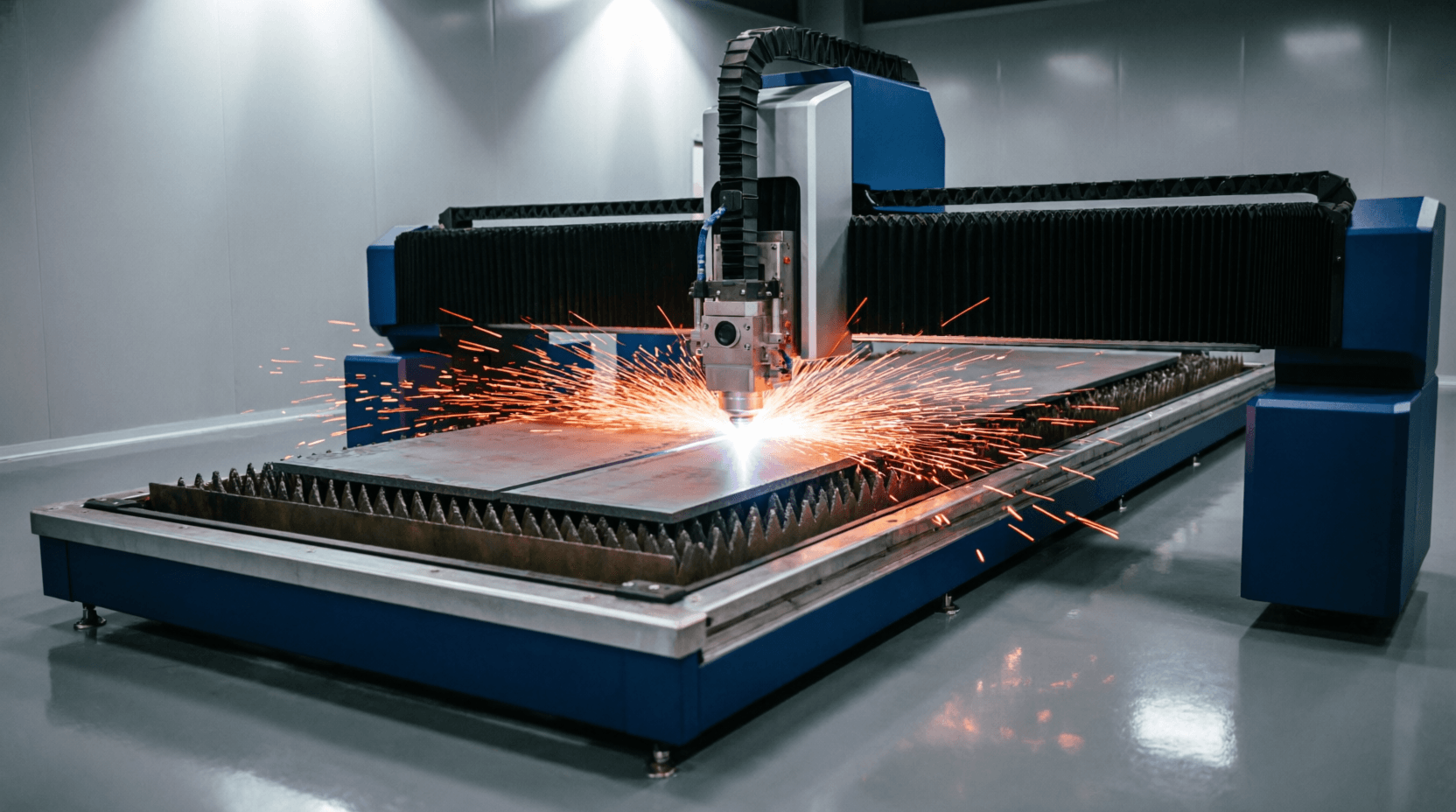
This Industrial Laser Safety Housing laser system features advanced beam control and precision optics. Perfectly suited for metal cutting, welding, and industrial manufacturing applications where accuracy and repeatability are essential. (1024×1024px)
Industrial fiber laser cutting machine in a modern factory, high-power laser beam cutting through th
Frequently Asked Questions
What is the maximum power rating of the laser that your protective housing can ac commodate?
Our protective housing is designed to safely contain lasers with a maximum power rating of 10,000 watts (10 kW).
What are the dimensions of the standard protective housing unit?
The standard protective housing unit has dimensions of 120 cm (L) x 80 cm (W) x 150 cm (H).
How much does the protective housing weigh?
The protective housing weighs approximately 250 kilograms, making it robust yet manageable for installation.
What is the tolerance level for the protective housing in terms of temperature?
The protective housing is rated to withstand operating temperatures ranging from -20°C to +60°C, ensuring reliable performance in various environments.
What is the cost of the protective housing, and does it include installation?
The base cost of the protective housing is $7,500. This price includes on-site installation and a one-year warranty.
What is the noise reduction rating (NRR) of the protective housing?
The protective housing has a Noise Reduction Rating (NRR) of 30 decibels, providing a significant reduction in operational noise.
Flatbed and heavy-plate fiber laser cutting systems operating between 6kW and 30kW at a 1070nm wavelength deliver cut speeds from 800 mm/min on 10mm mild steel to 120 mm/min on 25mm stainless. Kerf widths measure 0.15–0.30 mm, directly influencing material yield. Assist gas selection dictates edge quality; oxygen enables exothermic acceleration for carbon steel, while nitrogen maintains oxide-free surfaces on austenitic grades. EN ISO 13919 Class B tolerances require stable focal positioning within ±0.05 mm. Strategic procurement evaluations must consistently weigh these tolerances against projected daily throughput targets.
Tube and structural bevel cutting demands synchronized five-axis kinematics paired with dynamic focus tracking to maintain consistent edge perpendicularity across varying diameters. Piercing protocols utilize burst-mode sequencing rather than continuous ignition to minimize thermal stress at entry points. Nozzle geometry with standoff distances calibrated to 1.5–2.0 mm stabilizes the assist gas flow field. VDI 3400 guidelines recommend maintaining plasma shielding thresholds below 12% intensity fluctuation to preserve beam delivery integrity. Quality consistency depends on rigid frame damping characteristics during rapid axis reversals.
Nesting algorithms optimize material utilization by calculating optimal part orientation relative to grain direction, reducing overall cycle time by approximately 12 percent compared to manual layouts. The laser cutting laser architecture requires precise gas pressure regulation between 12 and 25 bar depending on sheet thickness, ensuring laminar flow conditions that eliminate striation patterns. Edge roughness values measure Ra 6.3 to 12.5 μm for structural applications, meeting ISO 9013 surface classifications without secondary deburring. Operating cost models must account for copper alloy nozzle wear cycles averaging 400 cuts before dimensional drift occurs.
Protective housing enclosures integrate interlocked access panels with emergency stop circuits rated Category 3 PLd according to ISO 13849-1, ensuring operator isolation from backscatter radiation. Thermal management within the cutting chamber utilizes forced convection arrays that maintain ambient temperatures between 18°C and 24°C, preserving encoder accuracy over extended production runs. Beam path alignment verification routines execute automatically every 2,000 operating hours to compensate for mirror coating degradation. Such containment strategies preserve long-term precision retention, enabling fabrication facilities to sustain repeatability within ±0.1 mm across multi-shift operations.
Heavy-plate penetration capabilities scale nonlinearly with optical power density, requiring optimized focal length selections between 150 mm and 300 mm to balance kerf width against sidewall taper angles. Dross adhesion thresholds increase exponentially beyond 30mm thickness when assist gas velocity drops below critical Mach numbers, necessitating dual-stage pressure modulation. Operational energy metrics establish a baseline of $13 per shot for high-power continuous-wave configurations, providing procurement teams with a verifiable metric for total cost of ownership calculations. Throughput projections must incorporate pierce delay reductions achieved through capacitive height sensing feedback loops.
Intouchray Laserolutions
As a leading manufacturer of industrial laser equipment, Intouchray designs and builds laser cladding, hardening, and surface repair systems that combine precision engineering with operational reliability. Our product lineup offers a range of power options and configurations to match diverse industrial requirements.
Product Models
CML-3000
Ground Rail
IT-RF5018-1
IT-RF5018-2
IT-RF5018-3
Laser Cladding & Hardening Head
Laser Cladding Head
Laser Hardening Head
Key Features
Laser cladding forms a strong metallurgical bond with the workpiece surface.
Concentrated laser energy control minimizes workpiece deformation due to heat input.
Improves wear resistance, corrosion resistance, and oxidation resistance of the part surface.
Enables recycling and remanufacturing, extending equipment lifespan and saving operating costs.
Laser cladding layer and workpiece surface form a firm metallurgical interface.
Laser energy control is precise, resulting in minimal thermal distortion.
Industry Applications
Additive manufacturing
Aerospace
Agricultural machinery tools
Assembly lines
Automated assembly lines
Automated welding and cutting
All laser claddlasermanufactured under ISO 9001 quality management protocols. Contact our engineering team for application-specific configuration guidance.