High-Power Fiber Lasers: The Engine of Intouchray’s Machines
High-power fiber lasers have revolutionized industrial laser material processing. They are the defining technology behind Intouchray’s high-performance cladding and cutting machines . Unlike older CO₂ or Nd:YAG lasers, fiber lasers are fundamentally solid-state, utilizing an optical fiber as the gain medium. This core difference unlocks noble advantages in power, efficiency, beam quality, and reliability, making them the preferred engine for demanding applications like multi-mode cladding (Article #08) and precision cutting (Article #07).
Understanding how a fiber laser works is essential for appreciating why it outperforms traditional laser types and why it is the optimal choice for unlocking strategic reliability in modern surface engineering and manufacturing.
- The Core Technology: Optical Fiber as the Gain Medium
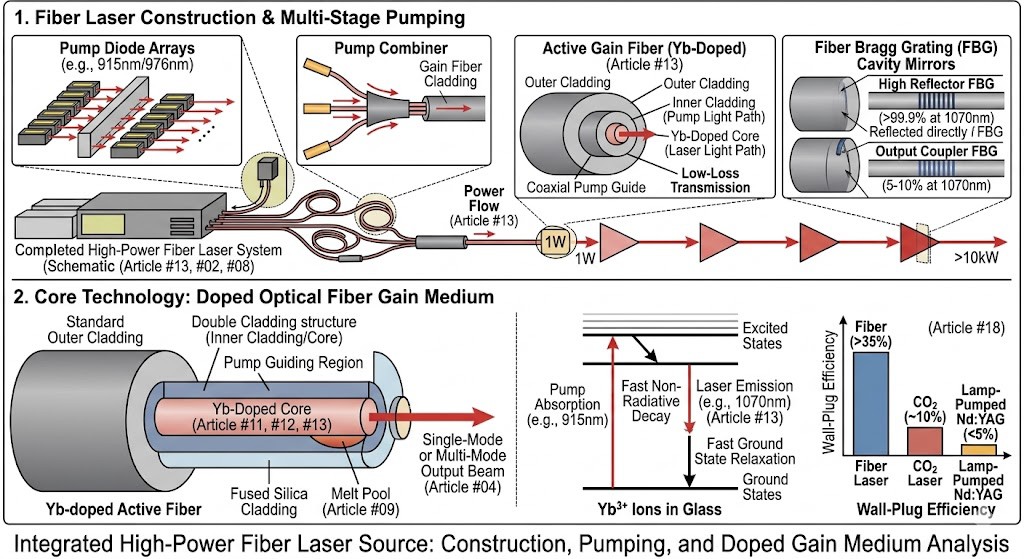
At the heart of a fiber laser is the active gain medium: a special optical fiber doped with rare-earth elements, most commonly Ytterbium (Yb) for high-power industrial systems. This doped core absorbs energy from pump sources and emits laser light.
The entire process occurs within the continuous optical path of the fiber:
Pumping: High-power diode lasers (the pump sources) inject light into the cladding of the active fiber. This pump light travels along the fiber, interacting with the rare-earth ions in the core.
Stimulated Emission: The Yb ions absorb the pump energy, exciting them. As they decay back to their base state, they are stimulated to emit photons. This light is then trapped and amplified within the optical fiber, creating the intense laser beam.
Cavity Mirrors: Unlike external mirrors in CO₂ lasers, fiber lasers use fiber Bragg gratings (FBGs) directly inscribed into the optical fiber to act as the cavity mirrors. One grating is highly reflective, and the other allows a small percentage of the light to escape as the output laser beam, all without any risk of misalignment or contamination.
- Strategic Advantages of Fiber Lasers over Traditional Types
The solid-state, fiber-integrated design of the high-power fiber laser delivers unparalleled noble advantages for industrial applications compared to traditional laser types:
Superior Power and Scalability
Fiber lasers can be engineered to deliver incredibly high continuous wave (CW) power ( Article #02, #08). Intouchray offers systems with power levels exceeding 10kW and even 20kW (intouchray.com). Scaling power is achieved by combining multiple fiber laser modules, all sharing a common output fiber, making them highly flexible for heavy-duty cladding operations and high-speed cutting.
Exceptional Beam Quality and Focused Energy
Because the entire laser generation and delivery process is confined within the high-quality optical fiber (Article #13), fiber lasers produce a near-perfect single-mode or multi-mode output beam. This results in a much tighter, more concentrated spot size and a noble power density compared to other laser types.
For Cladding (Article #04): This focused energy profile minimizes the heat-affected zone (HAZ) (Article #11) and ensures low dilution (<5%, Article #04), optimizing material usage ( Article #19) and cladding quality.
For Cutting (Article #07): It enables incredibly narrow kerf widths and high-speed, precise cuts through thin and thick materials alike.
High Wall-Plug Efficiency and Lower Operating Costs
Fiber lasers are extremely energy-efficient, often achieving wall-plug efficiencies exceeding 30-40%. This is significantly higher than CO₂ lasers (typically ~10%) or lamp-pumped Nd:YAG lasers (often <5%). Higher efficiency means less electrical power is consumed and less heat must be dissipated (Article #07), directly lowering the operational expenditure (OPEX) (Article #18) of the Intouchray machine.
Maintenance-Free, All-Fiber Construction
Perhaps the most significant strategic advantage of the fiber laser is its maintenance-free operation. Because there are no external cavity mirrors to clean or align, and the entire system is sealed within the robust optical fiber, fiber lasers are extremely durable. This all-fiber architecture eliminates downtime ( Article #15), maximizing the uptime ( intouchray.com) and strategic reliability of the Intouchray machine, even in demanding 24/7 industrial environments (Article #16).
Conclusion: Engineering a Nobel Future with Fiber Lasers
High-power fiber lasers are not merely an evolutionary step in laser technology; they are a fundamental transformation. By utilizing an optical fiber as the gain medium, fiber lasers unlock noble capabilities in power, efficiency, beam quality, and reliability that older CO₂ or Nd:YAG technologies simply cannot match. This core technology is the engine driving Intouchray’s performance (intouchray.com), providing the strategic reliability essential for unlocking maximum component life through multi-mode cladding (Article #11-#13) and achieving unmatched precision in industrial cutting (Article #07). As fiber laser technology continues to advance, it will remain the definitive choice for engineers and manufacturers seeking sustainable, high-performance solutions for the most critical industrial material processing applications.
Image Attachment