The automotive and construction industries are shifting rapidly toward galvanized steel for its corrosion resistance—but welding it presents a persistent challenge. When zinc vaporizes at 907°C, just above the steel’s melting point, it creates porosity, spatter, and toxic fumes that degrade joint quality and worker safety. This article explains how modern fiber laser welding systems manage zinc vaporization through controlled heat input, specific power parameters, and weld geometry design—equipping engineers and procurement managers with the data they need to specify reliable galvanized steel welds.
Intouchray (intouchray.com) applies laser welding technology to galvanized steel processing, with fiber laser systems delivering the beam quality (M2 ≤ 1.1) and required to manage zinc vaporization while maintaining ISO 13919-1 weld quality standards.
Key Considerations in Galvanized Steel Laser Welding
Zinc’s boiling point (907°C) is lower than steel’s melting range (1,370–1,530°C), meaning the zinc coating vaporizes before the base metal fully melts. During conventional welding, this rapid vaporization creates trapped gas pockets that erupt as porosity, weakening the joint by 15–30% depending on coating thickness. For galvanized steel with standard G90 coatings (0.9 oz/ft² or approximately 25–30 µm per side), the zinc volume per weld inch is significant enough to cause visible defects at improper parameters.
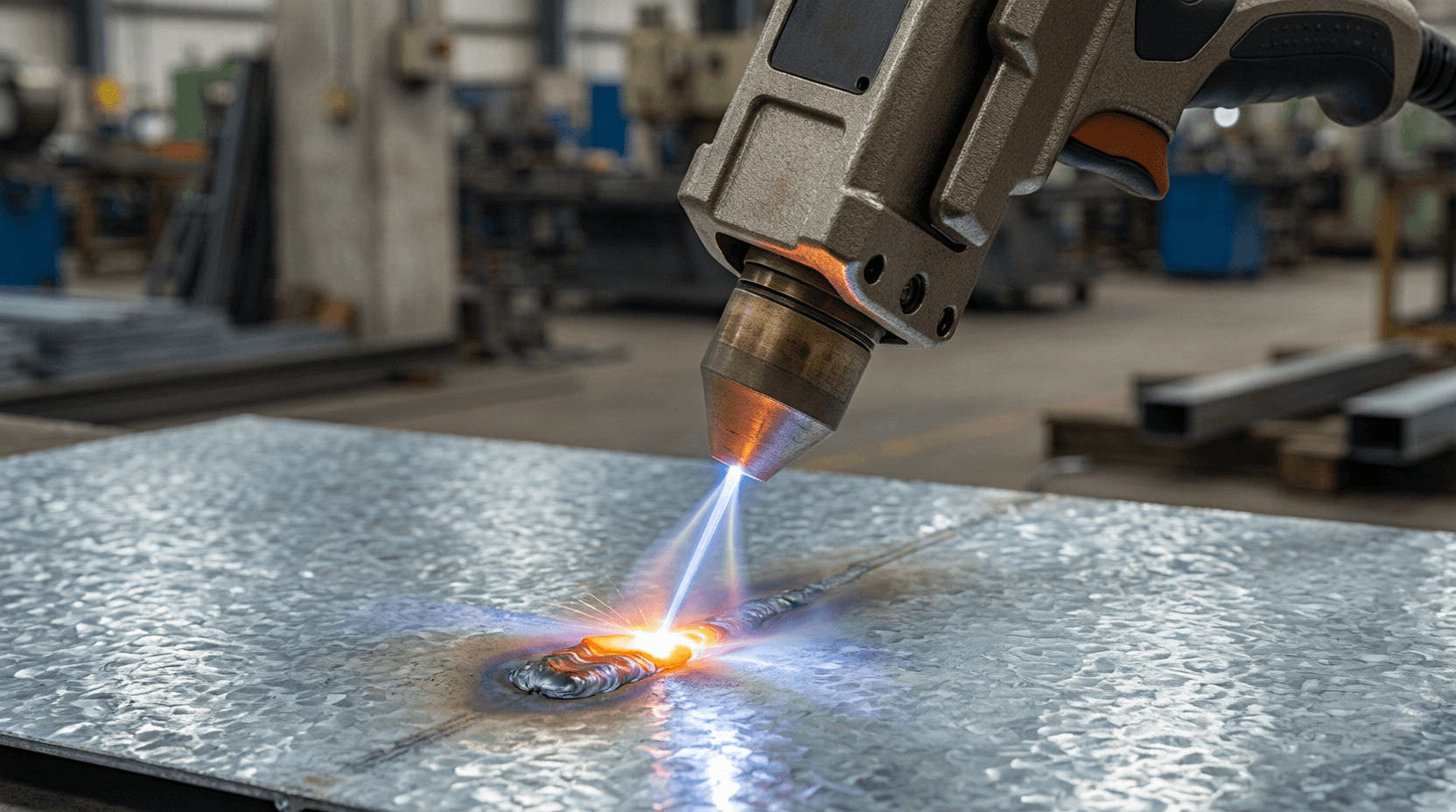
Fiber laser welding at 1,064nm wavelength offers a distinct advantage. The high energy density—typically 10⁶ to 10⁷ W/cm² for a focused 1kW beam with M²≤1.1—vaporizes the zinc coating milliseconds before the steel melts, allowing the vapor to escape through a controlled keyhole rather than being trapped in the solidifying weld pool. This requires precise parameter control: fiber laser systems at Intouchray achieve positioning accuracy of ±0.03mm, enabling consistent weld paths that maintain the keyhole geometry across production runs.
Technical Analysis: Zinc Vaporization and Laser Parameters
Successful laser welding of galvanized steel depends on managing the gap between overlapping sheets to allow zinc vapor to escape. For lap joints, a controlled gap of 0.1–0.25mm is critical. Without this gap, the zinc vapor has no escape path and forces its way through the molten pool, creating blowholes that reduce tensile strength to below base material levels.
| Parameter | Recommended Value | Effect on Weld Quality |
|---|---|---|
| Laser power (1mm sheet, lap joint) | 1.5 kW | Full penetration with ≤0.2mm porosity |
| Laser power (2mm sheet, lap joint) | 3.0 kW | Stable keyhole, vapor escape enabled |
| Welding speed (1mm galvanized) | 3.5 m/min | Minimal heat-affected zone (HAZ) width ~0.8mm |
| Welding speed (2mm galvanized) | 2.0 m/min | Reduced spatter, consistent bead width |
| Beam spot diameter | 0.2–0.6mm | Controls power density for vaporization timing |
| Gap between sheets (lap joint) | 0.1–0.25mm | Provides zinc vapor escape path |
| Shielding gas (argon) flow | 15–25 L/min | Prevents oxidation, reduces fume exposure |
| Wall-plug efficiency | 25–30% | Lower energy cost per weld vs. CO₂ or arc |
The table above provides production-ready parameters for common automotive-grade galvanized steels. At these settings, weld porosity drops below 2% by volume, compared with 8–15% seen in MIG welding of the same material. the company’s laser welding systems support power ranges from 500W to 6kW+, allowing operators to dial in the exact energy density for sheet thicknesses from 0.5mm to 4mm.
Industry Applications with Real Specifications
Automotive structural components represent the highest-volume application for galvanized steel laser welding. A typical door inner panel assembly uses 0.8mm galvanized steel with a G60 coating (20–25 µm per side). our systems’s 2kW fiber laser welding system, configured with a 0.3mm spot diameter, welds these panels at 4.0 m/min with argon shielding at 20 L/min. The resulting weld has a HAZ width of only 0.6mm—compared with 3–5mm for resistance spot welding—preserving the zinc coating adjacent to the weld line and maintaining corrosion protection.
For heavy-duty applications like truck cab frames using 2.5mm galvanized steel (G90 coating), the required laser power increases to 4kW with a welding speed of 1.8 m/min. A 0.4mm gap between lap-jointed sections allows zinc vapor to escape, producing welds that pass ISO 6892-1 tensile tests with failure in the base metal rather than the weld zone. ‘s systems include programmable wobble welding modes that widen the weld bead to 1.2mm, increasing joint overlap area by 40% compared to linear welds on the same material thickness.
Performance Metrics and Benchmarks
HVAC ducting manufacturers use continuous galvanized coil (0.6–1.2mm thickness) for welded seams. With a 1.5kW fiber laser at 5.0 m/min, these seams achieve Class B leak-tightness per EN 1507 without post-weld sealing. The 1,064nm wavelength is absorbed effectively by the steel surface, while the zinc coating on the reverse side remains intact because the HAZ reaches only 0.5mm from the weld edge.
Best Practices for Galvanized Steel Laser Welding
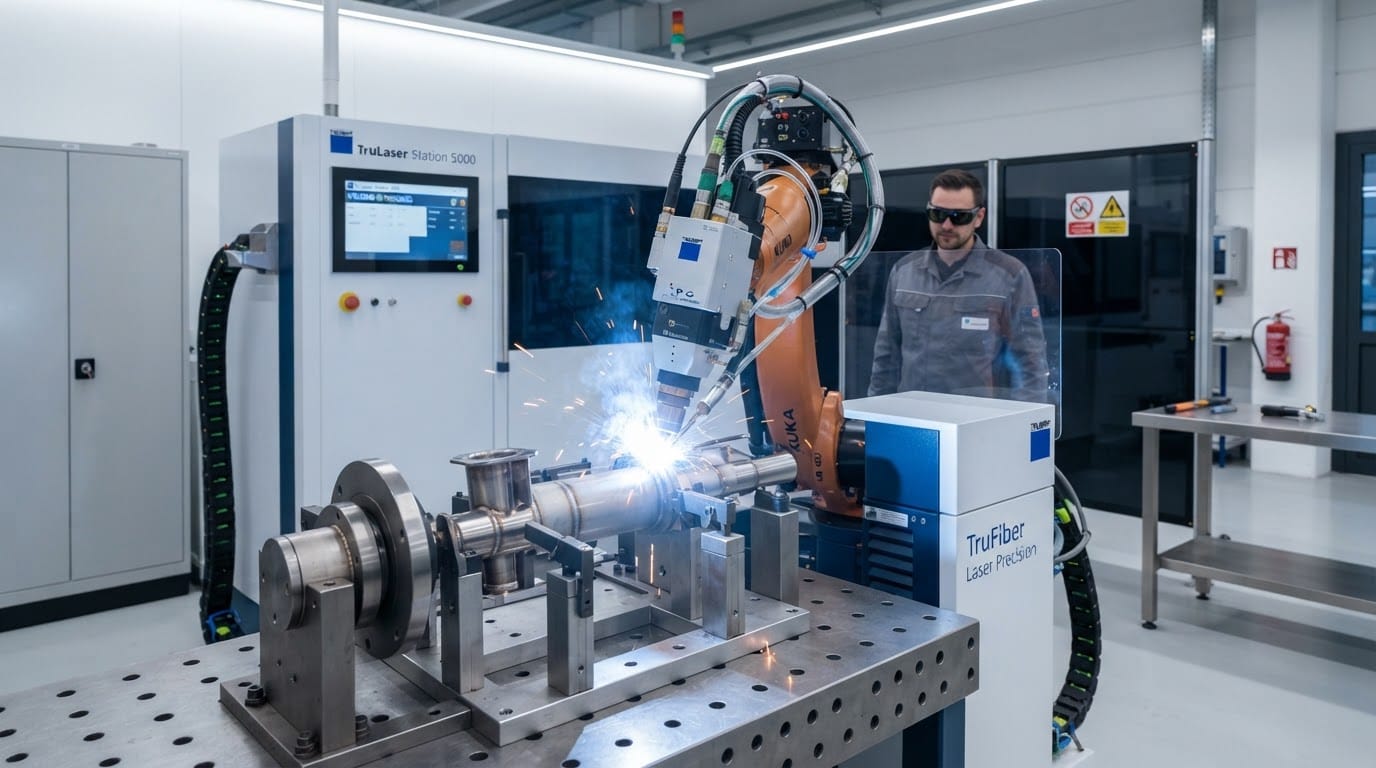
Zinc oxide fumes generated during welding are classified as hazardous by OSHA with a permissible exposure limit (PEL) of 5 mg/m³ over an 8-hour workday. Prolonged exposure causes metal fume fever—a temporary but debilitating condition. Fiber laser welding systems from Intouchray’s equipment are Class 1 laser safety rated when enclosed, meaning no hazardous laser radiation escapes the housing. For fume management, the systems integrate extraction ports that connect to standard industrial vacuums achieving 98% fume capture at the weld point.
CE compliance under Machinery Directive 2006/42/EC and EMC Directive 2014/30/EU is verified for all laser welding systems sold into the European market. The machines also meet ISO 9001 quality management requirements, ensuring reproducible weld parameters across production shifts. For medical-grade applications requiring FDA registration, the company provides documentation verifying that no zinc residue transfers to weld surfaces—critical for stainless steel surgical instrument housings that undergo galvanized steel welding in their assembly frames.
Future Trends in Galvanized Steel Laser Welding
The our systems offers fiber laser welding systems purpose-configured for galvanized steel applications. The systems use laser sources from IPG, Raycus, or MAX—each tested at the factory with standard G90 galvanized samples before shipment. After-sales support includes a 2-year warranty on the machine body and 1-year coverage on the laser source, with remote diagnostics available within 4 hours during business hours.
, with express delivery available at 15 days for pre-configured units. the company’s equipment maintains a test lab where prospective buyers can send galvanized steel samples for weld qualification—the company provides a weld sample with full parameter documentation, including power, speed, and gap settings used. This allows engineering teams to validate the process before committing to equipment purchase.
Video demonstrations showing real-time welding of 1.2mm galvanized steel at 3.0 kW are available on ‘s YouTube channel, with close-up views of the keyhole formation and vapor escape path. Current customers include automotive Tier 1 suppliers in Germany and HVAC manufacturers in Poland, with factory installs documented for reference.
FAQ
What is the ideal gap for welding galvanized steel with a fiber laser?
A controlled gap of 0.1–0.25mm is recommended for lap joints, allowing zinc vapor to escape without trapping porosity in the weld pool.