The Future of Laser Cladding: Next-Generation Materials, Process Innovation, and Strategic Challenges (2025-2035)
Over the past two decades, high-power fiber laser cladding (Article #02, #08) has matured from a specialized repair niche into a defining technology for surface engineering and remanufacturing. By enabling precise, low-dilution (Article #04), and metallurgically bonded (Article #11) coatings, it has unlocked immense value in industries ranging from aerospace (Article #16) to mining (Article #13).
However, the technology is now at a critical inflection point. The next decade will not merely be about incremental efficiency gains; it will be defined by radical shifts in material complexity, process intelligence, and strategic integration. Building on the pillars established in previous articles—such as advanced materials (Article #12, #13) and digital process control (Article #09, #10)—this final article maps the terrain for the future of laser cladding, identifying the definitive trends and strategic challenges of the next era (2025-2035).
- Emerging Materials: Pushing the Boundaries of Performance
The future of laser cladding is being rewritten by the materials it deposits. Standard superalloys and carbides (Article #12, #13) are giving way to advanced formulations designed for noble performance in extreme environments.
High-Entropy Alloys (HEAs)
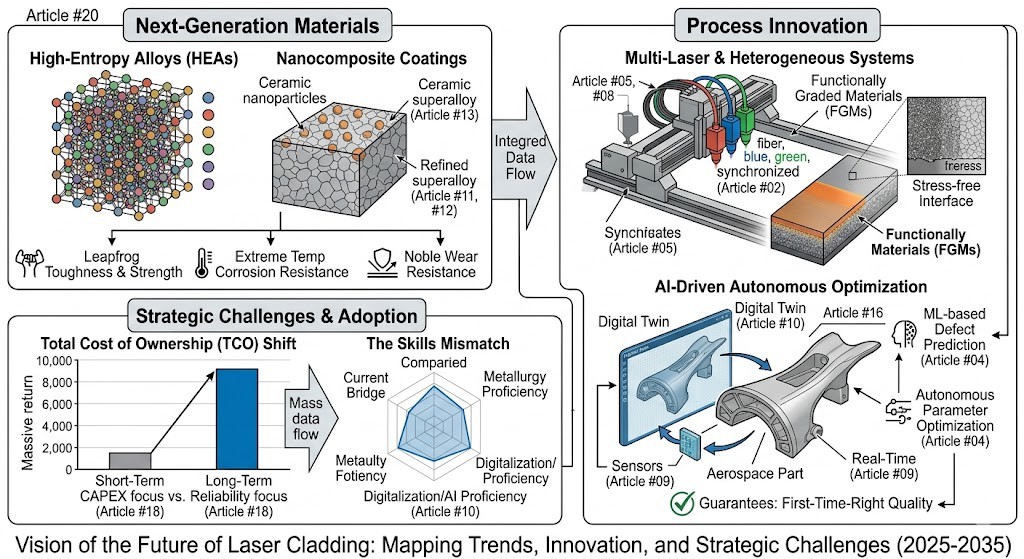
HEAs are revolutionary materials composed of five or more major elements in near-equal atomic percentages. This creates a highly disordered, complex lattice structure that imparts extraordinary properties: leapfrog improvements in simultaneous toughness and strength, exceptional corrosion resistance at extreme temperatures, and noble wear resistance.
The Future Cladding Challenge: Effectively cladding HEAs requires extreme control over melt pool dynamics (Article #09) and cooling rates (Article #11) to stabilize the single-phase structure and prevent detrimental elemental segregation.
Nanocomposite Coatings
Embedding ceramic nanoparticles (e.g., Al₂O₃, YSZ) directly into the cladding matrix (e.g., Inconel 625/718, Article #12) creates a refined microstructure (Article #11) with enhanced dispersion hardening. This results in coatings with significantly superior fatigue resistance and resistance to high-temperature oxidation, essential for next-generation aerospace and energy applications.
- Process Innovation: Moving Beyond Single-Mode Control
Process intelligence is evolving from localized adaptive feedback (Article #09) to system-wide synchronization, leveraging the capabilities of Industry 4.0 (Article #10).
Multi-Laser and Heterogeneous Systems
The next generation of cladding cells (Article #05, #08) will not rely on a single laser head. Instead, they will utilize synchronized arrays of lasers (combining single-mode and multi-mode fiber, blue/green wavelengths) and heterogeneous powder/wire feed systems (Article #03).
The Future Advantage: Imagine a system using a high-power blue laser for efficient copper absorption on a substrate, followed by multiple fiber lasers for high-speed alloy deposition (Article #02), all while precisely mixing standard powder with ceramic wire to create graded MMC structures (Article #13) in real-time. This level of complexity enables functionally graded materials (FGMs), where properties smoothly transition through the clad thickness, eliminating stress concentrations (Article #17) and maximizing component life.
AI-Driven Autonomous Optimization
The vast datasets generated by integrated process monitoring (Article #09, #10) are now being used to train advanced machine learning (ML) and artificial intelligence (AI) algorithms.
The Future Landscape: Instead of operators programming toolpaths and parameters (Article #04), future systems will be autonomous. An AI controller, linked to the component’s Digital Twin (Article #10), will analyze real-time melt pool data (Article #09), predict defect formation (Article #14), and autonomously optimize parameters—all faster than a human operator could react—ensuring guaranteed first-time-right quality for even the most complex aerospace geometries (Article #16).
- Strategic Challenges and the Skills Gap
Despite its immense technical potential, the definitive challenge facing laser cladding adoption is not technical; it is strategic.
The Strategic Cost of Reliability (Article #18)
High-power fiber laser systems represent a massive capital investment (CAPEX, Article #18). Building a business case for adoption requires shifting the industrial focus from short-term purchase price to long-term total cost of ownership (TCO). Strategic adoption necessitates quantifying the noble economic and environmental benefits of life extension, reduced downtime (Article #15), and Circular Economy remanufacturing (Article #19), making reliability a quantifiable core asset.
The Metallurgy/Digitalization Skills Mismatch
The successful deployment of future laser cladding systems requires a workforce proficient in both advanced metallurgy (Article #11-#13) and advanced digital technologies (Article #09, #10). Currently, a significant gap exists. Engineers must understand how heat input (Article #04) and cooling rates drive microstructure, while also mastering robotic programming (Article #05), ML data analytics, and digital twin simulation. Overcoming this skills mismatch is the defining strategic imperative for realizing the technology’s full potential over the next decade.
Conclusion: Engineering a Resilient Future
The future of laser cladding is not a distant vision; it is already under construction in advanced manufacturing labs and forward-thinking facilities around the world. As materials achieve noble complexity (HEAs, nanocomposites) and processes achieve autonomous intelligence (AI optimization, heterogeneous systems), laser cladding is transforming from a repair process into a fundamental strategy for achieving industrial sustainability (Article #19) and resilience.
By embracing this inevitable transition—balancing high-performance materials (Article #12, #13) with digital process control (Article #09, #10) and robust economic strategies (Article #18)—manufacturers can unlock unmatched reliability and performance. Laser cladding isn’t just about saving parts; it’s about pioneering the future of advanced, cost-effective, and safe industrial infrastructure, ensuring that the critical high-value assets defining modern civilization continue to operate with noble efficiency for a sustainable future.
Image Attachment