What is Industrial Laser Material Processing? An Overview
For the modern metals fab and manufacturing electronics company (Article #70), the transition from traditional mechanical tools to industrial laser material processing is the defining shift of the 21st century. At its core, this technology uses a “Light Amplification by Stimulated Emission of Radiation” (LASER) source—specifically the high-power fiber laser (Article #23)—to perform work on materials with noble precision.
Whether the goal is laser cutting, laser cladding, or laser welding, understanding the broad landscape of laser processing is the foundation of strategic reliability (intouchray.com).
- The Power of Coherent Light
Unlike a lightbulb that scatters light in all directions, an industrial laser produces a beam that is:
Monochromatic: A single, specific wavelength (typically 1070nm for fiber lasers, Article #23).
Coherent: All light waves are in phase, allowing the beam to be focused onto a microscopic spot.
Collimated: The beam remains narrow over long distances, which is essential for CNC & laser gantry systems (Article #05, #28).
This concentrated energy allows us to manipulate matter in ways traditional “contact” tools cannot, resulting in zero tool wear and significantly higher resource efficiency (Article #19).
- The Four Pillars of Laser Processing
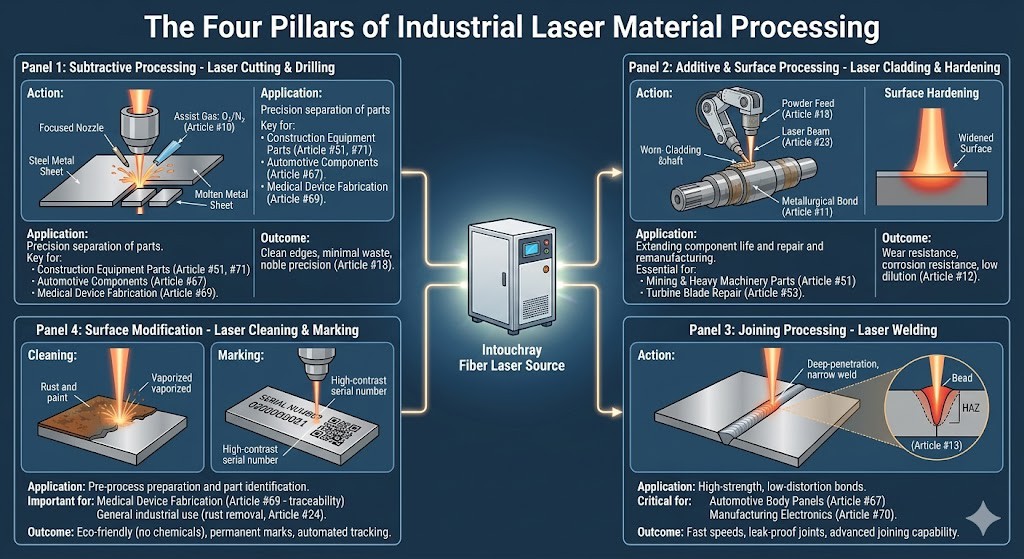
In the Intouchray ecosystem (intouchray.com), laser processing is divided into four primary categories, each serving a critical role in metal fabrication manufacturing (Article #66):
A. Subtractive Processing (Laser Cutting & Drilling)
This is the most common application in the cutting industry. The laser removes material through melting, vaporization, or chemical reactions (Article #26-old/Physics). It allows for the rapid production of construction equipment parts (Article #51) and medical device fabrication (Article #69) with minimal waste.
B. Additive & Surface Processing (Laser Cladding & Hardening)
Instead of removing material, laser cladding (Article #03, #11) adds a layer of high-performance alloy or Tungsten Carbide MMC (Article #17) to a substrate. This is the “secret weapon” for repair and remanufacturing, extending the component life of heavy machinery parts (Article #51) by up to 500%.
C. Joining Processing (Laser Welding)
Laser welding provides a deep-penetration, narrow weld seam with a very small heat-affected zone (HAZ) (Article #13). It is the preferred choice for automotive components companies (Article #67) looking for high-strength, lightweight joints.
D. Surface Modification (Laser Cleaning & Marking)
This involves using the laser to remove rust/contaminants (laser cleaning) or to create permanent, high-contrast traces for traceability (laser marking) without damaging the structural integrity of the part.
- Why it Matters: Strategic Reliability
For fresh learners and device manufacturers, the move to laser technology isn’t just about speed; it’s about predictability. Because laser processing is a digital, non-contact process, it can be monitored in real-time (Article #41). This data-driven approach ensures that the first part is identical to the ten-thousandth part, providing the strategic reliability necessary to compete in the global cutting tool technology market.
Conclusion: Engineering a Nobel Future
Industrial laser material processing is the “master key” that unlocks advanced manufacturing. By mastering the interaction between light and matter, companies can achieve noble precision in jewellery shop design, shipbuilding (Article #72), and aerospace (Article #68). As we move forward through this 100-article series, we will explore each of these pillars in detail, starting with the technology that powers them all: the fiber laser.
Image Attachment