The Economics of Laser Cladding: Calculating ROI and Building a Business Case for Adoption
The technical advantages of high-power fiber laser cladding (Article #02, #08) are undeniable: noble metallurgical bonds (Article #11), minimal dilution (Article #04), precise material deposition (Article #03), and extreme wear and corrosion resistance (Article #12, #13). For engineering and maintenance managers across industries like aerospace (Article #16), oil & gas (Article #15), and mining, the question is often not if laser cladding outperforms traditional methods, but how to justify the significant capital investment.
Building a compelling business case for laser cladding adoption requires moving beyond purely technical comparisons (Article #01) and performing a rigorous economic analysis. It demands calculating the Return on Investment (ROI) by comparing the total cost of ownership against the quantifiable benefits of life extension, reduced downtime, and improved performance.
- The Cost of Adopting Laser Cladding
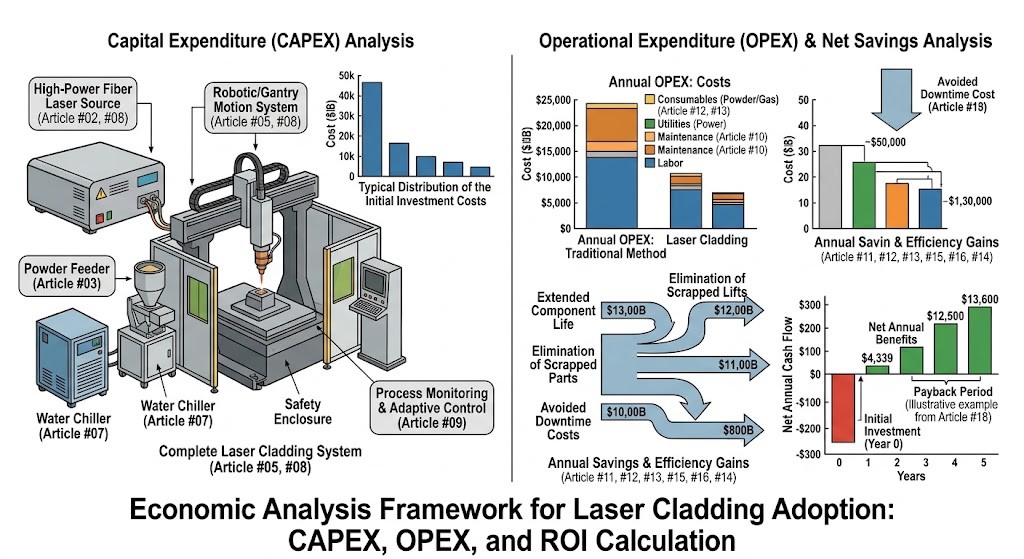
A comprehensive economic model must first account for all costs associated with integrating a laser cladding system (Article #05, #08):
Capital Expenditure (CAPEX)
System Integration: This is the primary upfront cost, including the high-power fiber laser source, robotic or gantry motion system, powder feeder, cooling chiller (Article #07), and safety enclosure.
Process Monitoring & Control: Optional but critical subsystems, such as coaxial process monitoring cameras and adaptive control software (Article #09), increase the initial CAPEX but improve yield and quality.
Post-Processing Equipment: A complete business case often includes costs for finish machining or grinding equipment necessary to restore components to final dimensions.
Operational Expenditure (OPEX)
Consumables: The ongoing costs of superalloy powders (Article #12), carbide MMCs (Article #13), and process gases (e.g., argon for shielding). Optimized parameter selection (Article #04) directly impacts powder utilization efficiency.
Utilities: Electrical power for the laser source, chiller, and motion system. High-power lasers require substantial industrial electricity.
Maintenance: Regular maintenance of the laser optics, powder feeder, and motion system (Digital Twins and Predictive Maintenance, Article #10).
Labor: Specialized labor required for laser programming, process setup (Article #03), and quality assurance (Article #14).
- The Quantifiable Benefits Driving ROI
The ROI calculation is balanced by quantifying the economic benefits that laser cladding provides, primarily through life extension and improved efficiency.
Direct Cost Savings
Reduced Material Usage: Laser cladding can apply thin, dense wear-resistant layers (Article #04), requiring significantly less expensive alloy powder than traditional hardfacing methods that require excessive over-building.
Elimination of Scrapped Parts: Remanufacturing high-value components (like blisks, Article #16, or stabilizers, Article #15) that would otherwise be scrapped directly translates into saved replacement costs. This is the cornerstone of the aerospace and oil & gas business case.
Operational Efficiency Gains
Extended Component Life: Optimized laser-clad surfaces can extend the life of critical tools (e.g., mining GET, Article #13) by 2x, 5x, or even 10x, reducing the frequency of replacement cycles.
Reduced Equipment Downtime: Catastrophic failure of downhole or industrial components halts production. The superior reliability of metallurgically bonded (Article #11), defect-free (Article #14) laser-clad repairs minimizes unscheduled maintenance. Every hour of avoided downtime in a mine or on a drilling rig (Article #15) can be worth tens of thousands of dollars.
Improved Process Performance: Components restored to their original geometric profiles (Article #16) operate with higher noble efficiency, reducing fuel consumption or processing costs.
- Calculating the Payback Period
The definitive metric for many business cases is the Payback Period—the time required for the cumulative net benefits to equal the initial CAPEX investment.
A simple payback calculation looks like this:
Payback Period (Years) = Total CAPEX / (Annual Savings + Annual Efficiency Gains – Annual OPEX)
A robust business case often calculates different payback scenarios based on conservative vs. optimistic estimates of component life extension and machine utilization (linking back to the predictive capabilities discussed in Article #10).
Illustrative Example (Simplified)
Imagine a mining company spending $500,000 annually on replacing high-wear components. By investing $1,000,000 in a robotic laser cladding system to hardface these parts with Vanadium Carbide MMC (Article #13), they triple the component life.
CAPEX: $1,000,000 (System + Setup)
Annual Replacement Savings: $500,000 – $166,667 (New replacement cost) = $333,333
Annual Efficiency Gains (Avoided Downtime): $100,000
Annual OPEX (Powder, Gas, Labor, Maintenance): $150,000
Net Annual Benefit: $333,333 + $100,000 – $150,000 = $283,333
Payback Period = $1,000,000 / $283,333 = ~3.5 Years
A 3.5-year payback for a high-value industrial system with a 10+ year lifespan presents a compelling case, even before accounting for improved reliability (Article #14) or strategic advantages.
Conclusion: Investing in Strategic Reliability
The economics of laser cladding are fundamentally about investing in strategic reliability. While the initial capital requirement is high, the technology delivers a transformation in total cost of ownership by maximizing component life and minimizing operational downtime. Building a successful business case requires a complete, cross-functional understanding—linking metallurgy (Article #11-#13) and process control (Article #04, #09) to quantifiable economic outcomes. In a global manufacturing landscape increasingly focused on efficiency and sustainability, laser cladding adoption isn’t just a technical upgrade; it’s an essential strategy for securing a noble and profitable future for high-value industrial assets.
Image Attachment