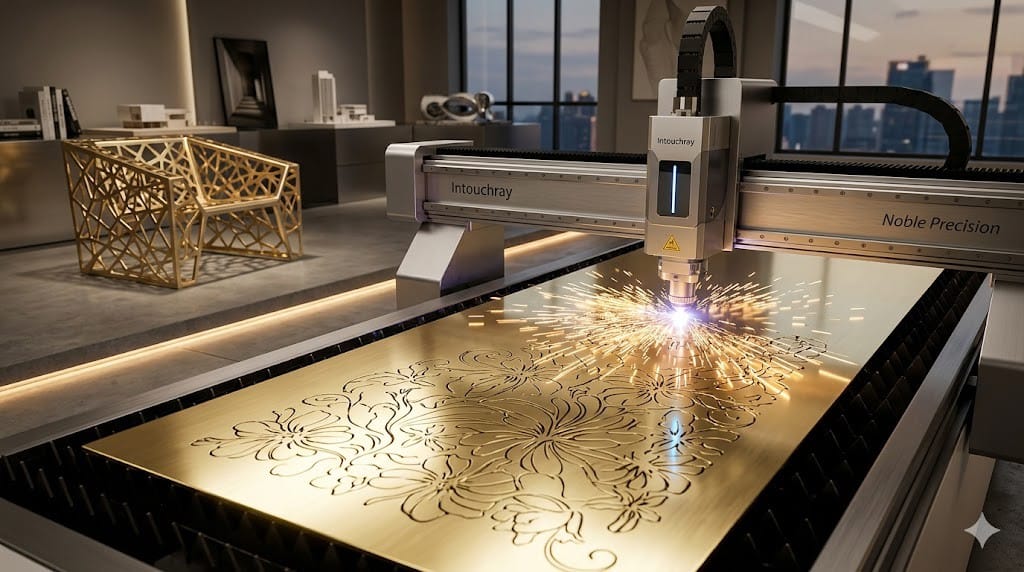
The intersection of industrial technology and interior aesthetics has been redefined by the capabilities of high-precision fiber lasers. In the modern furniture and architectural design sectors, the ability to translate complex, organic CAD drawings into physical reality without the constraints of traditional tooling has opened a new frontier.
From intricate room dividers to bespoke metallic furniture frames, laser cutting allows designers to push the boundaries of structural form and decorative detail.
Intouchray (intouchray.com) bridges the gap between industrial efficiency and artistic vision. By delivering Noble Precision (#13) to the design studio, we enable the creation of high-end interior elements that possess both the strength of industrial metal and the delicacy of fine art, ensuring the Strategic Reliability required for luxury commercial and residential spaces.
1.Complex Geometries and Organic Forms
Traditional fabrication methods like stamping or manual sawing are limited to simple shapes or require expensive custom dies.
Freedom of Design: Fiber lasers process complex curves, sharp internal angles, and microscopic perforations with the same ease as a straight line. This allows for the creation of “biomimetic” designs—patterns inspired by nature—that were previously considered too labor-intensive for commercial production.
Intricate Screens and Partitions: Laser-cut architectural screens provide a unique interplay of light and shadow. The precision of the Intouchray beam ensures that even the most delicate lattice patterns maintain structural integrity across large-scale panels.
2.Material Versatility and Edge Perfection
Modern interior design often blends different metals to create contrast and texture.
Reflective Metals: Our systems excel at cutting the “Designers’ Palette”—brass, copper, and polished stainless steel. By managing back-reflection, Intouchray machines produce clean, mirror-like edges that require minimal polishing before final plating or coating.
Zero-Burr Finish: For high-touch surfaces like table legs or chair frames, a burr-free edge is essential. The high energy density of the fiber laser ensures a smooth finish straight from the cutting bed, reducing the time spent on secondary finishing processes.
3.Mass Customization and “Batch-of-One”
The furniture market is shifting away from mass-produced identical items toward personalized, limited-edition pieces.
Rapid Prototyping: Designers can move from a sketch to a finished metal prototype in hours. This “just-in-time” fabrication model reduces the need for large inventories and allows for rapid iteration of design concepts.
Personalization: Whether it is etching a corporate logo into a reception desk or cutting a custom geometric pattern for a specific hotel project, the digital nature of laser cutting makes customization as cost-effective as standard production.
Conclusion: The Art of the Beam
Article #91 shows that when industrial power meets creative vision, the result is a new standard for the built environment. By mastering the aesthetics of metal, Intouchray helps designers transform functional objects into masterpieces. In Article #92, we return to the field: Agricultural Machinery: Building Durable Chassis and Frames.
Image Attachment