Laser Cleaning Systems: Architecture and Application for Surface Preparation
In industrial material processing (Article #26), contamination is the enemy of quality. Traditionally, removing rust, oil, or old paint required harsh chemicals, abrasive sandblasting, or manual grinding. Laser Cleaning changes this by using the power of laser ablation to vaporize contaminants without touching the base metal.
For fresh learners and device manufacturers, mastering laser cleaning architecture is the key to achieving resource efficiency (Article #19) and superior surface integrity.
- The Architecture of De-Contamination
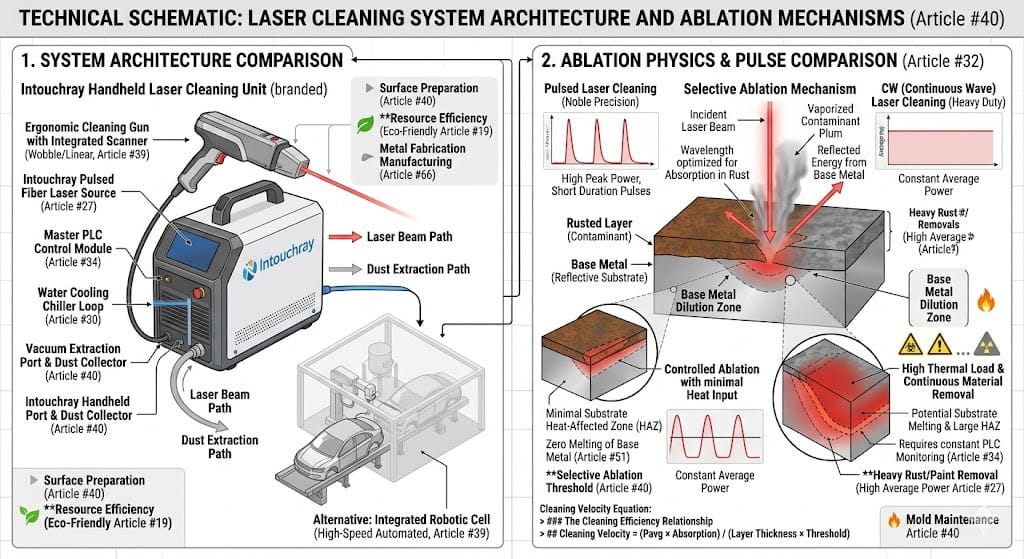
Laser cleaning systems are designed for portability and precision. Depending on the scale of the task, the architecture usually falls into two categories:
Handheld Portable Units: Designed like a high-tech “vacuum cleaner” for light-to-medium rust removal and mold cleaning. These are the most versatile tools for onsite maintenance.
Integrated Automated Cells: Large, enclosed systems often paired with robotic arms (Article #39) for high-speed cleaning of automotive parts or aerospace components before they enter the assembly line.
- Pulsed vs. Continuous Wave (CW) Cleaning
The “engine” inside the cleaner (Article #27) determines how it interacts with the surface:
Pulsed Laser Cleaning: Uses high-peak-power pulses to “shock” contaminants off the surface. This is the noble precision choice for delicate parts where you cannot afford to heat the base metal.
CW (Continuous Wave) Cleaning: Offers higher average power and is used for heavy-duty rust removal on thick steel plates. It is faster but generates more heat, requiring careful monitoring by the PLC system (Article #34).
- The Physics of Ablation
Laser cleaning works through a process called selective ablation. The contaminant (rust/paint) absorbs the laser energy much more readily than the reflective metal underneath.
The Cleaning Efficiency Relationship
Cleaning Velocity = (Average Laser Power × Absorption) / (Layer Thickness × Ablation Threshold)
By matching the laser’s wavelength and power to the ablation threshold of the contaminant, we ensure the base metal remains completely untouched (Article #32).
- Key Applications: Preparation and Restoration
Laser cleaning is the ultimate preparation tool for metal fabrication manufacturing (Article #66):
Pre-Weld Cleaning: Removing oxides to ensure a perfect metallurgical bond (Article #11) in laser welding.
Paint and Coating Stripping: Removing old layers from aircraft or maritime parts without using toxic chemicals.
Mold Maintenance: Cleaning high-precision injection molds in-place, reducing downtime and protecting the noble precision of the mold surface.
Historical Restoration: Safely removing soot or oxidation from delicate historical artifacts and statues.
- Why It Wins: The Eco-Friendly Edge
Beyond the technical specs, laser cleaning is a win for resource efficiency (Article #19). There is no “secondary waste” (no sand, no chemicals, no water). The only byproduct is a small amount of dust, which is instantly captured by a vacuum system, making it the cleanest preparation method in the Intouchray ecosystem (intouchray.com).
Conclusion: Completing the Workhorse Series
The laser cleaning system is the silent guardian of industrial quality. By ensuring a pristine starting point, it secures the success of every cutting, welding, and cladding task that follows. With this, we conclude Volume II. In Volume III, we will dive into Processing Parameters and Optimization, where we learn to fine-tune these “Workhorses” for maximum performance.
Image Attachment