In the power generation sector, whether nuclear, fossil fuel, or renewable, the primary objectives are uptime and safety. Components must endure some of the most punishing environments on Earth: high-temperature steam erosion, hot-gas corrosion, and rotational stresses. Scrapping massive turbine rotors or complex heat exchangers due to surface wear is a violation of resource efficiency (#19).
High-Speed Laser Cladding (Article #33) has emerged as a critical technology for the life-extension and re-manufacturing of these multi-million dollar assets, delivering noble precision to the heart of the energy grid.
- The Challenge: Extreme Erosion and Corrosion
Power plants operate with massive components that cannot easily be replaced. Over time, three main types of damage occur:
Steam Erosion: Water droplets in high-pressure steam cut through turbine blades like knives.
Hot-Gas Corrosion: In gas turbines, combustion byproducts attack superalloy surfaces.
Wear on Valve Seats: Critical safety valves must maintain a perfect seal under immense pressure, yet they face constant friction.
- Restoring Turbine Rotors and Blades
Turbine blades (specifically the leading edge of low-pressure steam turbines) suffer significantly from erosion.
The Old Way: Scrapping the blade or attempting traditional arc welding, which introduces fatal Heat-Affected Zones (HAZ) in single-crystal superalloys.
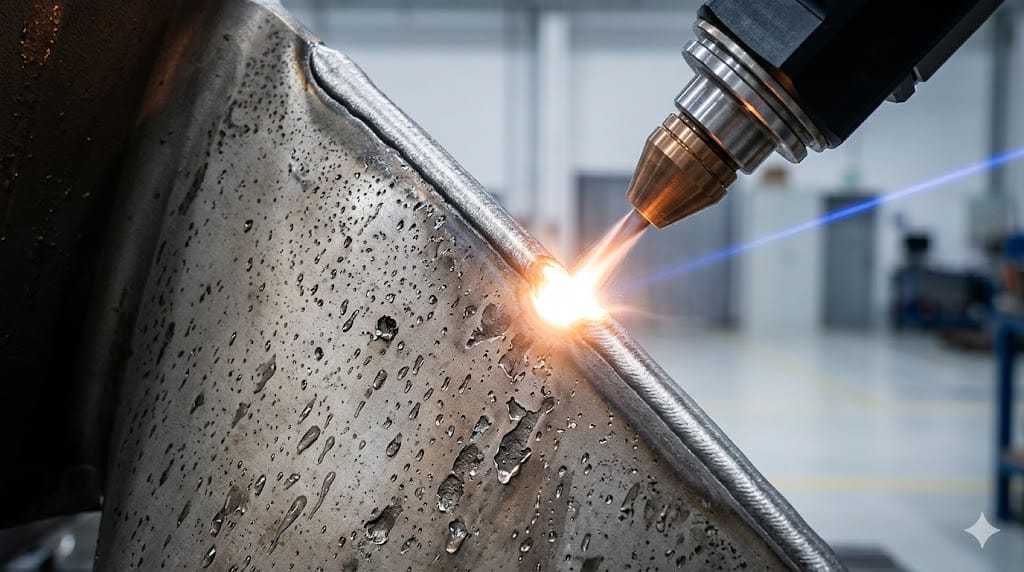
The Intouchray Way: Applying erosion-resistant alloys (like Stellite or custom cobalt-based powders) with high-power density laser cladding (Article #45).
The Advantage: A metallurgical bond with minimal dilution (<5%) restoring the airfoil geometry without compromising the mechanical integrity of the substrate, ensuring strategic reliability.
- Internal Diameter (ID) Cladding for Boiler Tubes
In coal and biomass plants, boiler tubes are exposed to aggressive chemical environments that lead to corrosion and wall thinning.
Intouchray’s specialized ID cladding probes (similar to those used in Oil & Gas, Article #50) can travel dozens of meters inside heat exchanger bundles.
We apply corrosion-resistant alloys (Inconel 625) to protect the tube walls, significantly extending the intervals between major plant shutdowns and enhancing resource efficiency.
- Nuclear Valve Repair and Cobalt-Free Solutions
The nuclear industry has the highest safety standards. Valves near the reactor core must operate perfectly.
Because the laser process has extremely low-heat input, it can be used to repair valve seats in situ without warping the massive valve body.
Furthermore, laser cladding is facilitating the shift to “cobalt-free” wear alloys, which are necessary to prevent the formation of radioactive Cobalt-60 in primary loop systems.
- Transitioning to Renewable Energy
While traditional power still relies on laser cladding for repair, new renewable applications are emerging. This includes applying corrosion protection to the main shafts of massive offshore wind turbines and wear protection for geothermal energy components. Intouchray technology is a cornerstone of the sustainable transition.
Conclusion: Maintaining the Flow
Power generation components are the bedrock of modern civilization. By applying noble precision to their maintenance cycles, we move from “reactive repair” to “proactive life extension.” Laser cladding ensures that the massive investments made in energy infrastructure continue to pay dividends for decades. In Article #53a, we will explore specific case studies regarding EHLA for Hydropower applications.
Image Attachment