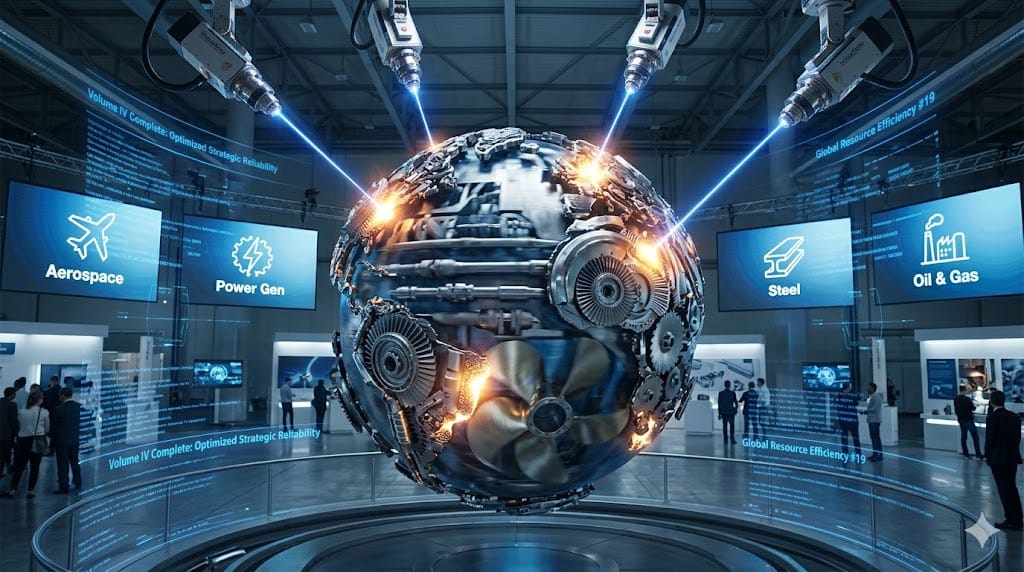
Advanced Applications. For the last ten articles, we have moved across the global industrial landscape, from the crushing forces of the steel mill (#58) to the microscopic tolerances of the aerospace repair hangar (#51).
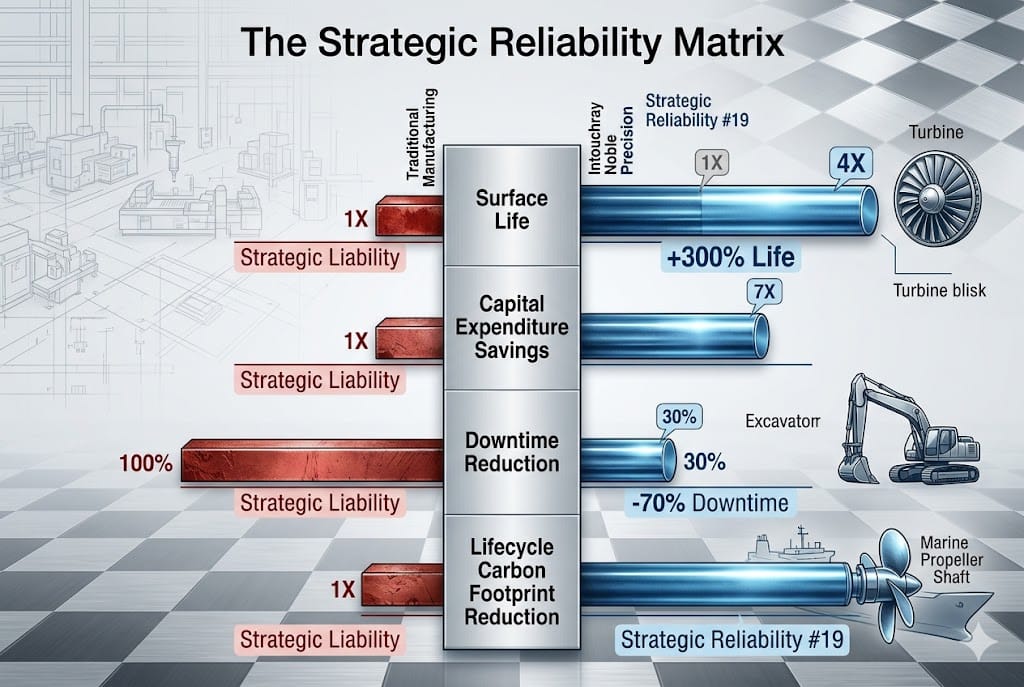
While the components and materials changed—from Titanium in flight to Tungsten Carbide in the soil (#54)—the fundamental solution remained the same. Intouchray technology (intouchray.com) provides the decisive metallurgical edge, transforming critical assets from strategic liabilities into pillars of strategic reliability.
As we wrap up this volume, we synthesize the three core benefits that laser cladding has brought to every sector.
- The Death of Compromise: Multi-Material Synthesis
The most significant takeaway from Volume IV is that engineers no longer have to compromise between core toughness and surface performance. Traditional manufacturing often required making an entire component out of an expensive superalloy just to protect its surface.
The Cladding Paradigm: By using noble precision (low heat input, minimal dilution), we can use a cheap, tough carbon steel for the bulk of a part and apply a 1mm armor layer of Inconel 625, Monel 400 (#56), or Hastelloy (#57) exactly where the corrosion or wear is targeted.
This approach, validated in industries from Oil & Gas (#50) to Automotive (#52), maximizes performance while minimizing material cost, delivering optimized resource efficiency (#19).
- The Rise of Re-manufacturing and Predictive Sustainment
Volume IV demonstrated that “scrap and replace” is a failed philosophy for expensive industrial assets. Laser cladding has industrialized Maintenance, Repair, and Overhaul (MRO).
** Aerospace and Tool & Die (#51, #55):** We proved that microscopic repair on single-crystal superalloys or mirror-finished H13 tool steel is not only possible but superior. The low Heat-Affected Zone (HAZ) preserves the substrate’s mechanical properties, returning the part to service with full strategic reliability.
Marine and Power Generation (#56, #53): We showed how cladding massive propeller shafts and turbine rotors—often in situ—saves millions in downtime. By transforming repair from a reactive “patch” into a proactive “optimization,” we create assets that are more durable than new cast parts, defining the future of predictive sustainment.
- Sustainability and the EHLA Revolution
Finally, Volume IV highlighted how laser cladding is moving from a specialized tool into a primary manufacturing powerhouse, essential for the green transition.
Extreme High-Speed (EHLA): The introduction of EHLA (Articles #52, #58) allows us to coat thousands of high-volume parts, like brake discs and rolling mill rolls, with noble precision. This reduces toxic dust (PM².5) and dramatically lowers the energy footprint compared to manufacturing new components from scratch.
By extending the life of ground-engaging tools in agriculture (#54) and enabling multi-material joining in EV manufacturing (#52), Intouchray technology is a cornerstone of global resource efficiency.
Conclusion: Halfway to Mastery
Volume IV proved that wherever critical surfaces meet extreme force, corrosion, or heat, Intouchray high-power fiber lasers (#27) provide the necessary armor. We have validated the applications; we have industrialized the process.
In Volume V: The Quantum Beam (Articles #61-70), we will move beyond how and where cladding is applied, and dive deeper into the microscopic world of metallurgical innovation, nanocoatings, and the future of additive manufacturing. Volume IV showed the body of the application; Volume V will explore the soul of the material.
Image Attachment