The chemical, petrochemical, and process industries operate some of the most unforgiving environments on Earth. Critical assets—reactors, heat exchangers, pumps, and valves—are subjected to a continuous “chemical soup” of corrosive acids, abrasive slurries, high temperatures, and extreme pressures. In these sectors, equipment failure is not just expensive; it is a significant safety and environmental risk.
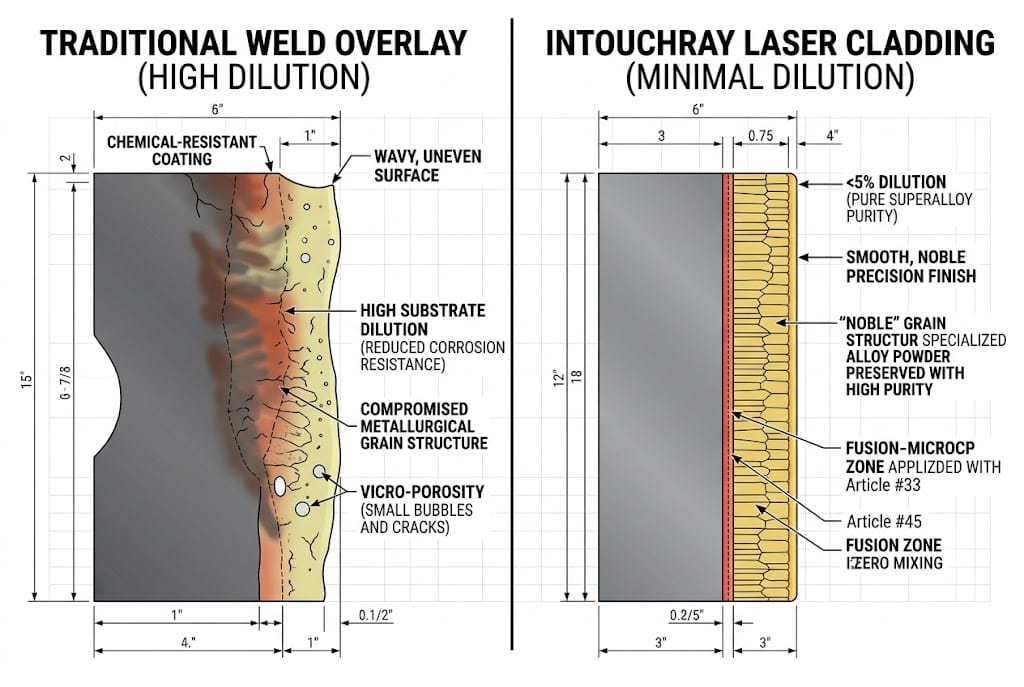
Traditional methods of protecting these surfaces, such as thick weld overlays or loose linings, often introduce problems of their own, including base metal distortion, high dilution of the protective layer, and catastrophic delamination. High-Speed Laser Cladding (Article #33) has emerged as the definitive solution, providing customizable, “noble precision” surface armoring that extends equipment life and guarantees strategic reliability.
- The Challenge: Severe Corrosion and Erosion
Process plants deal with mechanisms of degradation that are both diverse and aggressive. Standard carbon steel or common stainless steels often cannot survive without substantial protection.
Pitting and Crevice Corrosion: Highly reactive chemicals like chlorides attack the passive layers of metals, creating localized pits that tunnel through pipe walls and pressure vessels.
High-Temperature Corrosion (Sulfidation/Oxidation): In refineries, high temperatures accelerate metal loss, sometimes exceeding several millimeters per year.
Erosion-Corrosion: High-velocity fluids carrying suspended solids physically “scrub” away protective oxide scales, exposing fresh metal to immediate corrosive attack.
The traditional “scrap and replace” philosophy is a massive failure in resource efficiency (#19) for these massive components.
- The Intouchray Laser Solution: Minimal Heat, Maximum Purity
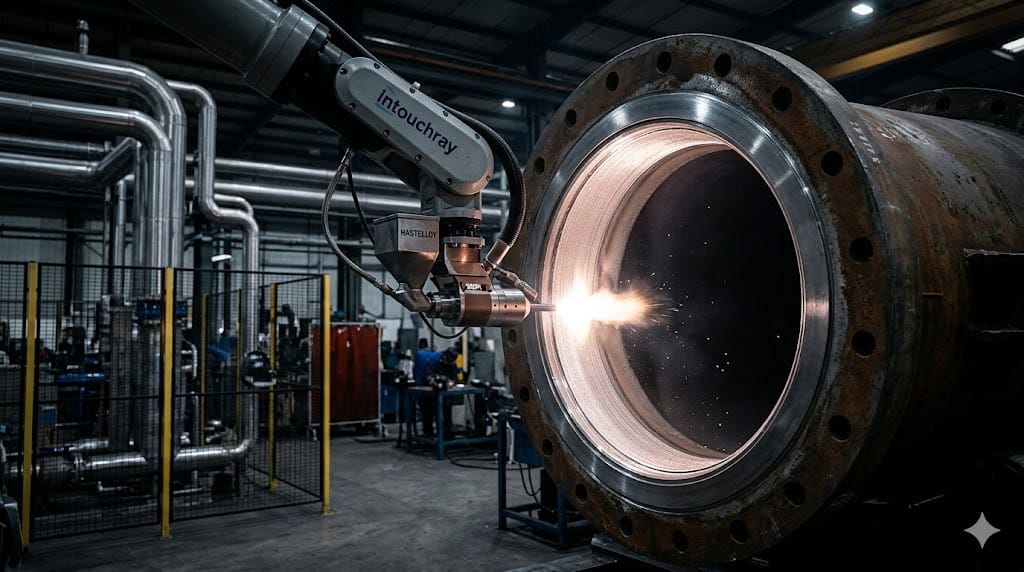
Intouchray high-power fiber laser systems (Article #27) solve the dilution problem inherent in traditional arc welding.
Low Heat Input: The laser melts only a microscopic layer of the substrate (Article #45). This keeps distortion virtually at zero, which is critical for preserving the dimensions of flange faces and valve seats.
Minimal Dilution: In traditional welding, the substrate metal mixes heavily with the protective alloy, reducing its corrosion resistance. Laser cladding keeps dilution below 5%. This ensures that a cladded layer of Hastelloy C22, for example, retains the full corrosion resistance of the bulk material, providing a “noble” barrier.
- Application Focus: Heat Exchangers and Pumps
Two of the most maintenance-intensive components in the process industries are heat exchangers and high-velocity pumps.
Tube Sheet Restoration: Heat exchanger tube sheets are highly complex components with hundreds of holes. Corrosion on the tube sheet face leads to leaks that contaminate process streams. Cladding allows for the precise application of corrosion-resistant alloys (CRAs) without plugging the holes or distorting the sheet, restoring the seal surfaces to optimized durability.
Pump Impellers and Casings: Pump internals face extreme erosion-corrosion. Using specialized internal diameter (ID) cladding probes, Intouchray systems can clad inside complex pump casings and apply wear-resistant superalloys to impellers, maintaining geometric noble precision and extending service life by 300%.
- Materials for Process Integrity: Hastelloy and Inconel
The process industries utilize specialized powders that are optimized for their specific chemical environment.
Hastelloy Alloys (C22/C276): The gold standard for extreme corrosion resistance, particularly against strong oxidizing and reducing acids, chlorides, and wet chlorine gas.
Inconel 625: Widely used for its high strength and excellent resistance to pitting and crevice corrosion in sea water and high-temperature environments.
Titanium Alloys: Applied to equipment handling highly aggressive oxidizing media where even superalloys might fail.
Conclusion: Predictive Sustainment in Process Control
Article #57 demonstrates that laser cladding transitions the chemical and process industries from “reactive patching” to “predictive sustainment.” By armoring critical components with specialized noble alloys using minimal heat and zero dilution, we achieve strategic reliability. This not only maximizes uptime but also enhances environmental safety by drastically reducing the risk of corrosion-induced leaks. This is resource efficiency optimized for the heavy process sector. In Article #58, we will explore another massive application area: Laser Cladding for the Steel Industry: Toughening the Rolls.
Image Attachment