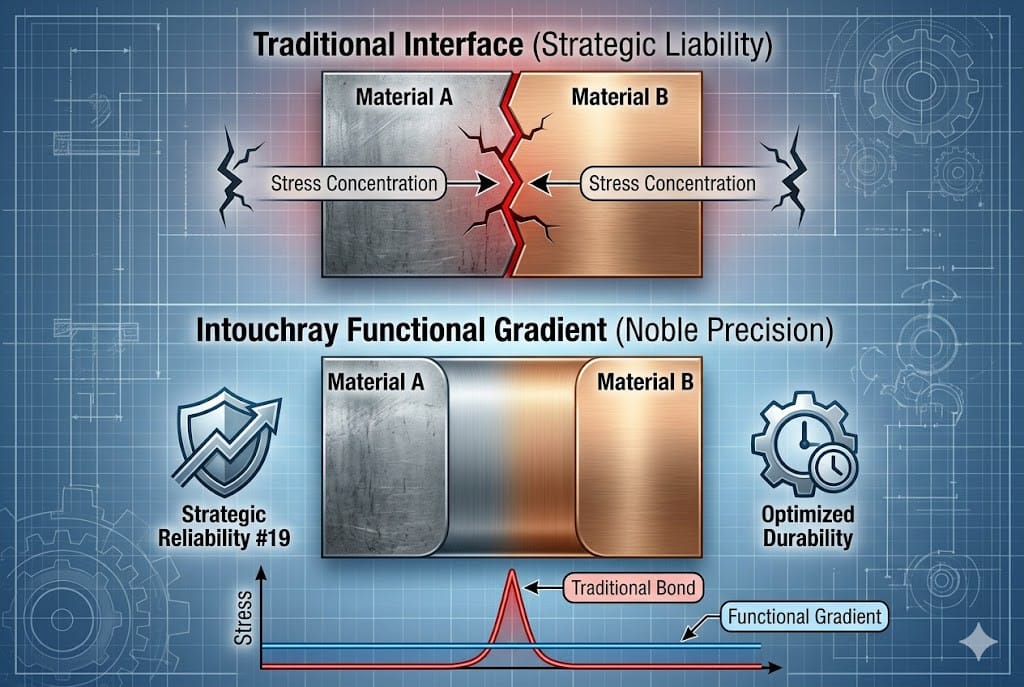
In traditional manufacturing, joining two dissimilar metals—such as a high-strength steel shaft to a corrosion-resistant copper-nickel sleeve—requires a sharp interface.
This interface is a strategic liability. Because the two metals have different thermal expansion coefficients and crystalline structures, the joint becomes a natural focal point for stress, cracking, and galvanic corrosion.
Intouchray Functional Gradient Cladding (FGC) (intouchray.com) eliminates the “joint” entirely. Using noble precision (#13), we are now capable of 3D-printing a transition zone where one material gradually morphs into another at the molecular level. We are replacing the weak interface with a seamless metallurgical bridge.
1. The Concept: Material Alchemy in Transition
A Functionally Graded Material (FGM) is a composite where the composition and structure change continuously over a specific distance. Instead of bonding “Material A” to “Material B,” we create a spectrum: 100% A -> 75% A / 25% B -> 50% A / 50% B -> 25% A / 75% B -> 100% B.
By smoothing the transition, we redistribute internal stresses that would normally shatter a traditional bond. This allows us to combine “impossible” pairs—like ceramics to metals or tungsten to steel—without the risk of delamination.
2. The Intouchray Methodology: Dynamic Powder Blending
Achieving a perfect functional gradient requires more than just a laser; it requires a sophisticated Multi-Hopper Powder Feeding System (Article #33) and real-time Closed-Loop Control (Article #34).
- Dual-Stream Synchronization: The Intouchray system utilizes two or more independent powder feeders. As the robotic head moves, the controller dynamically changes the RPM of each feeder, altering the “metallurgical recipe” of the melt pool in micro-increments.
- Melt Pool Homogenization: The high-power fiber laser (Article #27) ensures that as the powders enter the melt pool, they are perfectly homogenized before solidification. Because of the ultra-high cooling rates of EHLA, we can “freeze” these transition states before the different elements have time to segregate or form brittle intermetallic phases.
3. Applications: Bridging the Extremes
Functional Gradient Cladding is the ultimate tool for strategic reliability in high-value assets.
- Aerospace Heat Shields: We can transition from a structural titanium alloy core to a ceramic-reinforced superalloy surface. The gradient allows the component to handle the immense heat of re-entry on the outside while maintaining structural toughness on the inside.
- Nuclear Fusion Components: Transitioning from copper (for heat conductivity) to stainless steel (for structure) is a critical requirement. FGC ensures these joints survive the extreme thermal cycling of a reactor.
- Oil & Gas Drill Bits: We can clad a tool with a gradient that moves from a tough, impact-resistant steel core to an ultra-hard, tungsten-carbide-rich surface, optimizing resource efficiency (#19) by using expensive alloys only where they are needed most.
4. ROI: The Value of the Seamless Bridge
By eliminating the interface, we eliminate the primary failure point of complex machinery.
- Extended Fatigue Life: FGC components typically last 4 to 6 times longer in high-vibration environments than traditionally joined parts.
- Optimized Resource Efficiency (#19): We no longer need to make the entire part out of an expensive “middle-ground” alloy. We use exactly what is needed, where it is needed, creating a component that is lighter, stronger, and more cost-effective.
Conclusion: The Unified Material
Article #64 proves that the “Quantum Beam” is a tool of unification. We are no longer limited by the boundaries between elements. By engineering the transition, Intouchray ensures that noble precision delivers a component that is greater than the sum of its parts. In Article #65, we look at the next step in this evolution: Smart Cladding: Embedding Sensors Directly into the Metal.
Image Attachment