In the previous sixty-four articles, we have discussed how Intouchray technology (intouchray.com) protects and restores surfaces.
But even the most advanced nanocoating (Article #61) or metamaterial (Article #63) is ultimately a passive layer. To know if a component is failing, we traditionally rely on external inspections or “Set and Forget” maintenance schedules—both of which are strategic liabilities.
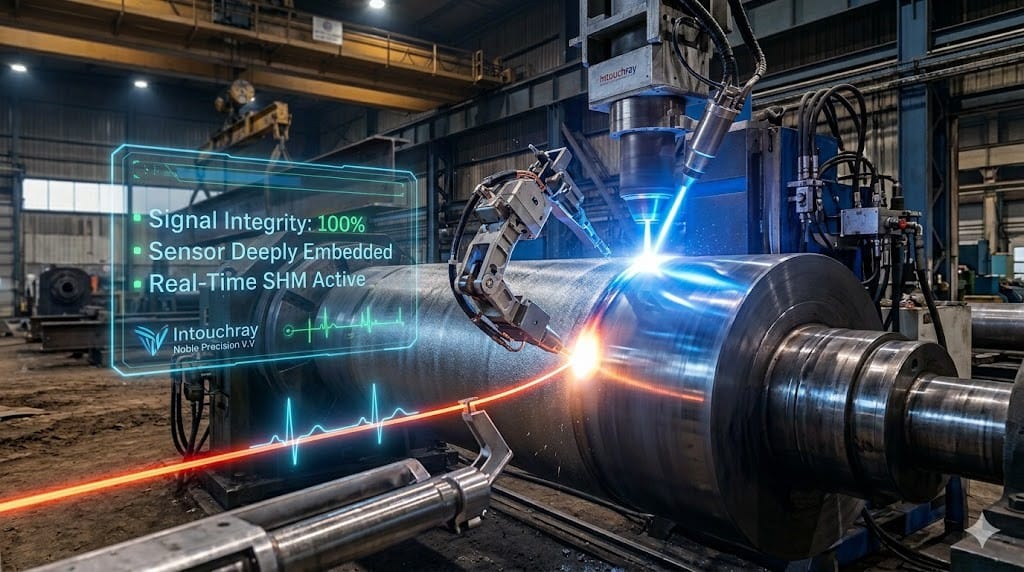
Smart Cladding changes the paradigm. By utilizing the ultra-low heat input of Intouchray EHLA (Article #33), we are now capable of embedding high-precision sensors—such as fiber-optic Bragg gratings (FBG) or thin-film thermocouples—directly into the metallurgical structure during the cladding process. We are transforming “dumb” metal into a self-sensing, intelligent asset.
1. The Challenge of Embedding Intelligence
Historically, embedding electronics or sensors into molten metal was impossible. The extreme heat of traditional welding or casting would instantly vaporize the sensors or destroy their delicate calibration.
This is where noble precision (#13) becomes a functional necessity. Because Intouchray EHLA focuses energy so tightly and solidifies so rapidly, the “Heat Affected Zone” (HAZ) is minimized to a degree that allows us to bypass the thermal destruction threshold of specialized sensors. We can lay a “buffer” layer of alloy, place the sensor, and then “over-clad” it, sealing it forever within a protective, high-performance metallic shell.
2. The Integrated Nervous System: Fiber-Optic Integration
The most common “smart” integration involves fiber-optic sensors. These sensors can detect microscopic changes in strain, temperature, and vibration.
In-Situ Structural Health Monitoring (SHM): As the cladded component (e.g., a massive marine shaft from Article #58) operates, the embedded fiber optics transmit real-time data to a central processing unit.
The Stress Equation: We can measure the internal stress (σ) at the exact point of wear using the relationship:
Δλ_B = λ_B ( (1 – P_e)ε + (α_Λ + α_n)ΔT )Where λ_B is the Bragg wavelength, Pe is the photo-elastic coefficient, ε is strain, and ΔT is temperature.
By monitoring these shifts, the asset can literally “feel” a crack initiating or a bearing overheating before it becomes a catastrophic failure.
3. Creating the Industrial Digital Twin
Smart Cladding provides the “ground truth” data required for a true Industrial Digital Twin. Instead of a computer simulation guessing how a part is wearing, the cladded layer provides live, high-fidelity feedback.
Predictive Maintenance: The system notifies operators exactly when a “Strategic Reliability” threshold is breached, allowing for maintenance only when necessary.
Optimized Resource Efficiency (#19): We eliminate premature part replacement and prevent the massive environmental cost of catastrophic failure. We use fewer materials because we have total confidence in the remaining life of the asset.
4. Applications: From Fusion to the Deep Sea
Nuclear Reactors: Embedding sensors into the Functional Gradient (Article #64) of reactor flanges to monitor thermal fatigue in real-time.
Intelligent Tooling: Injection molds (Article #57) that report their own internal temperature and pressure, optimizing cycle times and part quality.
Aerospace: Turbine blades that transmit real-time vibration and temperature data during flight, allowing for “on-wing” health assessments.
Conclusion: The Conscious Machine
Article #65 marks the point where metallurgy becomes information science. We are no longer just cladding surfaces; we are building a nervous system for the industrial world. Noble precision has evolved from a manufacturing standard to a sensory capability. In Article #66, we will look at the software side of this revolution: AI-Driven Material Synthesis: When the Beam Designs the Alloy.
Image Attachment