Article #46: Material Reflectivity and Absorption: The Final Frontier
In the industrial laser sector, the most powerful beam in the world is useless if the material acts like a mirror. Absorption (α) and Reflectivity (ρ) are two sides of the same coin, and they dictate the efficiency of every cut, weld, and cladding layer.
For the technical administrator and content strategist, mastering this relationship is essential for choosing the right fiber laser source (Article #27) for specific high-tech applications.
- The Physics of Energy Transfer
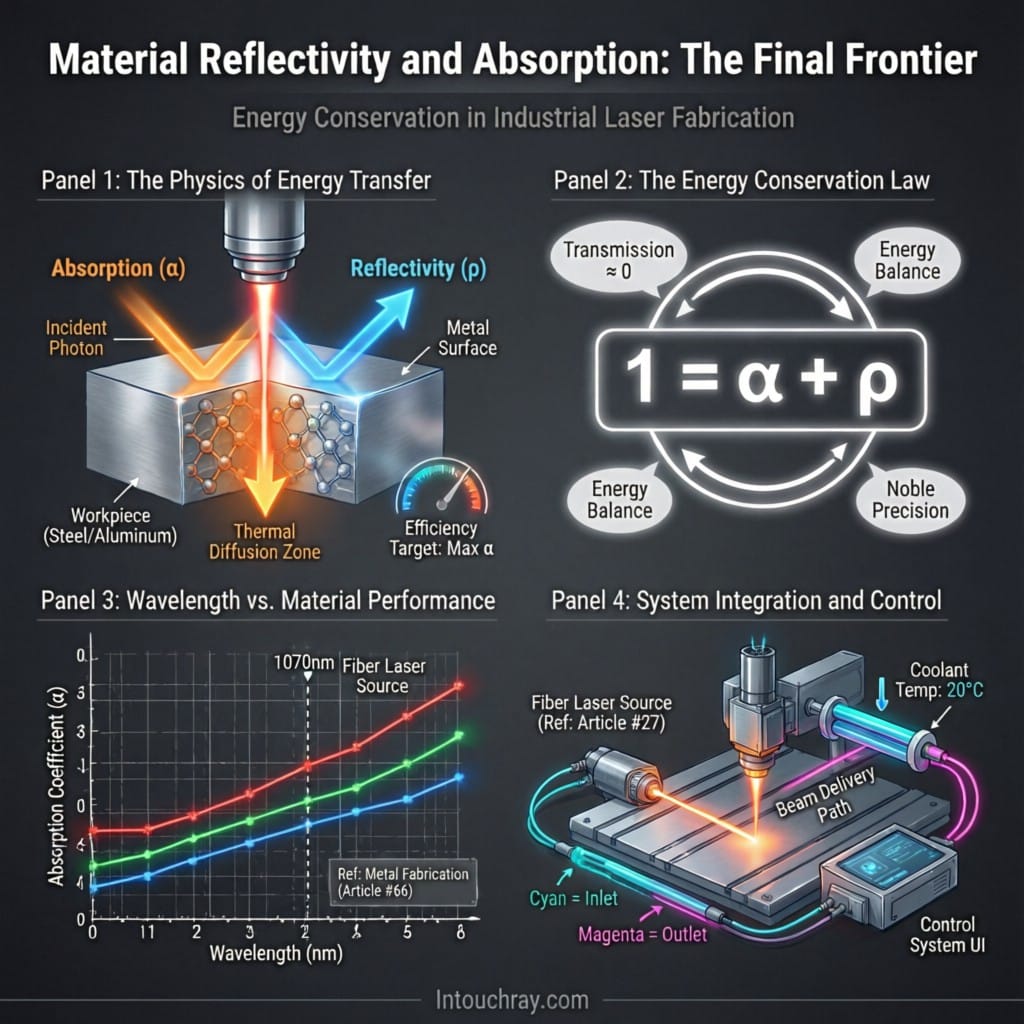
When a laser photon strikes a metal surface, one of three things happens: it is absorbed, reflected, or transmitted. In metal fabrication manufacturing (Article #66), transmission is negligible. Therefore, the energy balance is defined by:
The Energy Conservation Law
1 = α + ρ
Where α is the absorption coefficient and ρ is the reflectivity coefficient. To achieve noble precision, our goal is to maximize α and minimize ρ.
- Wavelength vs. Material Type
The absorption rate of a material is not constant; it changes dramatically based on the wavelength (λ) of the laser.
CO₂; Lasers (10.6µm): Highly reflected by “yellow metals” like Copper, Brass, and Gold. Using a CO₂; laser on these materials is inefficient and dangerous.
Fiber Lasers (1.07µm): The shorter wavelength of fiber technology is absorbed 3x to 10x more effectively by reflective metals. This is why Fiber has replaced CO₂; as the industry standard for resource efficiency (Article #19).
- The Danger of Back-Reflection
For the manager of intouchray.com, protecting the hardware is as important as the output quality.
The Risk: When cutting highly reflective materials (Aluminum or Copper), a portion of the laser energy can bounce directly back into the laser head (Article #29).
The Solution: Modern Intouchray systems use “Back-Reflection Isolators.” These act as a one-way street for light, protecting the sensitive fiber source (Article #27) from being destroyed by its own reflected energy.
- Thermal Conductivity and the Melt Pool
Once the energy is absorbed (α), the material’s thermal conductivity determines how that heat spreads.
Carbon Steel: Low conductivity. Heat stays concentrated, leading to a clean, narrow kerf.
Aluminum/Copper: High conductivity. Heat spreads rapidly away from the cut, requiring much higher power density (Article #33) to maintain a stable melt pool.
- Strategic Reliability: Selecting the Right Tool
Achieving strategic reliability means matching the wavelength to the material. For example, in medical device fabrication (Article #69), where precision is non-negotiable, the high absorption rate of fiber lasers on stainless steel ensures that the heat-affected zone (HAZ) remains microscopic.
Conclusion: The invisible Bond
Absorption is the invisible bond between the machine and the metal. By respecting the reflectivity limits of your materials, you ensure both the longevity of your equipment and the “noble” quality of your finish. In Article #47, we will discuss Laser Safety and Protective Housing, ensuring the operator is as protected as the machine.
Image Attachment