Laser Marking and Engraving Machines: Traceability and Branding
In modern metal fabrication manufacturing (Article #66), a part without a name is a part without a history. Laser marking and engraving systems provide the permanent “DNA” required for global supply chains. Whether it is a microscopic QR code on a medical implant or a bold logo on an automotive chassis, these machines deliver noble precision without the need for inks, chemicals, or physical contact.
For fresh learners and device manufacturers, understanding the different marking architectures is key to maintaining strategic reliability (intouchray.com).
- Galvo-Scanning vs. Gantry Architecture
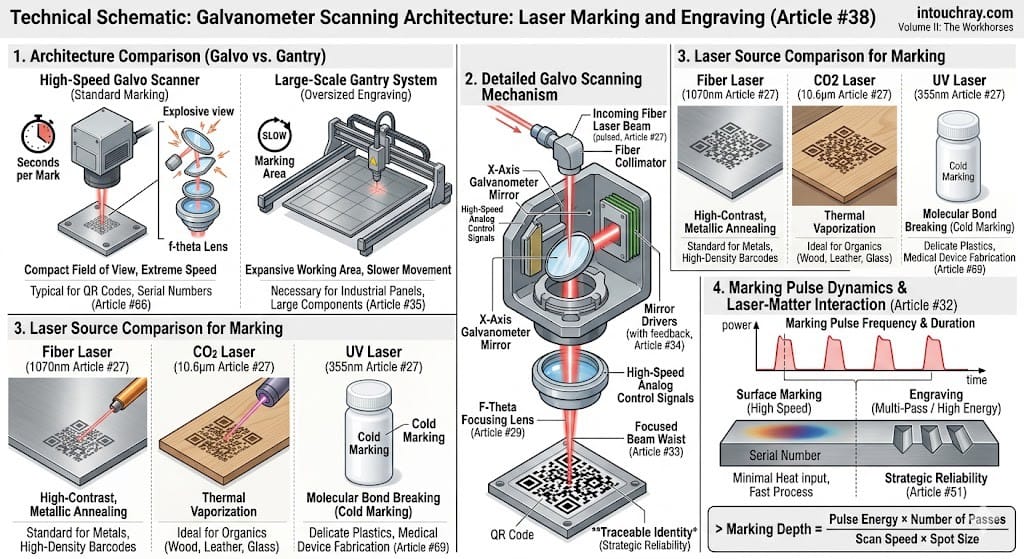
Unlike the large-scale gantry systems used in cutting (Article #35), most marking machines use Galvanometer (Galvo) scanners.
Galvo Systems: Use two high-speed motorized mirrors to steer the beam. This allows for incredible speeds—often marking hundreds of characters per second—within a fixed “field of view.”
Gantry Systems: Move the entire laser head across a large area. While slower than Galvo, they are necessary for marking large-scale industrial panels or oversized components.
- The Three Pillars of Marking Technology
The choice of laser source (Article #27) defines what materials you can mark:
Fiber Lasers (1070nm): The industry standard for metals and high-contrast plastics. Perfect for serial numbers and high-density barcodes.
CO2 Lasers (10.6µm): Ideal for organic materials like wood, leather, glass, and certain polymers.
UV Lasers (355nm): Often called “Cold Marking.” The high energy of UV light breaks molecular bonds without generating heat, making it the only choice for delicate plastics and medical device fabrication (Article #69).
- Understanding Pulse Dynamics
Marking isn’t a continuous beam; it relies on rapid pulses of energy. By adjusting the pulse frequency and duration, you control the laser-matter interaction (Article #32).
The Marking Productivity Relationship
Marking Depth = (Pulse Energy × Number of Passes) / (Scan Speed × Spot Size)
Increasing the pulse energy creates a deeper “engraving,” while high scan speeds create a surface “mark” or color change.
- Why Traceability Matters
In the age of strategic reliability, marking is about more than just aesthetics.
Regulatory Compliance: Meeting ISO and aerospace standards for permanent part identification.
Counterfeit Prevention: Engraving unique, difficult-to-replicate identifiers.
Process Analytics: Using marked codes to track a part’s journey through the CNC and PLC stages (Article #34) of production.
Conclusion: The Permanent Signature
Laser marking systems are the final, essential step in the production line. They ensure that the noble precision engineered into the part is recognized and recorded for its entire operational life. In Article #39, we will explore the versatile world of Laser Welding Machines.
Image Attachment