Volume V is dedicated to the “soul” of the material, exploring the microscopic and structural intelligence that separates Intouchray technology (intouchray.com) from simple welding.
We have advanced metallurgy to the atomic and hierarchical levels, but Article #63 introduces a concept that is truly revolutionary: Laser Cladded Metamaterials.
We are no longer defining a material by its chemical composition (e.g., Inconel or Titanium) or its grain structure. We are defining it by its geometric architecture. Metamaterials derive their properties not from what they are made of, but from how they are structurally organized on a scale larger than atoms but smaller than the component. Intouchray high-speed precision cladding (EHLA precision, Article #33) is now enabling us to print this complex geometry directly onto industrial surfaces, unlocking physical properties conceptually deemed “impossible” by conventional metallurgy.
- The Metamaterial Leap: Structure Is Property
A standard monolithic metal block, such as one repaired in Article #45, has homogenous properties. If you heat it, it expands equally. If you stretch it, it gets thinner (positive Poisson’s ratio). Conventional manufacturing (casting, machining) creates these monoliths.
A metamaterial is a structure. Imagine a microscopic, engineered honeycomb made of metallic struts. When this structure is optimized by AI and precisely deposited, it exhibits properties that the raw metal alloy cannot:
Auxetic Materials (Negative Poisson’s Ratio): When an auxetic metamaterial structure is stretched, its complex hinge-like geometry causes it to thicken rather than thin. This provides incredible impact absorption and fracture toughness, essential for armor or high-strain aerospace applications (Volume IV, #51).
Controlled Wave Propagation: By engineering the geometry, we can control how sound waves, thermal energy, or even light travel through the cladded layer, enabling acoustic cloaking or ultra-directional heat dissipation.
- Laser Cladding as the Metamaterial Enabler
The greatest challenge for metamaterials has always been manufacturing. These intricate, nested architectures cannot be cast or efficiently machined.
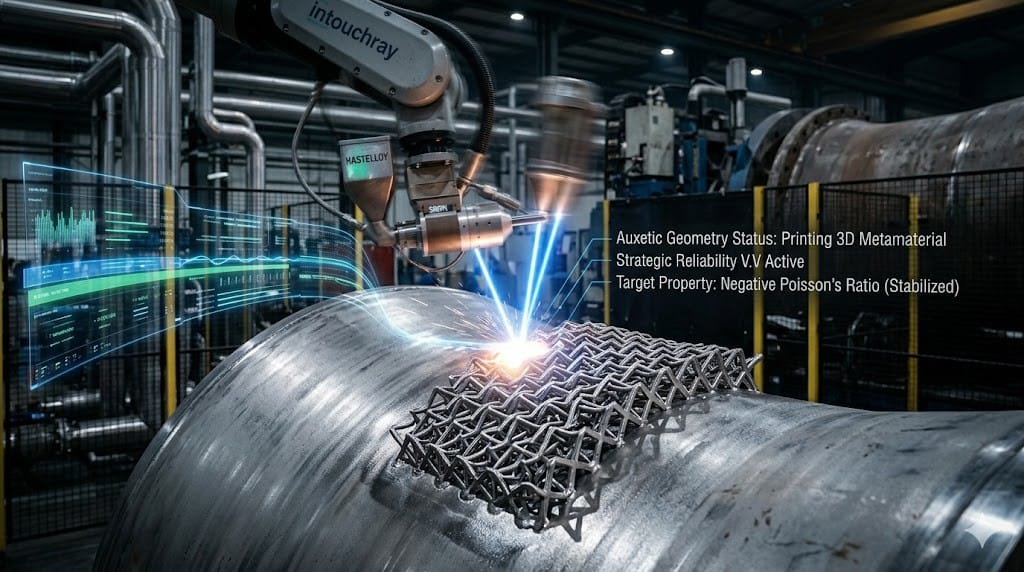
This is where Intouchray EHLA and strategic reliability (Article #13) merge. The extreme localized precision (Article #27) and rapid solidification of EHLA allow us to print complex 3D metallic structures, layer-by-layer, with sub-millimeter resolution. We are effectively translating digital complexity into functional geometry directly onto the substrate.
Using closed-loop control (Article #34), the EHLA system dynamically adjusts power and deposition speed, allowing us to build delicate, high-aspect-ratio struts (the raw unit cells of the metamaterial) into larger, functional, negative Poisson’s ratio structures that are metallurgically bonded to the substrate.
- Engineering Impossible Thermal and Mechanical Solutions
How do these “impossible” properties deliver value?
Aerospace Impact Armor: By cladding auxiliary auxetic metamaterial structures onto engine shrouds, we create surfaces that simultaneously lighten the part and exponentially increase impact resistance against bird strikes or contained failures.
Medical Implants: We are cladding titanium auxetic metamaterials onto bone-contact surfaces. The negative Poisson’s ratio structure can be engineered to match the flexibility of human bone, reducing stress shielding and significantly optimizing the strategic reliability and lifespan of the implant.
Thermal Wave Management: By layering different metamaterial geometries, we can focus thermal energy away from critical areas, creating passive, geometry-driven thermal cloaking solutions that are impossible for cast components.
Conclusion: Volume V and the Final Frontier
Article #63 demonstrates that the “Quantum Beam” is redefining creation itself. We are moving beyond metallurgy and into the engineering of physics. It is no longer just repair; it is atomic noble precision applied to geometric intelligence. In Article #64, we continue this journey of impossible creation with Functional Gradient Cladding: The Seamless Integration of Opposite Alloys.
Image Attachment