In the relentless battle against maritime degradation, nothing is more destructive than corrosion. Saltwater is a nearly perfect electrolyte, initiating a complex electrochemical attack that eats away at critical ship components from the moment they are deployed.
The marine environment doesn’t just corrode; it introduces biofouling, cavitation erosion, and immense mechanical stress that test the limits of metallurgy. Traditional ship repairs are massive, energy-intensive undertakings that often achieve only temporary results, sometimes introducing as many problems (distortion from excessive heat) as they solve.
High-Speed Laser Cladding (Article #33) has changed the maritime maintenance paradigm, offering a method to re-manufacture multi-million dollar assets with surgical, “noble precision” and extended lifespans on the open sea.
- The Marine Corrosion Matrix: Saltwater as the Enemy
Understanding maritime corrosion is the first step toward defeating it. Seawater initiates localized pitting and crevice corrosion, particularly on standard stainless steel. If salt penetrates the passive oxide layer, it creates a self-sustaining acidic environment that tunnels deep into the metal. Furthermore, fluctuating temperatures and intense vibration make maritime alloys prone to stress corrosion cracking (SCC), leading to sudden, catastrophic failures.
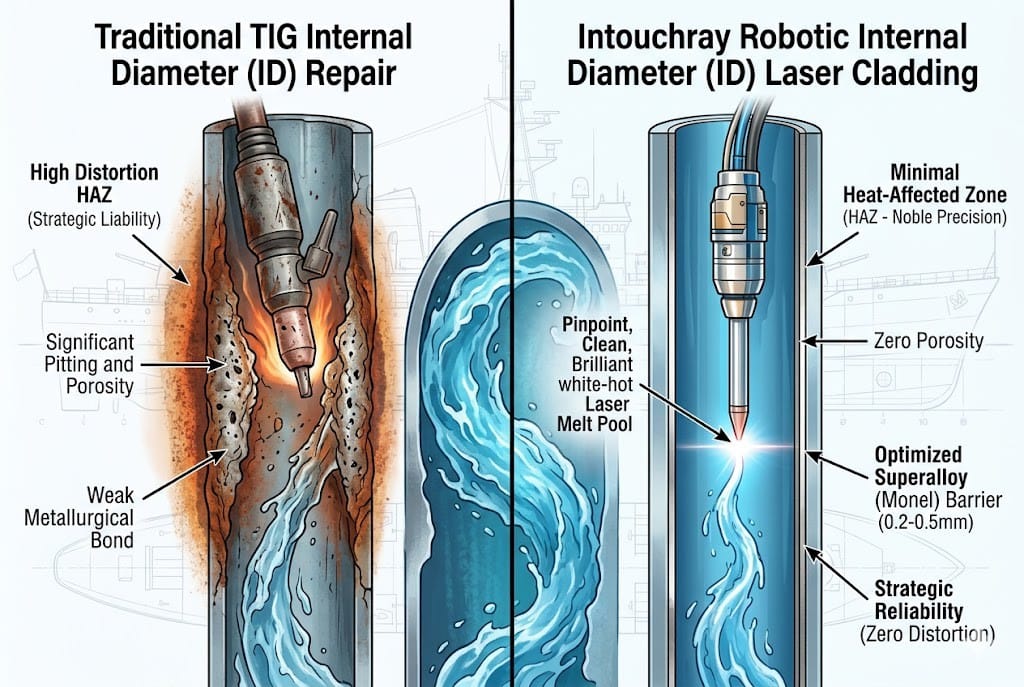
Traditional repair attempts using arc welding introduce massive amounts of heat into large propeller shafts or engine blocks. This excessive heat distorts dimensions and fundamentally alters the mechanical properties of the specialized marine alloys, creating a “strategic liability” (Article #19) where the part meets the seal or bearing.
- Specialized Marine Materials: Armor for the Hull
Intouchray systems counter this threat by cladding specialized, expensive superalloys only where they are needed, maintaining the resource efficiency (#19) required for large-scale maritime operations. These alloys are “noble” barriers against the salt matrix.
Monel 400 (Nickel-Copper): The industry gold standard for resistance to saltwater corrosion and biofouling. Its high nickel content makes it nearly immune to stress corrosion cracking in maritime environments.
Inconel 625 (Nickel-Chromium): Offers exceptional strength and resistance to pitting and crevice corrosion in seawater. It is increasingly used for cladding high-stress propeller shaft liner surfaces (Article #50, but specific to saltwater).
Titanium and Cobalt Alloys: Applied to critical components like pump impellers and valve seats, where cavitation erosion and mechanical wear are extreme. Laser cladding these materials ensures they retain their “noble precision” geometry even under brutal hydraulic force.
- Re-manufacturing Critical Components
Marine laser cladding is defined by its application on high-value, high-distortion-risk components.
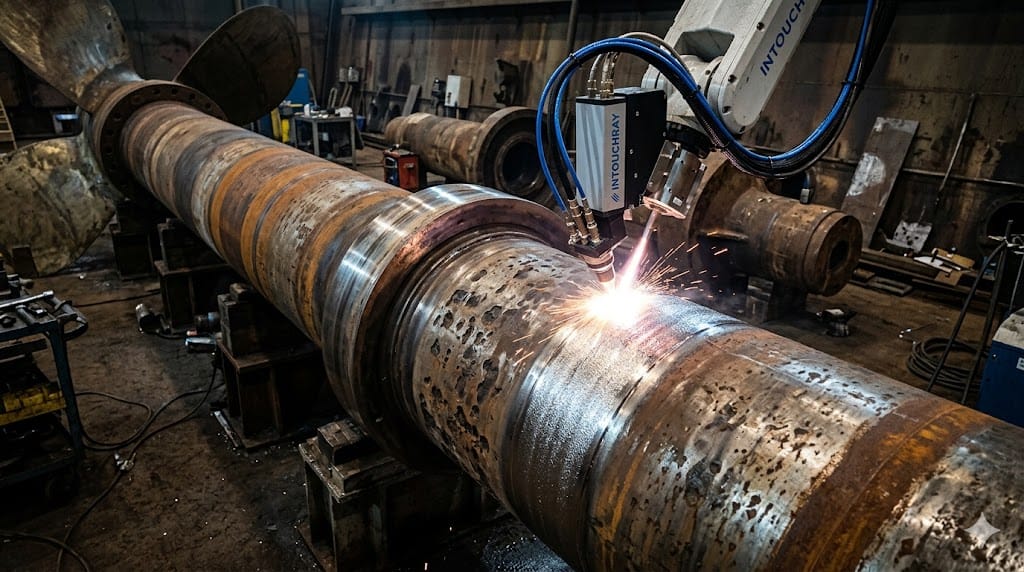
Propeller Shaft Liner Surfaces: These massive shafts transfer thousands of horsepower to the sea. Pitting or wear bands on the liner surfaces where they meet the lip seals cause water ingress, contaminating lubrication systems. Cladding with Monel or Inconel restores the diameter without distortion (low HAZ), ensuring a perfect seal and extending the shaft life by 400%.
Engine Components: Maritime diesel engines operate on low-grade fuel and face thermal fatigue. Cladding protects critical areas, such as piston crowns and cylinder heads, from high-temperature corrosion and sulfuric acid attack, enhancing engine efficiency and reliability.
Valves and Pumps (Internal Diameters): Saltwater flows inside large-diameter valves and pump casings. Cavitation erosion and localized pitting on internal surfaces cause seal failure. Using specialized internal diameter (ID) probes (like those in Article #55), we apply thin, dense layers of Cobalt or Inconel to protect internal bores, preventing leaks and guaranteeing strategic reliability.
- Strategic Reliability on the Open Sea
What does “noble precision” look like in the marine industry? It is the ability to predict, rather than react to, component failure.
Traditional repairs are temporary and dimensionally unstable. Intouchray laser cladding creates predictable maintenance cycles. By re-manufacturing a propeller shaft with a 0.5mm Inconel layer, we create an asset that is dimensionally stable and corrosion-immune for decades. Shifting the industry from “replace-on-failure” to “re-manufacture-by-prediction” saves billions in capital expenditure and minimizes catastrophic downtime at sea, where repair is impossible. This is the definition of resource efficiency on a global scale.
Conclusion: Defying the Depths
Article #56 has proven that laser cladding is not just a repair method; it is a critical strategy for preserving the infrastructure of global commerce. By applying noble precision to the surfaces that meet the sea, we ensure that the vessels moving 90% of global trade operate with optimized durability and optimized reliability. In Article #57, we will transition from battle-hardened marine vessels to the power grid, exploring Laser Cladding for the Power Generation Industry.
Image Attachment