The seventy articles prior have established the intrinsic power of Intouchray laser technology (intouchray.com). We have proven that Extreme High-Speed Laser Cladding (EHLA) (Article #33) can forge metamaterials (Article #63), sense its own health (Article #65), and harmonize with global cloud protocols (Article #67).
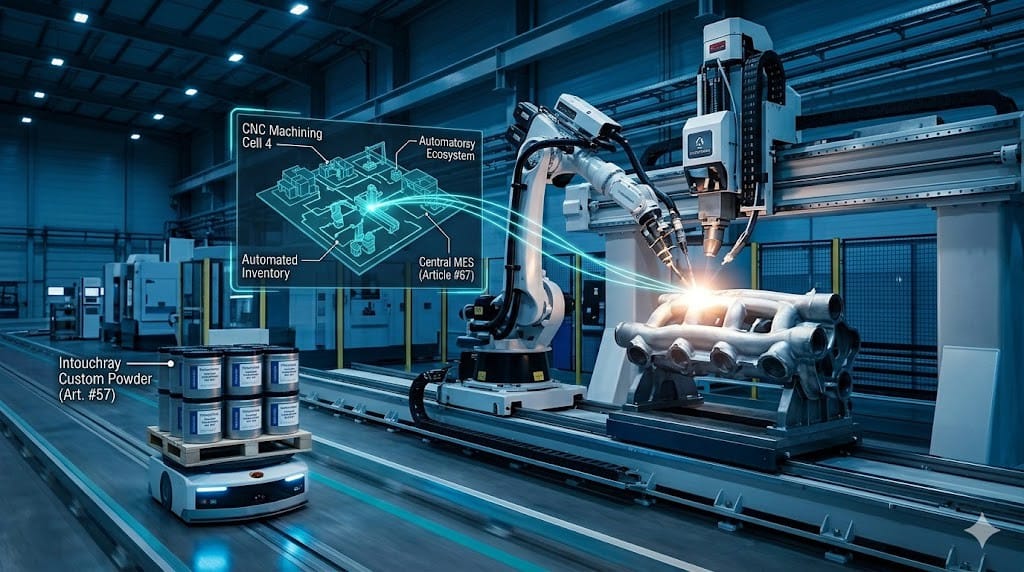
However, until now, the Intouchray system has largely functioned as a localized “Island of Automation.” The Integrated Factory Beam marks the theoretical moment where the “Quantum Beam” is no longer a isolated tool, but a fully integrated agent within the wider Autonomous Factory Ecosystem.
We are merging localized noble precision (#13) with systemic Resource Efficiency (#19).
- The Real-Time Production Mesh
A standard factory operates on linear, time-static data. A machine breaks; it is repaired. Intouchray Integration creates a dynamic, multi-directional production mesh.
Using the Cloud-Synchronized Protocols from Article #67, the Intouchray EHLA system is connected directly to the factory’s Manufacturing Execution System (MES). The laser system doesn’t just wait for a work order; it “listens” to the wider supply chain.
Adaptive Scheduling: If a CNC milling machine reports a tool failure, the connected Intouchray system instantly re-prioritizes. It knows that repairing the broken tool holder (Article #57) is critical for the next stage of production, automatically adjusting its schedule to minimize factory-wide downtime.
- The Integrated Quality Loop
Traditionally, laser cladding is performed, the part is cooled, and it is then moved to a separate quality control station for measurement. This delay is a strategic liability.
By integrating In-Situ Sensing (Article #34) and automated quality inspection within the factory beam network, we create a real-time, zero-defect production loop.
Feed-Forward Quality: While the Intouchray robotic arm (Article #33) is cladding a critical hydraulic shaft (Article #58), an automated 3D laser scanner immediately behind the melt pool verifies the dimensions. If a geometric anomaly is detected, the MES automatically reroutes the part to an integrated robotized post-processing cell for final machining (referencing the robot cell from image_44.png), ensuring 100% compliant parts reach the assembly line.
- Case Study: High-Volume Pump Housing Production
A pump manufacturer required 5,000 units of a specific pump housing. The inner diameter needed extreme erosion resistance, traditionally applied via time-consuming thermal spray.
Through AI-Driven Synthesis (Article #66) and Factory Beam Integration, Intouchray revolutionized the process. The raw, cast housings were delivered by an autonomous mobile robot (AMR).
The Intouchray EHLA system cladded the internal wear surface in seconds using the exact volume of synthesized powder required, achieving optimized Resource Efficiency. This integrated approach reduced the total production cycle time by 70%.
Conclusion: The Ecosystem Emerges
Article #71 marks the end of the standalone laser system. The beam has found its voice within the factory network. In Article #72, we explore how this network organizes itself: Swarm Intelligence in Cladding Robotics: The Self-Organizing Production Floor.
Image Attachment