In the previous sixty-five articles, we have largely discussed using established alloys—Inconel, Hastelloy, or Stellite—to solve industrial problems. But what happens when the environment is so extreme that no known commercial alloy can survive?
Traditionally, developing a new alloy takes years of laboratory trials. Intouchray AI-Driven Material Synthesis (intouchray.com) reduces this to days. By combining the high-speed processing of EHLA (Article #33) with machine learning, we are moving from “selecting” materials to “evolving” them in real-time.
- The High-Throughput Laboratory
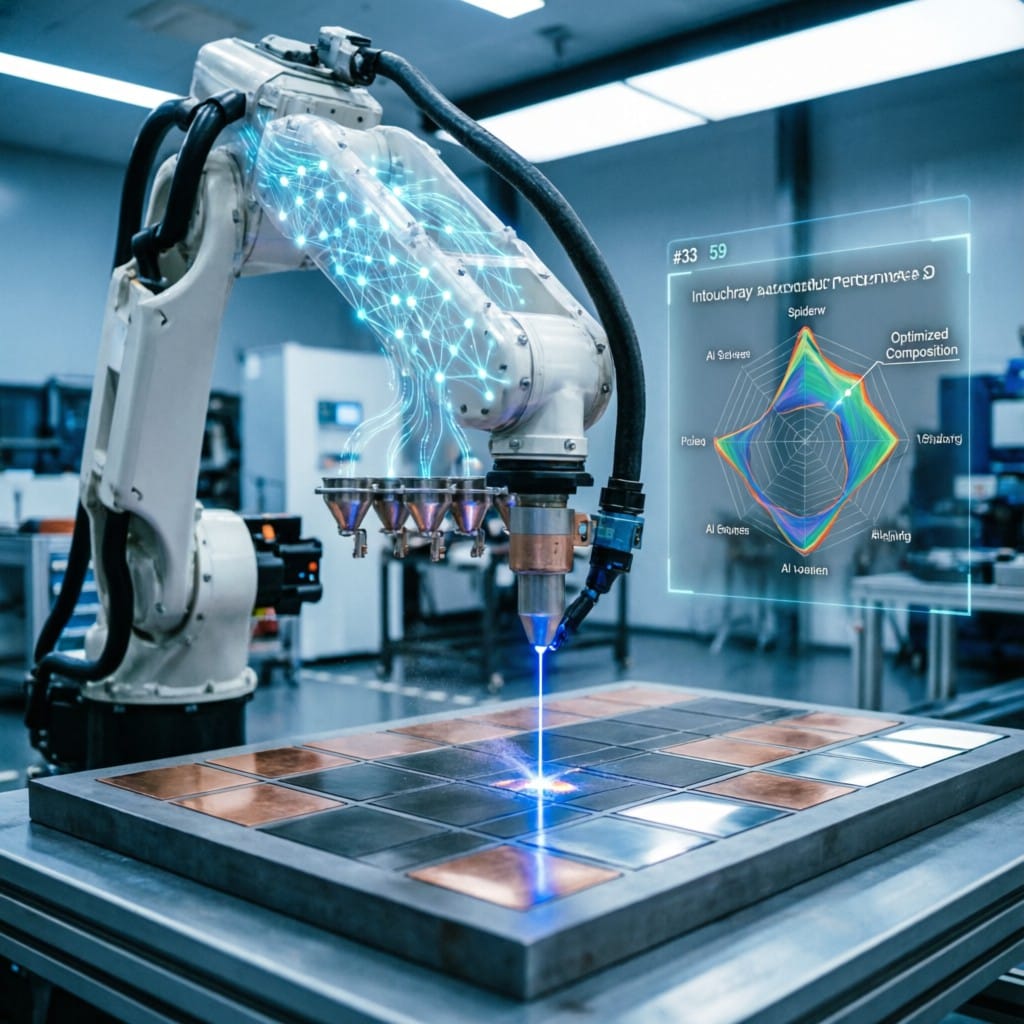
Standard laser cladding (Article #45) is a production tool. Intouchray EHLA, when paired with a Multi-Hopper System (Article #64), is a high-speed metallurgical laboratory.
Because we can change the powder mixing ratio (Material A, B, C, and D) millisecond by millisecond, we can clad a “Combinatorial Library” onto a single test plate. Each square centimeter of the plate represents a slightly different chemical composition. We then use automated hardness and corrosion testing to identify the “winner” of this evolutionary race.
- The AI Feedback Loop: Neural Metallurgy
The true power lies in the AI. Our proprietary neural networks analyze the results of these combinatorial trials. The AI doesn’t just look for the strongest alloy; it looks for the Optimized Durability (#19) balance between:
Coefficient of Thermal Expansion (CTE)
Fracture Toughness
Oxidation Resistance
Using the Closed-Loop Control (Article #34) data, the AI predicts how a theoretical alloy will behave under the “Quantum Beam.” It then instructs the robotic cladding head to synthesize that specific, non-existent alloy directly onto the workpiece.
- Case Study: The “Impossible” Corrosive Environment
A client in the deep-sea mining sector required a valve seat that could withstand high-pressure salt slurry and acidic chemical injection simultaneously. Standard Grade 5 Titanium failed within weeks.
Through AI-Driven Synthesis, the Intouchray system tested 400 variations of a Ti-Al-V-Mo-Zr alloy in 24 hours. The AI identified a specific “High-Entropy Alloy” (HEA) configuration that provided a 400% increase in lifespan. This is the definition of Strategic Reliability (#13)—solving the unsolvable through computational noble precision.
- ROI: Beyond the Catalog
By moving away from “off-the-shelf” materials, you gain a competitive advantage:
Reduced Material Waste: We synthesize only the exact volume of custom alloy needed for the wear surface.
Weight Optimization: AI can design alloys that are 30% lighter but 20% stronger than standard steel, critical for aerospace and mobile robotics.
Future-Proofing: As industrial environments become harsher, your ability to synthesize custom solutions ensures your assets remain operational.
Conclusion: The Beam is the Designer
Article #66 marks the transition from metallurgy as a craft to metallurgy as an algorithm. The beam is no longer just a tool for melting; it is a tool for creation. In Article #67, we will explore how this AI intelligence manages the largest scale projects: Global Fleet Maintenance: Cloud-Synchronized Cladding Protocols.
Image Attachment